Showing posts with label Northern Ireland. Show all posts

Monday, March 17, 2014

Happy St. Patrick's Day!

Cross of St. Patrick (which forms part of the Union Jack).

     Today is St. Patrick's Day, and it is a day of celebration throughout the island of Ireland (both in the Republic of Ireland and Northern Ireland).

     Saint Patrick is the patron saint of Ireland - one of the four patron saints of the British or Anglo-Celtic Isles (with the other ones being St. Andrew for Scotland, St. David for Wales, and St. George for England).

Saint Patrick as depicted on a stained glass window in the Cathedral of Christ the Light, Oakland, CA.

     He was born somewhere in Roman Britain to a wealthy Romano-British family, whose members were strong and faithful Christians. Patrick himself however, was not an active believer in his early years. At the age of sixteen, he was kidnapped by Irish pirates who took him into slavery in Ireland, where he worked as a shepherd for the next six years. It was during Patrick's time in captivity that he experienced a spiritual awakening and developed a true relationship with God, which eventually led him to escape and return home to his family in Britain. There, he studied Christianity, became a priest, and returned to Ireland as a missionary.

The three-leaf shamrock representing the Holy Trinity

     It was in Ireland that Saint Patrick become known for converting the Irish people from polytheistic paganism to monotheistic Christianity, and supposedly used the shamrock to teach the concept of the Holy Trinity (Father, Son, and Holy Ghost). It is said that St. Patrick spent several years evangelizing in what is now Northern Ireland and succeeded on converting "thousands" of people. He is also considered the first Bishop of Armagh and Primate of Ireland.

     It is not known what year St. Patrick died, but he is generally considered have died on March 17, which resulted in the day being named in his honor. He may not have been responsible for converting all of Ireland to Christianity, but he is credited for starting the process, and has been Ireland's patron-saint since around the 7th Century.

Flags of the United Kingdom of Great Britain and Northern Ireland and the Republic of Ireland

     St. Patrick's Day has been celebrated for centuries throughout Ireland and Great Britain. It is a celebration of Irish Christianity (in both the Catholic and Protestant traditions), as well as Irish culture and heritage in general. Public parades and festivals, the wearing of green attire and shamrocks, and church services are hallmarks of most St. Patrick's Day celebrations. There is also cĂ©ilithe (a traditional Gaelic social gathering, which usually involves playing Gaelic folk music and dancing) and the lifting of Lenten restrictions on eating and drinking alcohol for the day, which has resulted in the infamous tradition of consuming alcohol.

     However, it was not until the 1903 that St. Patrick's Day became a public holiday in Ireland, thanks to the Bank Holiday (Ireland) Act, which was passed by the UK Parliament when all of Ireland was part of the United Kingdom. It remains a holiday in both the Republic of Ireland and Northern Ireland, and large festivities are held in Dublin, Cork, and Galway in the ROI and in Belfast, Downpatrick, and Derry/Londonderry in NI. Outside of Dublin, the largest celebrations on the island of Ireland take place in Downpatrick, the city where the revered patron saint is supposedly buried at Down Cathedral.

St. Patrick's Day parade in Birmingham, UK.

     In mainland Britain, Birmingham is home to the largest St. Patrick's Day parade in the country, whilst London has held its own parade since 2002. Manchester hosts a two-week Irish festival leading up to the day itself, and the Irish tricolor flies opposite of the Union Jack above the town hall. Other celebrations take place in Glasgow, Liverpool, and Coatbridge - which have large populations of people with Irish backgrounds.

HRH The Duke of Cambridge and Baron Carrickfergus, Colonel of the Irish Guards

     The Royal family also does its bit to celebrate one of the patron-saints of the British Isles. Queen Elizabeth The Queen Mother used to present bowls of shamrock flown over from Ireland to members of the Irish Guards - a regiment of the British Army - whose members largely hail from the Republic of Ireland and Northern Ireland. In the last three years, the Duke and Duchess of Cambridge (Baron and Lady Carrickfergus) have attended the annual St. Patrick's Day Parade at Mons Barracks in Aldershot, Hampshire with the Irish Guards, whose Colonel is Prince William. The Duchess of Cambridge continues the royal tradition of having a senior female member of the Royal family present shamrocks to members of the Guards (including their Irish Wolfhound mascot), which was begun by Queen Alexandra - wife of Edward VII - in 1901. William and Kate are scheduled to do the same today.

Friday, August 23, 2013

Timeline of British Monarchs

     Here, I give some commentary on the Timeline. If you would rather skip right to the Timeline, you can access the link here. 

     For the past two weeks, I have been working on this Timeline of British Monarchs. It was inspired by an opinion article I read in a Scottish newspaper which remarked that the British Royal Family must really be the "English Royal Family", since we have been told by the media that the recently-born Prince George is in line to become the 45th monarch since William the Conqueror. 

     Since counting monarchs beginning with William is an English-only concern, it is understandable that some Scots feel bristled when such facts and figures are thrown around. This speaks to the issue of how Scotland's role in the history of the monarchy and in British history in general has in some respect been under-represented in favor of focusing predominately on the English part.

Elizabeth II is Queen of the United Kingdom of Great Britain
and Northern Ireland, not Queen of England.
     
     In fact, the current British royal line is as much Scottish as English. In some respects, it can be argued that the royal family has stronger roots in Scotland than in England. After all, it was a Scottish king, James VI, who in 1603 traveled from Edinburgh to London to claim his English inheritance as James I of England and Ireland because Elizabeth I of England and Ireland had failed to produce an heir of her own, and James was her closest living relative. 

     All British monarchs have since been descended from James VI & I, who was a promoter of closer social and political ties among the peoples of the British Isles. His vision was eventually realized when England and Scotland merged in 1707 to become Great Britain, and later in 1801 when Ireland and Great Britain came together to form the United Kingdom.


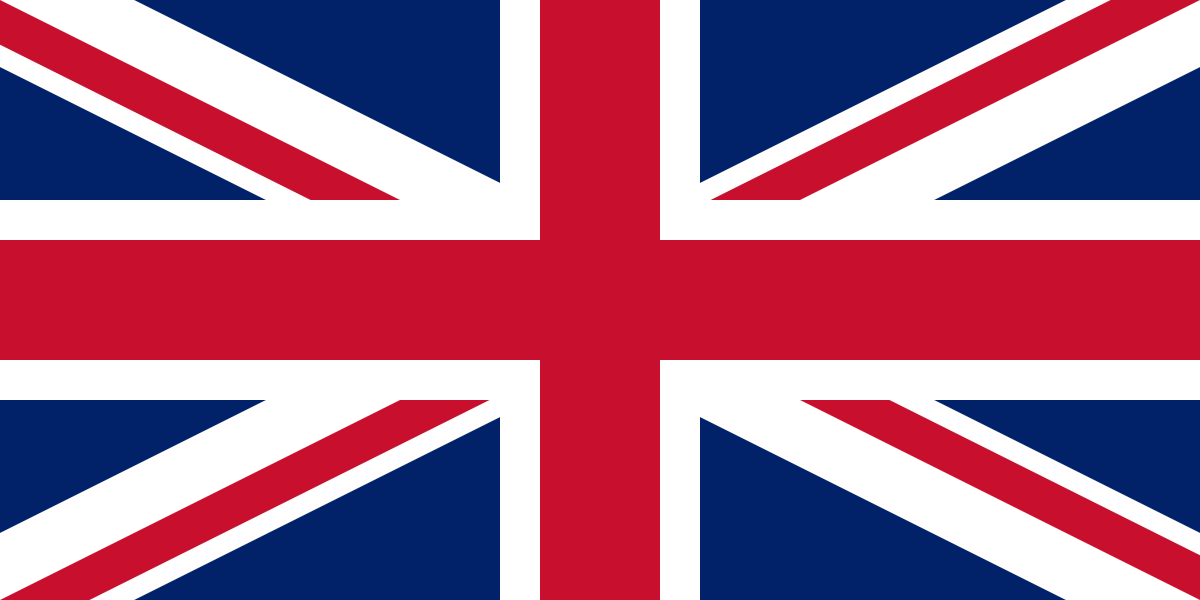
The Union Jack is the National Flag of the United Kingdom of Great Britain
and Northern Ireland, not the flag of England itself.

      What my timeline hopes to achieve is a greater understanding of the relationship between the separate kingdoms and monarchies of England and Scotland, and how the distinct entities became one and the same. It also explains why Elizabeth II is not Queen of England or Queen of Scots because both of those titles became extinct and were abolished upon the union of 1707. She is Queen of the United Kingdom of Great Britain and Northern Ireland (or more simply, Queen of the United Kingdom, Queen of the UK, Queen of Great Britain  and Northern Ireland, Queen of Great Britain, or Queen of Britain), and has only ever been addressed and titled as such. 

     To Elizabeth II the Queen of England shows an ignorance to the fact that England is a part of the United Kingdom, along with Northern Ireland, Scotland, and Wales, and makes it appear as though those areas are nothing more than appendages of England, which is an idea that is patently offensive to people who live in those areas. In general terms, the Northern Irish, Scots, and Welsh view the English as their fellow British countrymen and women, and look to Elizabeth II as their queen. 

     Last year during the Olympics, all of the peoples of Britain came together to support Team GB regardless of what part of the UK the individual athletes came from. However, the Northern Irish, Scots, and Welsh do not appreciate being lumped in as being "English." A recent example of this occurred back in June of this year when Andy Murray - a Scot - became the first British man since 1936 to win at Wimbledon, and the New York Times referred to him as "English," which created a backlash among Scots and people of Scottish descent before it was corrected. 

     Certainly, England has been confused with the UK for a long time, but there has been an increasing awareness of the non-English peoples of the United Kingdom as an integral part of Britain's past, present, and future. When it comes to the monarchy, most timelines I have seen feature only the English monarchs, and tend to ignore the unions that took place in 1603, 1707, and 1801. Even the monarchs after the 1707 Anglo-Scottish union are sometimes referred to as "King and Queens of England", which is not correct.

Map of the United Kingdom and its constituent parts:
England, Northern Ireland, Scotland, and Wales

     This is why producing the timeline was important to me. I want to show that Prince George is destined to be the successor of British monarchs going back to 843 A.D. with Kenneth MacAlpin in Scotland and 871 A.D. with Alfred the Great of England (which further shows the mistake of counting back only to William the Conqueror since English monarchs existed before his 1066 conquest). 

     Indeed, it can be argued that I could have gone further back, but to do so would introduce the fact that England and Scotland were made up of several smaller petty kingdoms. Kenneth I founded a dynasty that would preside over the unification of Scotland into a single state, just as Alfred the Great had a similar effect in England.

     Eventually, England (with Wales) merged with Scotland to become Great Britain, and English and Scottish monarchs became British monarchs. According to my count, Prince George will be the 61st monarch since Kenneth I of Scotland as well as the 61st monarch since Alfred the Great of England. 

     As have said before, this project became more complex and detailed by the day. First, at the completion of the timeline itself, there was an abundance of excessive space in the areas where I had named the royal houses of the monarchs. So I decided to fill up such space with illustrations of the royal coats of arms, emblems, and shields used by successive monarchs over the centuries (courtesy of Sodacan on Wikipedia), as well as illustrations of the national flags of England, Scotland, Great Britain, and the United Kingdom. 

     When that was done, I realized that I perhaps needed to provide explanations for these illustrations, which resulted in an appendix containing detailed information on these various symbols of the British nation and monarchy. Then, another appendix was creating which listed the top ten longest reigning monarchs on British history, complete with images of the kings, queens, and princes who served for 40 or more years. 

     After finishing that, there was still some space on the margins of the Microsoft Excel sheet I was working on, which resulted in the placement of the anthems and patriotic songs of the nations of the United Kingdom, as well as the UK National Anthem, God Save the Queen

     Along the way, many modifications and adjustments had to be made to keep the timeline, text, and images as proportional as possible and without ruining the basic outlines and structure of the timeline, which meant a lot of trial-and-error to ensure that what I saw on the spreadsheet also appeared when I converted it to a PDF format.

     I must stress that the earlier history of Britain, its monarchy, and symbols can be cloaked in a mixture of legend and fact. I tried to base what I said in the timeline on as much fact as possible by explaining legends but also establishing known truths. But like most things in early history, myth, fact, and legend can often be inseparable.


     That being said, I hope that this timeline will help to view the British monarchy in a different light, with it being as much a Scottish institution as an English one. The Scottish and English monarchs (and their respective royal houses) are listed side-by-side before becoming a single British entity. With all of the illustrations and information packed into it, I hope the Timeline can lead to a better of understanding of British royal and national symbols, as well as the history of the monarchy itself and how it came to be. 


   Without further ado, here is my 


     In order to view it correctly, click on the above link, and once the page is loaded, click on the printer symbol below the "File,View, Edit, and Help" tabs, or press the "CTRL" and "P" together. Either of these actions will operate the“Print (PDF)” function. A window prompt may ask you to send the document to a printer. Just click “No” or "Cancel" so you can view the Timeline. If that does not work, you may click "File" and then "Download" to view the timeline. If you are using a mobile device, you may need to use desktop settings to access these controls.

     You can also choose to view the Timeline as it is on the main Google Docs page, but be warned that the process of uploading to Google Docs resulted in the quality of the images being substantially reduced and the text formatting changed from "Times New Roman" to "Arial". I could not find a way to rectify this (and it appears this an ongoing issue for Google Docs). That is why I provided the instructions above to ensure that you see the Timeline properly, and fully appreciate the work that was put into it. 

Photo Credit: Matt Lewis via Wikimedia Commons cc