Showing posts with label Scotland. Show all posts

Sunday, August 9, 2015

The Long-Reigning and Reconciling Queen


Elizabeth II of the United Kingdom.
Image Credit:
Joel Rouse/Ministry of Defence via Wikimedia Commons
(
Contains public sector information licensed under the Open Government Licence v3.0)

     This week, it was announced that HM the Queen will be marking the date that she becomes the longest-reigning British monarch by officially opening the new Borders Railway line from Edinburgh to Tweedbank, near Galashiels in the Scottish Borders on September 9, 2015.

     Train services will actually start a few days earlier, but with the formal opening, the new line will get its Royal seal of approval from Her Majesty, who along with the Duke of Edinburgh will participate with the opening celebrations at Waverly Station. Following this, they will board a train drawn by a historic steam locomotive – the Union of South Africa – with Scottish First Minister Nicola Sturgeon, and make the 35 mile journey to Tweedbank, which will include a stop at Newtongrange in Midlothian along the way.

     It will be a day of profound commemoration and ceremony, for at a cost of £300 million, this line will be the largest new railway to be built in Britain for over a century. However, its path will be quite familiar to train enthusiasts and local residents, for it will travel the much of the northern part of the old Waverly Route (named in honor of Sir Walter Scott’s first novel), which ran 98 miles from Edinburgh to Carlisle across the border in England, which was built and opened in stages from 1844 to 1862, but was controversially closed in 1969 following the Beeching Report, which resulted in the closure of several rail lines and stations throughout the United Kingdom for purposes of cost-cutting.

     Since then, a nearly 50 year campaign has been waged to restore the line, and these efforts over the decades will bear partial fruit when the Borders Railway begins to serve the people of Midlothian and the Scottish Borders, which has been the only region in Britain without rail service, and this has caused adverse economic effects for the area. Now with the restoration of this line, the people living there will mark a truly historic occasion, which promises to open their area up for work, education, tourism, leisure, and other pursuits to drive economic activity. It is hoped that with this much achieved, the entire Waverley Route can eventually be restored.

     But alongside the historical significance of the return of this railway is the fact that it coincides with Queen Elizabeth II surpassing her great-great-grandmother Queen Victoria as Britain’s longest-reigning monarch. It has been known that the Queen, who is already the country’s longest-lived monarch and marked her 63rd year on the throne back in February, would reach this point in her reign in early to mid September 2015, but it was not entirely clear what day on which it would exactly fall. Buckingham Palace has calculated that Victoria had reigned for 23,226 days, 16 hours, and 23 minutes – taking into account the precise timings of her accession in 1837 and her death in 1901, and the 63 years in between (including 15 leap days). From there, it was determined that the momentous day would be September 9th.

     Despite achieving this milestone, the Queen herself likely wanted no public celebration – just as the date of her accession usually comes and goes without much of a fuss. Such displays commemorating the reigning monarch are typically reserved for jubilee’s like the ones in 1977 (Silver), 2002 (Golden), and 2012 (Diamond). However, given the significance of this particular event – after all, becoming Britain’s longest-reigning monarch is a pretty big deal – it only made sense to do something.

     The opening of the Borders Railway has therefore provided a perfect opportunity for the 89 year old monarch to be see out and about during a significant public engagement on what will be remembered as a very historic day, so that her record-breaking won’t be the sole reason for the celebrations that will take place, and instead will be part of something greater.

     It is quite significant that by formally opening this line, the Queen is reviving a tradition of rail in the area that goes back to a time when new rail lines were built almost every day throughout the UK, which happens to be the era of Queen Victoria, and so there will be parallels with that earlier reign – especially because of the travel by steam train, which ought to be an interesting sight for everyone and a thrilling experience for the Queen herself.

     It is also significant that this is taking place in Scotland, for it was Queen Victoria who started the Royal Family’s modern love of Scotland, which was been passed down through the generations to the present Queen, who has maintained the family tradition of spending summer holidays at Balmoral in Aberdeenshire. Spending this day in Scotland as she marks her milestone is a demonstration of her affection for a part of Britain which she holds dear to her heart – so much so, that during the independence referendum campaign last year, she memorably remarked that she hoped that the people of Scotland thought carefully about the future when deciding between whether to become an independent country or remain part of the United Kingdom.

     As it was, the people of Scotland voted to stay as part of the Union, and despite her official silence and not explicitly giving her stance on the issue, there is no doubt that she wanted her kingdom to stay together. It is therefore all the more interesting that she will be riding in the train with First Minister Sturgeon, who campaigned for and has continued to advocate for the break-up of Britain. Not only this, but it is believed that Ms. Sturgeon harbors republican sympathies.

     Nevertheless, the Queen – as a constitutional monarch – will carry herself appropriately in her engagements with the First Minister, so she will not show hostility to her or disrespect to her party. In this way, the Queen probably wants to show that she is indeed, above the day-to-day political fray, just as she likely believes the existence of the United Kingdom to be above politics and nearly beyond reproach, and she certainly doesn’t want it breaking up from under her.  Indeed, in her Christmas broadcast last year, she talked about reconciliation following the referendum and how this process would take time following the end of the two year long and emotionally-driven campaign, which as she said, had brought disappointment to some and relief to others. And she knows that she has a role to play in that reconciliation process, and that she must be Queen of all Britons.

     The monarchy is in many ways, a major piece of the glue that holds the United Kingdom together, and Her Majesty takes her role seriously. More than almost anybody else (including the politicians), the Queen understands the importance of celebrating the UK as a whole and acknowledging the constituent parts of the UK, so that each part may have a sense of ownership in the monarchy and in the idea that it is an institution that represents the entire UK. This helps to strengthen the Union because the Queen and members of her family are seen throughout the country carrying out a variety of engagements – many of which are of social, cultural, or economic significance to a particular area, and it is good to see them out and about – especially when showcasing areas of the UK outside of the capital city, London.

     In the case of opening the new Borders Railway, Her Majesty is shining a spotlight on Scotland, and this is her way of showing that Scotland matters to her personally and as Queen of the United Kingdom. She herself is half-Scottish through her beloved mother, and is a direct descendant of and successor to Scottish kings and queens going back over a thousand years, including Robert the Bruce – who defeated the English at the Battle of Bannockburn, Mary, Queen of Scots – who was beheaded under the orders of Elizabeth I of England, and James VI & I – who brought Scotland and England together in a personal union which paved the way for the full political and economic union resulting in the country we know today: the United Kingdom.

     Therefore, the Queen represents the long and complicated history of her country and her people – the themes, values, issues, tensions, paradoxes, and contradictions, as well as the triumphs and tragedies, good and bad, joys and sorrows, and times of unity and division. With the constitutional arraignments of the UK being hotly debated, and with the country coming to terms on issues such as immigration, the economy, the role of government, and its place in the world, the Queen and the Royal Family function to help bring the British people together and see that what they have in common outweigh the forces which drive them apart.

     So it is fitting that within a year following Scotland’s decision to stay part of the Union, the Queen is coming to the part of UK for which she has great affection to mark the return of rail transportation to the Midlothian and Borders regions, while also inviting Scotland and Scots to share with her in the celebrations for that, as well as helping to mark her personal milestone.

     She has been praised for doing this – from Infrastructure Secretary Keith Brown calling it a “great honour” for her to lead the commemorations, to Councillor Graham Harvie, the Convener of the Scottish Borders Council, who remarked that the area was “thrilled” to welcome the Queen for the formal opening, and said: “The fact that this occasion coincides with Her Majesty becoming Britain’s longest serving monarch makes it unique in the history of the Borders.”

     In addition, whatever issues she has with Nicola Sturgeon will not be on display, and indeed, it may well be that the two women will personally have a pleasant time as they join together to mark the historic occasion.

     When that day comes, hopefully there will be crowds from all across Scotland and the wider United Kingdom at Waverley Station in Edinburgh, at Tweedbank Station, and at places in between along the route to take part in the double celebration. It ought to be a great day, with a cheerful atmosphere for all amongst individuals, families, and communities, which will be remembered for a lifetime. Witnessing her people having fun and enjoying themselves – more than anything else – is likely all that the Queen asks for as she goes through with this blessed moment in her reign.

Friday, August 1, 2014

Last of the Stuarts; First of the Hanoverians

     300 years ago today, a Queen died and was succeeded by a King.

     But this was no ordinary change of the guard for the British monarchy. Indeed, this day marks one of the most significant turning points in the history of Britain and its ancient and venerable institution. It marked the end of one royal dynasty which had gone through much social, political, and religious upheaval, and the beginning of another, which paved the way to the development of the modern pattern of British governance that we know today.


Statue of Queen Anne, the last Stuart monarch, outside of St. Paul's Cathedral.
Image Credit: Peter Weis via Wikimedia Commons cc

     It had been over twelve years since Queen Anne had acceded her brother-in-law, William III & II, to the thrones of England, Scotland, and Ireland. During that period, her armies had won many a great victory in Continental Europe during the War of the Spanish Succession under the command of her leading captain-general - John Churchill, Duke of Marlborough, whose greatest triumph was arguably the defeat of the French at the Battle of Blenheim.

     However, Anne's finest hour may have been the moment when two of her kingdoms - England and Scotland - were joined together to form a new country under the name of Great Britain, and it was the United Kingdom of Great Britain that rose to new heights to become the greatest power in Europe, and which was on its way to becoming a world power.

     But for all of the public achievement, Anne was unable to do the one thing required of every sovereign: producing an heir to the throne. Having gone through 17 pregnancies (from 1684 to 1700) via her husband, Prince George of Denmark, only one child - Prince William, Duke of Gloucester, survived infancy, but he was in precarious health throughout his life, and died aged 11 in 1700. The result was that there was nobody to succeed Anne, who was heir to the throne following her brother-in-law King William.

William III & II and Mary II.

     William himself became King during the Protestant-led Glorious Revolution of 1688-89, in which William's Catholic father-in-law and uncle - James VII & II - had fled Britain and was more or less deposed. Under the English Bill of Rights and the Scottish Claim of Right, William and his wife, Mary (James' eldest daughter) were made joint monarchs of England, Scotland, and Ireland. If they died without heirs, then the crowns would pass on to Anne - the younger daughter of King James - and her heirs. The point was to prevent the restoration of James and (after his death in 1701) his only surviving son, James Francis Edward Stuart, who were now exiled in France.

     In 1694, Queen Mary died aged 32 without having produced an heir, and William ruled alone until his death in 1702. With the passing of Prince William two years earlier, the prospect of a Catholic Stuart restoration seemed imminent, so in 1701, the English Parliament passed the Act of Settlement, which barred Catholics from succeeded from the throne, as well as anybody married to a Catholic. It also provided that in lieu of any legitimate heirs by either William or Anne, Sophia of Hanover and her heirs would inherit the throne of England.


The Act of Settlement, which largely governs succession to the British Crown to this day.
Image Credit:
Torsten Bätge via Wikimedia Commons cc

     Sophia of Hanover was a daughter of Elizabeth Stuart, who in turn was the only surviving daughter of James VI of Scotland and I of England and Ireland. She was married to the German Duke of Brunswick-Lüneburg and Elector of Hanover and had a grown son, Georg Ludwig, who by this time had succeeded to his hereditary titles and offices. Though there were over 50 Catholic's ahead of them, Electress Sophia and her son were the first Protestant's on the list, and that was all that mattered.

     In England the issue of the succession was settled, but in Scotland, whilst there were similar feelings towards having a Catholic king, there was also a sense of loyalty to the Stuart family, who had originated from Scotland and reigned in that country since 1371.

Flag of Scotland

     In response to the English, the Scots Parliament passed – and Queen Anne granted Royal Assent to – the Act of Security in 1703, which declared that the next monarch of Scotland should be Protestant and of the royal line, but should not be the same person who succeeded Anne to the Crown of England (probably in the hope that James Stuart would convert), unless the English granted freedom of trade to Scottish merchants within England, Ireland, and the overseas colonies.

Flag of England

     With the ball back in England’s court, it then passed – with Anne’s assent – the Alien’s Act of 1705, which declared that all Scots were to treated as aliens in England (save for those already living there) unless Scotland either repealed the Act of Security or agreed to a union with England. The Scots chose the latter option, and a set of commissioners from both countries were appointed by the Queen, who met in London to hash out an agreement.

     The result was the 1707 unification of Britain into a single country under a single parliament and a single crown, which was governed under the terms of the Act of Settlement - ensuring that there would be a Protestant Hanoverian succession throughout the island nation.

The original Union Flag of Great Britain.

     This island nation of Great Britain - Britannia - would go on to emerge as a leading world power, but Queen Anne would not long savor this triumph. Plagued by ill health throughout her life, she became increasingly corpulent and lame in her later years, and her end finally came on August 1, 1714. Her heir, Electress Sophia of Hanover, had died on May 28th of that year following a collapse resulting from running to shelter during a storm.

     This meant that Sophia's eldest son, Georg Ludwig (with his name Anglicized as George Louis) was proclaimed King of Great Britain and Ireland. George I - great-grandson of James VI & I - arrived in Britain on September 18th and was crowned at Westminster Abbey on October 20th.

First of the Hanoverian's - George I of Great Britain and Ireland

     His accession and coronation marked the end of the House of Stuart - which had ruled for 343 years - and with it, the theory of Divine Right, in which many of its members believed. It was this belief in Divine Right and Absolutism, and the very rejection of these principles by the British people, which arguably cost Charles I and James VII & II the throne, and led to the creation of a limited - or constitutional - monarchy in which the monarch respects the will of Parliament and observes limitations on his or her authority.

     With George I being German, not knowing English, and more interested in foreign affairs and the affairs of his native Hanover, he left the day-to-day business of running Britain to trusted and capable ministers, one of whom, Robert Walpole, emerged in 1721 as the first Prime Minister. As the century went on, it would be relationships between the early Hanoverian monarchs (George I, his son - George II, and great-grandson - George III) and Parliament that would decisively change the way Britain was governed.

     The monarchy itself took on a German identity, and even though every monarch beginning with George III was born and raised in Britain and spoke English as their first language, members of the Royal Family continued marrying Germanic royalty and practiced German customs. This would continue for the next 200 years until the House of Windsor was born in 1917, and it was from this royal line begun by George I that we have the reigning monarch - Elizabeth II.

     Indeed, the arrival of the Hanoverian's in 1714 changed the trajectory of the monarchy and of Britain.

Thursday, May 1, 2014

The Royal Union of England and Scotland into Great Britain

     307 years ago on May 1st, Great Britain was born.

     Of course, the ancient kingdoms of England and Scotland had been in existence on the island of Great Britain for nearly a thousand years, and for a substantial part of that time, the kings, queens, and peoples of each country fought – sometimes with each other, but often against each other in several conflicts.

Queen Elizabeth, the last of the Tudors.

     Then on March 24, 1603, Elizabeth I of England and Ireland died without an heir, and her closest blood relation was her cousin – James VI of Scotland, who journeyed from Edinburgh to London to peacefully – and amid much celebration – take his place as James I of England and Ireland. With Wales having been annexed into the Kingdom of England during the reign of Henry VIII, King James was now the first person to rule over all Britain in an arrangement that has become known as the Union of the Crowns.

King James.

     But the kingdoms over which he reigned remained separate and distinct from each other, and they had their own parliaments, along with their own national interests. James VI & I sought to change that by attempting to persuade the parliaments of England and Scotland to agree to a full political and economic union, which would create a new kingdom under the name of Great Britain.

     Indeed, King James was a passionate supporter of the concept. In his Accession speech to his first English Parliament, James made references to his great-great grandfather, Henry VII of England, who united the warring royal houses of York and Lancaster under the Tudor dynasty, which had brought peace to England following the Wars of the Roses. He went on the say that “union of these two princely houses is nothing comparable to the union of two ancient and famous kingdoms, which is the other inward peace annexed to my person.” 

St. Andrew's Saltire

     With this message, he saw himself and his Stuart dynasty as bringing peace to the whole of Britain by ending the ancient Anglo-Scottish feuding. He also emphasized the similarities between the English and Scots “in language, religion, and similitude of manners”, and believed that God had meant for the kingdoms to be united in such a way as to make the border between the two indistinguishable. (“What God has conjoined then, let no man separate.”) Persons opposed to bringing the countries together were “blinded with ignorance, or else transported with malice.” 

Cross of St. George
     James continued on his theme of a destiny towards union by reminding his audience that England was once divided into seven kingdoms (known as the Heptarchy) and Wales, and that Scotland was also an amalgamation of Picts, Scots, Gaels, and others.

     With unification to become Great Britain, the peoples of this new country would become part of a stronger entity, where they could work with a common purpose and toward a common cause. In other words, they were better together.


English Coat of Arms under James VI & I
Photo Credit: Sodacan via Wikimedia Commons cc
     This was all very well, but on both sides of the border, there was lukewarm reaction as well as outright hostility to the concept of union – some of it driven by xenophobia. There was already some consternation amongst the English political elite at the fact that they were now being ruled over by a Scot, whilst some in Scotland were fearful of their country being annexed into England as a mere province. In addition, there were other nagging questions on trade, commerce, religion, and political representation.
Scottish Coat of Arms under James VI & I
Image Credit: Sodacan via Wikimedia Commons cc

     During remainder of James’ reign, the differences and fears between the two kingdoms proved insurmountable and the union did not come to pass. However, he did enact the merger symbolically by using his powers under the Royal Prerogative to proclaim himself as “King of Great Britain”, combine the royal arms of England and Scotland (with the English lion balancing the Scottish unicorn), and to mesh the flags of St. George (England) and St. Andrew (Scotland) into a new Union Flag.

     Over the next hundred years, there were other attempts to create an official union, but one country or the other had reasons to resist.

Queen Anne

     Then in 1702, Queen Anne ascended to the thrones of England, Scotland, and Ireland, succeeding her childless brother-in-law, William III & II.

     Like her predecessors going back to James VI & I, Anne was a believer in the political integration of Britain, but what finally made the circumstances favorable to union on both sides during her reign was a mixture of religion, monarchical succession, politics, and economics.

     For starters, it had been nearly fourteen years since Anne’s father – James VII & II, a Catholic – had been deposed in the Protestant-led Glorious Revolution, in which the Dutch prince, William of Orange, invaded Britain. William, along with his wife (and Anne’s older sister) Mary were eventually declared joint monarchs of England, Scotland, and Ireland, but they failed to produce a healthy heir to the throne by the time Mary died in 1694.

     Then in 1700, Anne’s only child to survive infancy – Prince William, Duke of Gloucester – died aged eleven. This meant that loyalty to the House of Stuart could only lead to one thing – the return of the Stuart male line, embodied by the ex-King James, and following his death in 1701, his son (and also Anne's half-brother) James Francis Edward Stuart, who were living in exile in France.

The Act of Settlement, which largely governs succession to the British Crown to this day.
Image Credit:
Torsten Bätge via Wikimedia Commons cc

     In England, parliamentarians were determined not to have a Catholic back on the throne, so they passed – and King William granted Royal Assent to – the Act of Settlement in 1701, which barred Catholics from the succession, and handed it to Sophia of Hanover in Germany. She was a granddaughter of James VI & I, and though there were about 50 other claimants ahead of her, she was the first Protestant on the list.

     Meanwhile in Scotland, there were similar feelings towards having a Catholic king, but there was also a sense of loyalty to the Stuart family, who had originated from Scotland and reigned in that country since 1371.

     In response to the English, the Scots Parliament passed – and Queen Anne granted Royal Assent to – the Act of Security in 1703, which declared that the next monarch of Scotland should be Protestant and of the royal line, but should not be the same person who succeeded Anne to the Crown of England (probably in the hope that James Stuart would convert), unless the English granted freedom of trade to Scottish merchants within England, Ireland, and the overseas colonies.

The English rose and Scottish thistle growing from the same stem.
Photo Credit: Sodacan via Wikimedia Commons cc
  
     With the ball back in England’s court, it then passed – with Anne’s assent – the Alien’s Act of 1705, which declared that all Scots were to treated as aliens in England (save for those already living there) unless Scotland either repealed the Act of Security or agreed to a union with England. The Scots chose the latter option, and a set of commissioners from both countries were appointed by the Queen, who met in London to hash out an agreement.

     From April to July 1706 at the Palace of Whitehall, the commissioners worked out a Treaty of Union, which contained the following key provisions:

  • That from May 1, 1707, the kingdoms of Scotland and England were to be “united into one kingdom by the name of Great Britain”, with the flags of St. George and St. Andrew to be combined,

  • That the succession to the monarchy of Great Britain would be vested in the House of Hanover, and to the exclusion of Catholics, as well as people marrying Catholics, and

  • That the people of the United Kingdom of Great Britain were to be represented by one and the same parliament, known as the Parliament of Great Britain.

     These were main objectives of the English commissioners. On the other side, the Scots replied that they would agree to them in exchange for free trade throughout the United Kingdom and access to the combined colonies of a British Empire. The English promptly accepted this on the principle that such free trade - including a customs and monetary union - was necessary for a full and complete union.

The Scottish copy of the Articles of Union.
Image Credit: Scottish Parliament (Public Domain)

     There were other provisions as well, including ones for Scottish representation in the House of Commons and the House of Lords within the new British Parliament, where MP’s and peers from both sides of the border were afforded equal rights and privileges.

     Language was eventually added in the parliamentary debates on both sides of the border which guaranteed the independence of the Scottish legal system, education system, as well as the Presbyterian Church of Scotland (the Kirk), and the Scottish Crown Jewels were to remain in Edinburgh. Similar language would also protect the independence and status of the Church of England.

     On July 23, 1706, the articles of the Treaty were presented to Queen Anne at St. James’s Palace, and from there, they had be ratified by the Parliament of England in London and the Parliament of Scotland in Edinburgh.

Illustration of the Opening of the original Scottish Parliament.
Image Credit: Atlas Historique (Public Domain-US)

     The Scottish Parliament took up the Treaty first in October, and clause-by-clause debates were held through the rest of year and into January when the last article was approved, and a formal bill was presented to the assembly. That bill, known as the Union with England Act, was passed by a healthy majority of 110 to 67 on January 16th.

     To this day, there has been debate on the extent to which members of the parliament were bribed in order to ensure passage of the Act. It is known that the Treaty and the Act basically provided for the compensation of losses in the Darien scheme, which was Scotland’s failed attempt to establish a colony in Central America. 

     But there were also some back-room deals regarding pensions, honors, titles, and appointments which has given rise to the idea that Scotland was "sold out" by its own politicians at a time when there was considerable opposition amongst Scots toward the Union, and it is a debate which may never fully be settled.

The original Palace of Westminster, home to the houses of the parliament for England and Great Britain.
Image Credit: HJ Brewer - 1884 (Public Domain-US)

     With the Scots Parliament having done its work, the English Parliament took up the issue of the Union in February 1707, where the Commons required only two sessions to pass the articles.

     But in the House of Lords, some members of the Tory Party held up the proceedings by voicing concerns over some provisions, especially with regard to the status of the Church of England, and they also had issues with the confirmation of the Scottish Kirk. Objections were raised on every article, but the opposition did not gain much traction, and the articles were approved at the end of February.

     The Commons then drafted and passed the Union with Scotland Act, which was passed by the Lords and received Royal Assent from Queen Anne in the Lords’ chamber on March 6, 1707.

Statue of Queen Anne, the first monarch of a unified Britain, outside of St. Paul's Cathedral.
Image Credit: Peter Weis via Wikimedia Commons cc

     Almost two months later, the date of April 30, 1707 marked the last day of England and Scotland being separate and independent sovereign states. On the following day of May 1st, Anne came to St. Paul’s Cathedral to attend a service of thanksgiving in honor of the Acts of Union that had taken effect.

The original Union Flag of Great Britain

     It was a grand celebration involving 400 horse-drawn coaches, and the Queen herself wore the combined honors of the English Order of the Garter and the Scottish Order of the Thistle. A Scottish nobleman who attended the service wrote: "nobody on this occasion appeared more sincerely devout and thankful than the Queen herself."

     Indeed, she told her cheering subjects that this day marked the true happiness of her reign – the day that England and Scotland became the UNITED KINGDOM OF GREAT BRITAIN.

     To this day, England and Scotland have remained together as part of a country that has proudly spread its wings far and wide over the last 307 years, and the monarchy is a living symbol of the unity that has made Britain what it is today. Indeed, it is better to be together. Long may this Union continue.

The current flag of the United Kingdom of Great Britain and Northern Ireland, with St. Patrick's Cross added for Northern Ireland.

Wednesday, March 26, 2014

Royal Profile: Malcolm III of Scotland

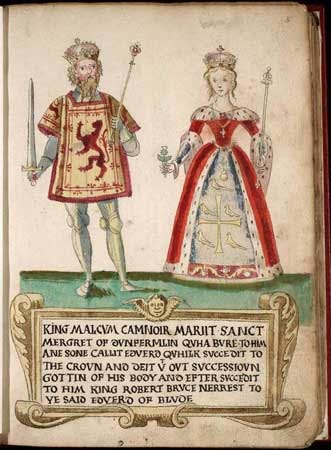
Depiction of Malcolm III and Saint Margaret of Scotland. History
also knows him as Malcolm Canmore (Gaelic for
great head' or 'chief).

     Malcolm was born in 1031 - possibly on March 26th - as the eldest son of Duncan I of Scotland and Queen Suthen.

     His father's reign was not successful, and it ended with the King's death at the hands of his cousin, Macbeth, who seized the throne for himself on August 15, 1040. Malcolm's family unsuccessfully attempted to overthrow Macbeth, and he was sent to a safe haven - possibly in England, at the court of Edward the Confessor.

     In 1057, he returned to Scotland, and at the Battle of Lumphanan in Aberdeenshire, he defeated and killed Macbeth, who was succeeded by his stepson, Lulach, until he too was killed by Malcolm on April 23, 1058. Malcolm was now King of Scots and he was crowned as such two days later at Scone.

     Before taking the throne, it is likely that the King had been married for some time to Ingibjörg, the daughter of a Norwegian nobleman, Finn Arnesson, who was an adviser to Olaf II and Harald III of Norway, as well as Sweyn II of Denmark. Ingibjörg was also the widow of Thorfinn Sigurdsson – the powerful Earl of Orkney. Because much of north and western Scotland was still under Scandinavian, Norse-Gael, and Gaelic control, this marriage helped to secure peace in those areas for King Malcolm. It also produced three sons: Duncan, Donald, and Malcolm.

     Meanwhile, events south of the border would greatly shape the course of Malcolm III's reign. The Norman Conquest of England led by William the Conqueror in the late 1060's and early 1070's resulted in Malcolm granting sanctuary to the Anglo-Saxon royal exiles, including Edgar the Ætheling, who had been elected as King of England after the death of Harold II at the Battle of Hastings and before the takeover by William I on Christmas Day 1066.

     In either 1070 or 1071, Malcolm III married for a second time (following the death of Ingibjörg) to Edgar's sister, Margaret of Wessex, with whom he had eight children. Their names marked a change from the Norse or Gaelic names (i.e., Malcolm, Cináed and Áed) that had been the established tradition previously for Scottish royalty, but also marked out their Anglo-Saxon heritage: Edward was named for Queen Margaret's father Edward the Exile, Edmund for her grandfather Edmund Ironside, Æthelred for her great-grandfather Æthelred the Unready, and Edgar for her great-great-grandfather Edgar and her aforementioned brother. The remaining children from this marriage were Alexander, David, Matilda, and Mary.

     King Malcolm may have believed that his marriage into Anglo-Saxon royalty and the Anglo-Saxon names of his children could have put him in a position to challenge William the Conqueror, or at least undermine his shaky authority by carrying out raids into England on land and sea without consequence. However in 1072, William I's position was strengthened by his Harrying of the North, and he rode to Scotland and forced Malcolm to sign the Treaty of Abernethy, which stipulated that in return for swearing allegiance to William, he was to be given estates in Cumbria, England.

     Nonetheless, Malcolm continued to conduct raids on northern England, with the hope of annexing the northern English counties and pushing Scotland's border further south. In 1080, William sent his eldest son Robert to deal with Malcolm, and a new peace deal was struck, which lasted for over a decade.

     During the reign of William Rufus (William II of England), the peace began to break down again in 1092, but an attempt was made to settle the disputes over lands and estates in Cumbria when a meeting was arranged between Malcolm and Rufus in Gloucester. This failed to materialize when Malcolm was informed that Rufus was not negotiating and that the dispute would be judged by English barons. Malcolm left for home angry and humiliated, and he proceeded to raiding the northern counties again.

     It was on his return journey from one of these raids that Malcolm was ambushed by Robert de Mowbray, Earl of Northumbria, whose lands had been devastated by Malcolm. This incident became known as the Battle of Alnwick, at which Malcolm III of Scotland was killed on November 13, 1093. He was initially buried at Tynemouth Priory, but was re-interred at Dunfermline Abbey next to his queen, Margaret (who was later beatified and is Scotland's only royal saint), during the reign of his son, Alexander I.

     Malcolm was immediately succeeded by his brother as Donald III, who in turn was succeeded by Malcolm's surviving sons - Duncan II, Edgar, Alexander I, and David I. His elder daughter Matilda would marry Henry I of England, and be an ancestor to the English Plantagenet dynasty, beginning with her grandson, Henry II.

      In terms of his legacy, Malcolm - despite his efforts - did little to change to political map of Britain. What he did achieve was the founding of a line of kings who would gradually remove Norse influence and power from Scotland. The royal dynasty to which he belonged, the House of Dunkeld, would rule Scotland for nearly 200 more years.

     Malcolm III of Scotland is a 26th great-grandfather of Elizabeth II of the United Kingdom.

Tuesday, March 25, 2014

Royal Profile: Robert I (the Bruce) of Scotland

Robert the Bruce, King of Scots

     Robert the Bruce was born on July 11, 1274 at Turnberry Castle in Ayrshire, Scotland as the first son of Robert de Brus, 6th Lord of Annandale and Margaret, Countess of Carrick.

     Descending from a noble family of Scoto-Norman and Gaelic stock, he was a fourth great-grandson of David I of Scotland through his father, who held lands in Dumfries and Galloway along the English border - which had been granted to his family by King David. On his mother's side, Robert inherited a Gaelic ancestry through the Earldom of Carrick, and in this mix of Anglo-Norman and Gaelic culture's (typical of southern Scotland and northern England), Robert probably spoke up to three languages: Anglo-Norman French, Gaelic, and early Scots.

     In 1286, Alexander III of Scotland died and the Crown was passed to his granddaughter and Norwegian princess, Margaret. Four years later, the seven year old queen died on the way to Scotland, which initiated a succession crisis during which several competitors lined up to lay their claims to the Scottish throne before Edward I of England, who arbitrated these claims on behalf of the Guardians of Scotland.

     Out of fourteen candidates, only four presented a serious claim to the throne, and one of them was Robert's grandfather - Robert de Brus, 5th Lord of Annandale. In the end, Edward judged in November 1292 that grandfather Robert's first cousin once removed, John Balliol, had a better claim and awarded him the Crown of Scotland.

     Within years, relations between Edward I and John Balliol broke down has Edward continued to assert his overlordship of Scotland. He agreed to hear appeals of cases from Scottish courts and demanded that Balliol appear before him to answer for charges in one particular case. However, the final straw came when Edward made further demands that Scottish nobles provide military service in England's war against France, which provoked the Scots into forming an alliance with the French (the Auld Alliance).

     In this early struggle, the Bruce's supported Edward, in part because they viewed Balliol as a usurper, and took refuge in Carlisle, England with the backing of King Edward. It was also around this time that younger Bruce (and future king) married his first wife, Isabella of Marr, with whom he had one child, a daughter named Marjorie.

A depiction of Robert Bruce with his first wife, Isabella of Marr.

     It was in Carlisle that the Bruce's were attacked in March 1296 by the Balliol-backed Comyn faction of Scottish nobles in what was one of the first blows in the Wars of Scottish Independence. Edward responded to this and the Auld Alliance by invading Scotland, crushing the resistance, and deposing John Balliol as King of Scots, who was taken as a prisoner to the Tower of London.

     Following this, Robert Bruce, 6th Lord of Annandale and Robert Bruce, Earl of Carrick (the future king) were among 1,500 Scots who swore fealty to King Edward, who set up an English administration in Scotland. Within a year however, a revolt broke out and the younger Bruce, aged 22 and possibly under the influence of the Stewart and Wishart families, joined in the patriotic cause against the English.

     Over the next decade, Bruce would change his allegiance several times as the political and military circumstances changed. During this period, he was appointed as a co-Guardian of Scotland, but left the post due to personal differences with a fellow Guardian and political rival, John Comyn. He supported Sir William Wallace's revolt against Edward I, but Edward's invasion of Scotland in 1303 resulted in the country being under his submission again, and all of the nobility - save for Wallace - swore fealty to him. Wallace himself was eventually captured in Glasgow and brought to London, where he was tried and executed. Meanwhile, another English-backed administration was set up, and nobles such as Bruce participated in it. However, King Edward distrusted him, which was reflected in the withholding of lands once promised to Bruce.

     Among the Scottish nobility as well, there were misgivings over Bruce due to his support for both sides in the conflicts. Chief amongst them was his longtime rival, John Comyn, who was more resolute in his opposition to the English, and like Bruce, held a claim to the still-vacant Scottish throne. In the late summer of 1305, Bruce and Comyn swore a secret deal in which Comyn agreed to forfeit his claim to the throne in favor of Robert Bruce upon receipt of the Bruce lands in Scotland should an uprising occur led by Bruce.

The killing Comyn by Bruce
(Engraving by
Henri Félix Emmanuel Philippoteaux)

     At some point, it is believed that Comyn divulged the details of this deal to King Edward, who then moved to arrest Bruce whilst he was at the English court. Bruce received a tip-off about his impending arrest, and fled back to Scotland, where he confronted Comyn in a fateful meeting at the Chapel of Greyfriar's Monastery in Dumfries on February 10, 1306. There, Bruce accused Comyn of treachery and killed him before the High Altar.

     Having crossed this Rubicon, Bruce pressed his claim to the Scottish throne, and six weeks later, he was crowned King of Scots at Scone by Bishop William de Lamberton on March 25, 1306. Traditionally, a member of Clan MacDuff performed the crowning of the monarch, but the closest member of the clan in support of Bruce, Isabella MacDuff, Countess of Buchan arrived too late for the ceremony. A second coronation ceremony was held he next day, in which MacDuff crowned the new King, so as to head off charges of ceremonial irregularity, which could have placed his throne at risk.

A tableau depicting King Robert being crowned at his second coronation by Isabella MacDuff.

     The actions of King Robert resulted in his excommunication by Pope Clement V, and Edward I marched north yet again to bring Robert to account and establish overlordship of Scotland. He defeated Robert at the Battle of Methven in June 1306, seized Robert's lands and gave them to his adherents. Robert and group of nobles fled to the Hebrides, but as fate would have it, Edward I of England - the Hammer of the Scots - died aged 68 on July 7, 1307, and was succeeded by his son, Edward II.

     King Robert and his forces returned to mainland Scotland a few months before Edward's death, and began conducting a fierce guerrilla campaign against the English armies, resulting in significant victories at Glen Trool and Loundon Hill. From there, Robert led another campaign across the west and north of Scotland - defeating his Comyn enemies and their allies, laying waste to their lands, and destroying their significant power base, which was always an obstacle to the King's ambitions.

     In March 1309, King Robert held his first Parliament at St. Andrews and had achieved control over Scotland north of the River Tay by August. His position was further strengthened when the Scottish clergy - in spite of the excommunication by Clement V - acknowledged Robert as the rightful King of Scots.

     Over the next five years, Robert and his nobles not only recaptured English-occupied territories and defeated English forces and their Scottish sympathizers, but they also began making raids into northern England and other places of strategic importance. In the spring and summer of 1314, they gained control of both Sterling and Edinburgh castles.

Statue of King Robert on his horse at Bannockburn.

     Under Edward II, the English attempted to recover their position at Bannockburn. The odds were in their favor as the English army was twice the size of King Robert's forces, but they found themselves decisively routed by the Scots and retreated after two days. This significant battle all but secured Scotland's independence, and to this day, remains a pivotal moment in the history of Scotland in particular and Britain in general.

     From here, Robert initiated more raids in northern England - particularity wreaking havoc in Lancashire and Yorkshire. He also attempted to open a second front in Ireland, where he hoped to forge a pan-Gaelic alliance against English rule. Robert certainly had Gaelic Irish lineage on his mother side, and his second wife (Elizabeth de Burgh, whom he had married in 1302 following the death of Isabella of Marr) came from a noble family that held the Earldom of Ulster in present-day Northern Ireland. However, many chiefs in the southern parts of Ireland did not distinguish between English occupation and Scottish occupation, and were only too glad when Edward Bruce - King Robert's brother - was defeated and killed at the Battle of Faughart 1318, which largely ended the Irish part of these Anglo-Scottish conflicts.

     Two years later, the Declaration of Arbroath was submitted to Pope John XXII. It was a statement of Scotland's independence, and sought the pontiff's recognition of that independence, as well as the lifting of his predecessors excommunication of King Robert for his murder of John Comyn. The Pope initially heeded the document, but was later persuaded to take the English side under Edward II. Robert continued his raids into northern England, partly in response to Edward allowing privateers to attack and seize vessels trading with Scotland.

     Following their defeat at Weardale, the English - having deposed Edward II and now under the governance of his wife Isabella and her lover, Roger Mortimer in the name of Isabella and Edward's son, Edward III - sent envoys to Scotland to open peace negotiations. This resulted in the Treaty of Northampton-Edinburgh of 1328, which recognized Scotland as an independent kingdom with King Robert and his heirs and successors as rightful rulers, and established the Anglo-Scottish border as it had been under Alexander III. The Treaty was signed by Robert in Edinburgh on March 17th, and ratified by the English Parliament on May 3rd. With Scotland's independence came the lifting of the papal excommunication of Robert I in October of that same year.

     However, the recognized King of Scots would not live long in his moment of triumph. For at least the past year, he has suffered from a medical condition which may have been tuberculosis, syphilis, or strokes. In the spring of 1329, he held his final council at his bedside, during which he made gifts to religious houses and orders, and repented for not going on a crusade in the Holy Land.

     On June 7, 1329, King Robert died aged 54 at the Manor of Cardross near Dumbarton, having achieved the recognition of the Bruce claim to the Scottish throne.

The eastern tower of Dunfermline Abbey, where King Robert is buried.
Atop the tower are the carved letters: KING ROBERT THE BRUCE

     In accordance to his wishes, his heart was removed so that it could be taken on a crusade, but this never materialized, and the heart was brought back to Scotland, where it was buried at Melrose Abbey in Roxburghshire, also in pursuant to the King's instructions. His body was embalmed and buried at Dunfermline Abbey beneath the High Altar beside his queen, Elizabeth de Burgh.

     Robert I was succeed by his and Elizabeth's only surviving child as David II of Scotland at the age of five. He died without an heir, and was succeeded by his nephew, Robert Stewart - son of Marjorie Bruce (Robert I's daughter via his first wife, Isabella) and Walter Stewart, 6th High Steward of Scotland - as Robert II, inaugurating the Royal House of Stewart/Stuart.

     King Robert's descendant's include all subsequent monarch's of Scotland, and after the accession of James VI to the English throne in 1603, all monarch's of England, Great Britain, Ireland, and the United Kingdom, including the reigning queen, Elizabeth II, who is his 19th great-granddaughter.


Photo Credit: Kim Traynor via Wikimedia Commons cc, Joe Thomissen via Flickr cc, Dave Conner via Flickr cc