Showing posts with label Queen Elizabeth. Show all posts

Wednesday, September 9, 2015

The Longest Reign, and Still Going Strong


Photomosaic of Queen Elizabeth II by Helen Marshall
using more than 5000 photos of people for Diamond Jubilee.
Image Credit: Abuk SABUK via Wikimedia Commons cc


“I declare before you all that my whole life, whether it be long or short, be devoted to your service and to the service of our great imperial family to which we all belong.”

     These words were uttered by Her Majesty the Queen in 1947 via a radio broadcast to the British Empire and Commonwealth whilst she was still Princess Elizabeth and heiress presumptive to the throne. She was celebrating her 21st birthday during a tour of South Africa with her parents and younger sister, and made this extraordinary lifetime pledge to the peoples and lands over which she would one day reign.

     For her, that day came sooner than she or almost anyone expected, for on February 6, 1952, George VI – whose health had been declining since the end of World War II – passed away at the relatively young age of 56. Elizabeth and her husband Philip, Duke of Edinburgh were on a Commonwealth tour in place of her father, and upon receiving the news while in Kenya, promptly returned to the United Kingdom with Elizabeth as Queen.

     Since then, she has stayed true to the vow which she made with her people, and now at over 63 years on the throne, she has surpassed her great-great grandmother Queen Victoria as the longest-reigning monarch in British history. There is arguably no other person as well-known or highly regarded as Elizabeth II as she has become an instantly recognized figure around the world, and indeed, very few  people have ever been closely watched since birth for as long a period as she has.

     In the beginning however, this was not to be. She was born as the first child of Prince Albert, Duke of York and Elizabeth Bowes-Lyon, a Scottish aristocrat (who in time would eventually become the much-beloved Queen Mother). Albert – known to family and friends and “Bertie” – was the second son of George V and Queen Mary, and as such, was not expected to ascend to the throne, for that was the destiny reserved for his older and more glamorous brother, Edward, Prince of Wales – known as “David” within the family. The result was that despite the attention she received for being a granddaughter of the King, for the first ten years of her life, she could expect to live a relatively quiet existence in the countryside with her horses and corgis – away from the pomp and glitz which royal duties required, especially with the rise of mass media in the form of radio.

     Indeed, at some level, this was the sort of life which for which her Uncle David was suited as a modernizing, photogenic, and dazzlingly popular prince – as opposed to her shy and stammer-plagued father. But her father’s strength was his solemn commitment to royal duties and to his close-knit family, to which he was devoted, and this stood in contrast to the Jazz Age playboy lifestyle of David, who enjoyed the social scene and his status as a celebrity, but detested the more serious, traditional, and (boringly) grounding demands of being a royal prince.

     By the time he came to the throne as Edward VIII in 1936, he was still unmarried and carrying on an affair with a twice-married American woman, Wallis Simpson, and provoked a constitutional crisis by his determination to marry her against the wishes of the UK government and the Church of England, of which he was Supreme Governor. The result was that Edward abdicated after only eleven months as monarch, and his brother Bertie succeeded him as George VI.

     This changed everything for Princess Elizabeth, who was now first in line to the throne and knew what destiny lay in store for her. She watched as her father was thrust into a position for which he was temperamentally unsuited, but also saw him eventually grow into it with the support and devotion of his family, most notably his wife Elizabeth, as well as the speech therapist Lionel Louge, who helped him to overcome his stammer and public speaking issues. He and the Queen endeared themselves to the British people by staying in the United Kingdom, and in particular, in London during the Blitz, during which was a raid on Buckingham Palace which nearly killed them.

     The devotion to duty to the country in the face of aggression had a profound impact on the young princess – who served in the Auxiliary Territorial Service as a automobile mechanic and driver – with her parents providing her the example by which to lead, and the morale of the British people as a whole was immeasurably boosted by the actions of their king and queen, which helped to sustain them to victory over Nazi Germany. But the stress of being a wartime king, compounded with the effects of a lifetime of smoking took their toll on George VI, and this led to his premature death in 1952.

     Coming to the throne at the age of 25 and with two young children of her own, his daughter had little experience with affairs of state, but guided by her sense of duty, she carried on with the task of being a monarch, and this was helped along with the guidance of her first prime minister, Sir Winston Churchill, who poetically referred to her as “a fair and youthful figure, princess, wife, and mother” being the “heir to [Britain’s] traditions and glories.” He and others even talked of a new Elizabethan Age.

     Unlike that period which was characterized by imperial ambitions and territorial expansion around the globe, this one has been noted for the transition from an Empire to a Commonwealth – a club of former colonies with the Queen as its head to symbolize their voluntary association with each other and the former mother country, the United Kingdom. The Queen has been keen to keep this association together, and has grown with the Commonwealth as its biggest and most enthusiastic supporter in its mission to foster greater business and cultural links amongst the countries of the former British Empire, and it now stands with 53 members and a population of over 2 billion people – roughly a third of humanity.

     Closer to home, the pace of change has been dizzying. Britain has become a more liberal, less religious, and more multi-cultural society. Unquestioned deference has given way to more measured respect as the country has become more cynical and critical, as and traditional societal norms and conventions have broken down. Within her own family, she has had to deal with the turmoil of the marriages of three of her four children, all of which ended in divorce, most notably the marriage of her heir Prince Charles and Diana, Princess of Wales. The failure of those marriages, other private indiscretions, and a fire at her favorite residence of Windsor Castle all contributed to what she referred to as her annus horrilibus in 1992. 

     Following this, the worst period of her reign was when Diana died from a tragic automobile accident in Paris in August 1997. Staying at Balmoral in Aberdeenshire to care for her grandchildren – princes William and Harry – in the wake of their mother's death, she was criticized for not appearing in public to grieve, failing to have the Union Flag flying at half-mast from Buckingham Palace, and in general, for being out of touch and misjudging the mood of the people. For the first time, there was real hostility toward the Queen and an aggressive press piled on the stinging criticisms of the Queen personally and the monarchy as an institution. But all was forgiven as she flew down to London to preside over Diana’s funeral and present a live broadcast to the nation in which paid tribute to her former daughter-in-law as a Queen and as a grandmother.

     This moment was part of the monarchy becoming more media-conscious and professional in its relations with the press in an age of increased exposure, and with the Internet age, the ancient institution has adapted with an online presence – including websites and social media accounts to help it connect it more directly with the people and marking a huge leap in her lifetime from radio broadcasts to YouTube.

     Indeed, this new Elizabethan Age as seen the explosion of technological growth and innovation on a scale never seen before, alongside advances in medicine, science, transportation, communications, and other areas – with Britain being at the forefront of many of these. There has also been the rise of British exports such as the Beatles, James Bond, and Harry Potter, which have done their part to ensure that Britain remains relevant as a cultural, social, and economic (i.e., soft) power.

     The Queen herself and the institution she leads have themselves become British exports, in part because of her role as Head of the Commonwealth (including being head of state of 15 Commonwealth countries aside from the UK), and as such, she has become the most widely-traveled monarch in British history – visiting the vast areas of the Commonwealth and being a face of Britain throughout the world on many overseas journeys.

     Through all of this, she has maintained that sense of duty with all of the change around her. To some, she may look like a stiff with no personality or emotion, but this isn’t to say that the Queen doesn’t have a wicked sense of humor about her, and as time has progressed, we have seen her more loose, engaged, and interactive with people as she and monarchy adapt to changing times.

     During her reign, the ancient institution has continued with the standard set by George V of getting out, being seen, and working hard, and the Queen herself has said, “I must be seen to be believed.” With that, she has introduced the Royal walkabout, so that she can meet more people and allow them to have interactions with her and other members of the Royal family. She has also dispensed with the presentation of debutantes in favor of more garden parties in which a more representative cross section of society is invited for a once-in-the-lifetime opportunity to be in the presence the Royal family – whether at Buckingham Palace, Holyroodhouse, Windsor, or Hillsborough Castle. The Royal residences themselves have become more accessible to the public as a means of helping to meet the cost of maintaining them, especially in the wake of the Windsor Castle fire.

     But even with the changes, the Queen still represents the continuity of the monarchy in the overall fabric of Britain and its long history, and this is a powerful symbol. Since coming to the throne, she has had 12 British prime ministers, from Churchill to David Cameron, which is a remarkable span of history when one considers that Churchill was born in 1874 during the reign of the previous reigning female monarch and two of her last three prime ministers (Tony Blair and Cameron) were born after she had acceded to the throne. In 63 years, they have come and gone while she has remained faithfully at her post as the one constant.

     In this sense, she also represents stability in government, for as a constitutional monarch who is above politics, she openly favors no party. True, the government is termed Her Majesty’s Government, but it is the politicians elected to Parliament who run it in her name. She accepts the election results and appoints the prime minister accordingly, but otherwise steers away from politics and the charge of being a political operative. This way, she can be the head of state of everybody, as was suggested by Walter Bagehot in the Victorian Era, and this is one reason why the monarchy survives and provides stability, especially in these rapidly changing times.

     However, none of this would be possible without the help and support of her family, who despite some of their personal issues being made public and causing embarrassment and disappointment, have been invaluable in working to keep the monarchy as relevant today as it was in 1952. In addition to what the Queen has done, other members of the Royal family have taken it upon themselves to step up their involvement in good works for the benefit of the UK and the world at large. It’s not just about carrying out engagements and giving speeches, but also about being actively involved with the causes they support and showing that they can make a positive difference, which further entrenches the monarchy into the public and civic life of the United Kingdom as charities and organizations seek to have a royal patron.

     But of all the family members, perhaps none has been more important or reliable than her husband of nearly seventy years, Prince Philip. His unstinting devotion to her through marriage, family life, and public duties has indeed provided a rock of stability at times when it seemed that everything was coming apart at the seams, and her reign as we know it would not be possible without him. At times, his verbal gaffes and forthright speaking in public has provided fodder for the press, but for her, he provides an outlet to which she can convey her thoughts, and he has no compunction against telling what he thinks. For his part, he has carved out a role for himself with initiatives such as the Duke of Edinburgh’s Award for young people who come up with good and innovative ideas that improve the lives of others. But as the Queen’s consort, he has been there for her, just as she has been there for the country, and he has only become more important with the deaths of the Queen Mother and Princess Margaret in 2002. He has been, as she herself has said, quite simply, the “strength and stay” of her life.

     Going forward, the Queen can be assured that the monarchy is as stable and secure as it ever has been throughout its long and illustrious history, with the institution having recovered from its most recent nadir in the 1990’s. She has a capable heir in Prince Charles, a man who as Prince of Wales, has probably had the longest apprenticeship for any sort of job, and has had his own recovery of sorts since his marriage to Camilla Parker Bowles and the development of his own charitable and advocacy efforts – particularly with regard to opportunities for young people, architecture, and the environment. Further down the line is Prince William, the eldest son of Charles and Diana, and his beautiful wife Catherine, along with their two children, Prince George and Princess Charlotte. Together with Prince Harry (who has been doing conservation work in Africa), they form the core of the future of the monarchy, and for them, and the Queen has provided the example by which to lead.

     For over 63 years, she has been the face of the monarchy and an icon of the United Kingdom and the Commonwealth. She represents continuity over the decades of her incredible reign, and as acted sensibly to ensure the monarchy’s survival into the 21st Century with her adaptations to changing times and circumstances, while also maintaining the traditions of the institution and presiding over a changed Britain where in many ways, she not only relies on the blessings of God, but also of the people. Her legacy has been that through it all, she has kept the obligation she made to the people in her “salad days” when she was “green in judgment”, and has not reneged on it or regrets it. In an age when people find it easy to get out of duties and responsibilities, she represents the idea of sticking around and committing to something bigger than themselves, something her Uncle David did not understand in his vanity.

     Looking back, his abdication, as much as it caused a crisis which rocked the monarchy, was a good thing in the long-term, for it provided George VI and eventually the present Queen, who has been steadfast in her duties and responsibilities, and has made her people proud. Indeed, her popularity can be traced to the fact she really does not aim for popularity, but simply aims to do her job, and so there is a sincerity and realness about the Queen that is absent from celebrities who do seek the attention of the cameras and the press.

     She has now been Queen for so long, that few remember the reigns of her father or grandfather, and it feels inconceivable that anyone can replace her. Of course, this is bound to happen, but this is a testament to her reign and herself as an individual, for in leading by example and living by her words from 1947, she has earned the respect, affection, and love of her people.

     For many Americans (including your truly), the Queen has definitely earned our respect and appreciation over these last 63 years, and we look to her as well for that sense of stability and continuity. It is not so much that we yearn for a monarchy of our own or wish for the return of the British monarchy, but that we see it as an integral part of the UK – representing its past, present, and future like virtually nothing else does – and we see the Queen as the living embodiment of everything that is decent and good about Britain. Along the way, 12 of our presidents have occupied the White House in the course of her reign, from Truman to Obama – many of whom have expressed their appreciation for her as an individual and as a living testament to the strength of the Special Relationship between Britain and America.

     As the Queen does finally eclipse her great-great grandmother to become Britain’s longest-reigning monarch, she has much to be proud of and much to look forward to as she carries on – reigning as ever, going from being a willowy young woman to the matriarch of a country and a global commonwealth. She has already secured her place in history on many fronts simply because she has been at the service of her people. Those people – of the United Kingdom and throughout the Commonwealth – are lucky to have her, and long may she reign.

Sunday, August 9, 2015

The Long-Reigning and Reconciling Queen


Elizabeth II of the United Kingdom.
Image Credit:
Joel Rouse/Ministry of Defence via Wikimedia Commons
(
Contains public sector information licensed under the Open Government Licence v3.0)

     This week, it was announced that HM the Queen will be marking the date that she becomes the longest-reigning British monarch by officially opening the new Borders Railway line from Edinburgh to Tweedbank, near Galashiels in the Scottish Borders on September 9, 2015.

     Train services will actually start a few days earlier, but with the formal opening, the new line will get its Royal seal of approval from Her Majesty, who along with the Duke of Edinburgh will participate with the opening celebrations at Waverly Station. Following this, they will board a train drawn by a historic steam locomotive – the Union of South Africa – with Scottish First Minister Nicola Sturgeon, and make the 35 mile journey to Tweedbank, which will include a stop at Newtongrange in Midlothian along the way.

     It will be a day of profound commemoration and ceremony, for at a cost of £300 million, this line will be the largest new railway to be built in Britain for over a century. However, its path will be quite familiar to train enthusiasts and local residents, for it will travel the much of the northern part of the old Waverly Route (named in honor of Sir Walter Scott’s first novel), which ran 98 miles from Edinburgh to Carlisle across the border in England, which was built and opened in stages from 1844 to 1862, but was controversially closed in 1969 following the Beeching Report, which resulted in the closure of several rail lines and stations throughout the United Kingdom for purposes of cost-cutting.

     Since then, a nearly 50 year campaign has been waged to restore the line, and these efforts over the decades will bear partial fruit when the Borders Railway begins to serve the people of Midlothian and the Scottish Borders, which has been the only region in Britain without rail service, and this has caused adverse economic effects for the area. Now with the restoration of this line, the people living there will mark a truly historic occasion, which promises to open their area up for work, education, tourism, leisure, and other pursuits to drive economic activity. It is hoped that with this much achieved, the entire Waverley Route can eventually be restored.

     But alongside the historical significance of the return of this railway is the fact that it coincides with Queen Elizabeth II surpassing her great-great-grandmother Queen Victoria as Britain’s longest-reigning monarch. It has been known that the Queen, who is already the country’s longest-lived monarch and marked her 63rd year on the throne back in February, would reach this point in her reign in early to mid September 2015, but it was not entirely clear what day on which it would exactly fall. Buckingham Palace has calculated that Victoria had reigned for 23,226 days, 16 hours, and 23 minutes – taking into account the precise timings of her accession in 1837 and her death in 1901, and the 63 years in between (including 15 leap days). From there, it was determined that the momentous day would be September 9th.

     Despite achieving this milestone, the Queen herself likely wanted no public celebration – just as the date of her accession usually comes and goes without much of a fuss. Such displays commemorating the reigning monarch are typically reserved for jubilee’s like the ones in 1977 (Silver), 2002 (Golden), and 2012 (Diamond). However, given the significance of this particular event – after all, becoming Britain’s longest-reigning monarch is a pretty big deal – it only made sense to do something.

     The opening of the Borders Railway has therefore provided a perfect opportunity for the 89 year old monarch to be see out and about during a significant public engagement on what will be remembered as a very historic day, so that her record-breaking won’t be the sole reason for the celebrations that will take place, and instead will be part of something greater.

     It is quite significant that by formally opening this line, the Queen is reviving a tradition of rail in the area that goes back to a time when new rail lines were built almost every day throughout the UK, which happens to be the era of Queen Victoria, and so there will be parallels with that earlier reign – especially because of the travel by steam train, which ought to be an interesting sight for everyone and a thrilling experience for the Queen herself.

     It is also significant that this is taking place in Scotland, for it was Queen Victoria who started the Royal Family’s modern love of Scotland, which was been passed down through the generations to the present Queen, who has maintained the family tradition of spending summer holidays at Balmoral in Aberdeenshire. Spending this day in Scotland as she marks her milestone is a demonstration of her affection for a part of Britain which she holds dear to her heart – so much so, that during the independence referendum campaign last year, she memorably remarked that she hoped that the people of Scotland thought carefully about the future when deciding between whether to become an independent country or remain part of the United Kingdom.

     As it was, the people of Scotland voted to stay as part of the Union, and despite her official silence and not explicitly giving her stance on the issue, there is no doubt that she wanted her kingdom to stay together. It is therefore all the more interesting that she will be riding in the train with First Minister Sturgeon, who campaigned for and has continued to advocate for the break-up of Britain. Not only this, but it is believed that Ms. Sturgeon harbors republican sympathies.

     Nevertheless, the Queen – as a constitutional monarch – will carry herself appropriately in her engagements with the First Minister, so she will not show hostility to her or disrespect to her party. In this way, the Queen probably wants to show that she is indeed, above the day-to-day political fray, just as she likely believes the existence of the United Kingdom to be above politics and nearly beyond reproach, and she certainly doesn’t want it breaking up from under her.  Indeed, in her Christmas broadcast last year, she talked about reconciliation following the referendum and how this process would take time following the end of the two year long and emotionally-driven campaign, which as she said, had brought disappointment to some and relief to others. And she knows that she has a role to play in that reconciliation process, and that she must be Queen of all Britons.

     The monarchy is in many ways, a major piece of the glue that holds the United Kingdom together, and Her Majesty takes her role seriously. More than almost anybody else (including the politicians), the Queen understands the importance of celebrating the UK as a whole and acknowledging the constituent parts of the UK, so that each part may have a sense of ownership in the monarchy and in the idea that it is an institution that represents the entire UK. This helps to strengthen the Union because the Queen and members of her family are seen throughout the country carrying out a variety of engagements – many of which are of social, cultural, or economic significance to a particular area, and it is good to see them out and about – especially when showcasing areas of the UK outside of the capital city, London.

     In the case of opening the new Borders Railway, Her Majesty is shining a spotlight on Scotland, and this is her way of showing that Scotland matters to her personally and as Queen of the United Kingdom. She herself is half-Scottish through her beloved mother, and is a direct descendant of and successor to Scottish kings and queens going back over a thousand years, including Robert the Bruce – who defeated the English at the Battle of Bannockburn, Mary, Queen of Scots – who was beheaded under the orders of Elizabeth I of England, and James VI & I – who brought Scotland and England together in a personal union which paved the way for the full political and economic union resulting in the country we know today: the United Kingdom.

     Therefore, the Queen represents the long and complicated history of her country and her people – the themes, values, issues, tensions, paradoxes, and contradictions, as well as the triumphs and tragedies, good and bad, joys and sorrows, and times of unity and division. With the constitutional arraignments of the UK being hotly debated, and with the country coming to terms on issues such as immigration, the economy, the role of government, and its place in the world, the Queen and the Royal Family function to help bring the British people together and see that what they have in common outweigh the forces which drive them apart.

     So it is fitting that within a year following Scotland’s decision to stay part of the Union, the Queen is coming to the part of UK for which she has great affection to mark the return of rail transportation to the Midlothian and Borders regions, while also inviting Scotland and Scots to share with her in the celebrations for that, as well as helping to mark her personal milestone.

     She has been praised for doing this – from Infrastructure Secretary Keith Brown calling it a “great honour” for her to lead the commemorations, to Councillor Graham Harvie, the Convener of the Scottish Borders Council, who remarked that the area was “thrilled” to welcome the Queen for the formal opening, and said: “The fact that this occasion coincides with Her Majesty becoming Britain’s longest serving monarch makes it unique in the history of the Borders.”

     In addition, whatever issues she has with Nicola Sturgeon will not be on display, and indeed, it may well be that the two women will personally have a pleasant time as they join together to mark the historic occasion.

     When that day comes, hopefully there will be crowds from all across Scotland and the wider United Kingdom at Waverley Station in Edinburgh, at Tweedbank Station, and at places in between along the route to take part in the double celebration. It ought to be a great day, with a cheerful atmosphere for all amongst individuals, families, and communities, which will be remembered for a lifetime. Witnessing her people having fun and enjoying themselves – more than anything else – is likely all that the Queen asks for as she goes through with this blessed moment in her reign.

Thursday, July 3, 2014

The International Appeal of the British Monarchy

The extended Royal Family on the Buckingham Palace balcony in 2012.
Image Credit: Carfax2 via Wikimedia Commons cc

     The British monarchy is the most well-known and widely-recognized monarchy in the world. No other such institution can claim to have something even close to what this monarchy has in terms of news coverage, notoriety, and international respect. Queen Elizabeth II herself has become an icon of representing the best of Britain. She and members of her family make headlines across the world, for good reasons and not-so-good reason, and it is almost assured that a large-scale event involving the monarchy will be broadcast to every corner of the globe.

     Certainly, the monarchy has been at first a recurring, and now a constant, presence of my life. From the death of Diana to the birth of Prince George and beyond, the British monarchy has always been there with its ability to be relevant to many people, no matter where they live. This includes many Americans, whose identity is partly bound up by its independence from Britain and the rejection of hereditary monarchy.

     There are several reasons for why the British monarchy still captures the attention of the world. Such typical reasons include the fascination with what members of the Royal Family are wearing at any given time, the pageantry and ceremony, the history going back over a thousand years, the constitutional and legal nature of the institution, as well as its force for uniting the people.

The Queen's longevity is another factor in the monarchy's popularity, but the King of Thailand has been monarch longer than Elizabeth II by two years.
Abuk SABUK via Wikimedia Commons cc (Mosaic by Helen Marshall)
     However, none of these reasons get to the heart of why the British monarchy has global influence and how it got this influence.

     It is not as though this monarchy is the only one left in the world, for there are still several functioning monarchies from the Netherlands to Saudi Arabia to Japan, and they have their own ceremonies, lengthy histories, and other attributes usually linked to the monarchy in the United Kingdom of Great Britain and Northern Ireland.

     The natural response would be that in Britain, the monarchy is at the center of national life; that is thickly woven into British society; that ceremonial and pomp is done better in Britain than any other country, and that this monarchy still has a role – however reduced – in government.

     Indeed, this is something a bit more unique, but it only justifies the monarchy’s reach within the United Kingdom itself, and still does not explain why hundreds of millions – possibly billions – of people around the world have tuned in to watch Royal weddings and funerals, as well as being on pins and needles for Royal birth announcements, or why when people speak of the “Queen”, they likely mean the Queen of the United Kingdom of Great Britain and Northern Ireland – Elizabeth II, making her arguably the most famous woman in the world.

     This leads me to believe that there is one catch-all reason for this phenomenon: the British Empire, which has been long gone, but whose legacy still casts a long shadow over Britain and her former colonies.

The British Empire at its height in 1921.
 
     At its height, the British Empire was the largest empire in human history, covering a quarter of the world’s land surface and containing nearly a third of its population. This meant that the British monarch, his or her family, and their actions and movements were front page news for a substantial part of the world’s population by virtue of the position of the Crown in places such as Canada, Australia, New Zealand, India, and South Africa.

     As time went on and those countries gained self-governance within the Empire, and later outright independence, some of them decided to retain the monarchy as a system of governance. Today, Queen Elizabeth is head of state in 15 independent countries outside of Britain. The Crown in those countries has its own unique character, with Her Majesty simultaneously being Queen of Canada, Queen of Australia, Queen of Jamaica, etc, and several institutional have “Royal” in their name (i.e., Royal Canadian Navy).


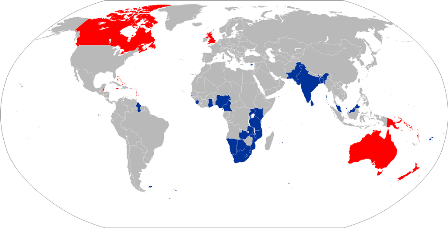
The Commonwealth of Nations. All member states recognize Elizabeth II as Head of the Commonwealth, but the red countries are the members of the organization that share allegiance to Elizabeth and her heirs and successors as head of state (and are informally known as Commonwealth Realms). The blue countries are the members that either have their own indigenous monarchies, or are republics. Many of them were once independent realms, including India, Pakistan, Kenya, and South Africa.


     But what about the former colonies that either became republics or have home-grown monarchies?

     Out of the Empire came the Commonwealth of Nations, a voluntary organization which currently contains the 16 countries with the British monarch as head of state (known as Commonwealth realms), 32 republics (i.e., India, Pakistan, and South Africa), and 5 independent monarchies (i.e., Malaysia and Lesotho). Elizabeth II is recognized as “the symbol of the free association of [the] independent member nations” in her role as Head of the Commonwealth, and she and her family make regular visits to these countries.

     With the Commonwealth and the shared monarchy between 16 countries, the British Royal Family still commands attention and notoriety across a wide swath of the world. One only needs to review the recent tour of Australia and New Zealand by the Duke and Duchess of Cambridge and Prince George, as well as the tour of Canada by Prince Charles and Camilla to see why the monarchy still matters in those countries alone. Therefore, it should not be surprising to see the coverage of the Royal Family on a large scale. 

     But how does one explain America and her love-affair with the British monarchy, especially given the events of 1776?

     Well it’s important to remember that the war for independence had more to do with the actions of the British Parliament rather than George III, but he nevertheless became the face of tyranny and oppression. In spite of this however, many Americans had respect and affection for the King – even if they had issues with his Parliament, which is why several Founding Fathers wanted a status within the Empire like that of Canada and other colonies in the 19th and 20th centuries, in which there was autonomy from Britain, but the British monarch remained head of state.

Britain and America.
 
     Even after independence, we have not really shed our social links and commonalities with Britain, so the monarchy still retains a special place, and this was evident when George VI and Queen Elizabeth (the Queen Mother) became the first reigning British monarchs to visit our shores and the American people turned out to warmly welcome them. The American media – which has come to shape the coverage of world events – has covered Royal events in a wall-to-wall fashion and the people have been tuning in time after time.

     The result is that the British Royal Family in some respects is now the world’s royal family, and this is a testament to the long shadow cast by Britain and the Empire on which the sun never set.

Tuesday, June 10, 2014

Prince Philip: Still Getting On After 93 Years

     What can one say about Prince Philip, Duke of Edinburgh?

     Well, he has certainly led an unusual and quite interesting life, even as a member of the British Royal Family.

Still living a remarkable life.
Image Credit: University of Salford Press Office via Flickr cc

     Born into a Greek Royal Family on the run from revolutionaries, Philip's childhood was chaotic and full of uncertainty. Eventually, the family became impoverished and broke up as Philip's older sister's were married off in quick succession, his father took to a mistress in the South of France, and his mother was diagnosed with schizophrenia and committed to a sanatorium. Philip himself shifted around to live in France, Britain, and Germany. He was educated at several schools, and was reliant on his royal/noble connections for shelter, food, and some sense of security.

     If this sounds like the type of upbringing that produces a child with developmental and social issues, it certainly did not manifest itself in Prince Philip of Greece and Denmark. If it did have a negative effect, he certainly did not show it and just got on with his life.

     Now at the age of 93, it can certainly be said getting on with life and not making a fuss about things is central to how Philip has conducted himself over the years.

     From that difficult childhood, he made his way into the Royal Navy, where he excelled as a cadet at the Britannia Royal Naval College at Dartmouth. Soon after that, he served as an officer during World War II. He saw action in the Mediterranean and Pacific theaters, was mentioned in despatches, and was present in Tokyo Bay for the unconditional surrender of Japan.

The Royal Naval College at Dartmouth, where
Philip began a career in the Navy and met his future wife.
Image Credit:
Andrew Yong via Wikimedia Commons cc

     The sailor prince then got married to Princess Elizabeth, the heiress presumptive of George VI, after a courtship that had lasted for nearly eight years, and they soon began to have a family of their own. Prince Charles was born in 1948 and Princess Anne followed in 1950. It was expected that the young couple would not have to worry about Elizabeth's succession, allowing them to raise their children and for Philip to have a full career in the Royal Navy - rising through its ranks and eventually becoming First Sea Lord.

     But it was not to be. Within five years of their marriage, George VI passed away and his daughter was now Elizabeth II of the United Kingdom. This effectively ended Philip's naval career because he was now a consort and expected to be at his wife's side to support her in carrying out her duties and responsibilities as Sovereign.

     Once again however, Philip put his personal feelings and desires aside. He looked forward to that naval career, but as ever, he simply got on with life - not only supporting the Queen, but also carving out his own existence. In the last 62 years, he has become patron of several hundred organizations, and has also created new ones - most notably and successfully, the Duke of Edinburgh's Award, which now has an international scope in helping young people to unlock and achieve their full potential.

In the shadow of the Queen.
Image Credit: West Midlands Police via Flickr cc

     But day in and day out, he has been an unflinching supporter of the Queen, dutifully walking two paces behind her.

     Over time, he was developed a reputation for speaking his mind - sometimes making what are referred to as gaffe's which at times have caused headaches for the Palace staff because of the perceived insensitivity and outright bluntness of some comments, such as appearing to complain on television (Meet the Press) that he might have to give up polo if the Royal finances went into the red during the 1960's and telling a President of Nigeria who was wearing traditional robes: "You look like you're ready for bed!"

     But Philip's risque tongue has endeared him with sections of public who see him as being himself and not always sticking to what his politically correct, and the Duke himself has taken criticism in stride - joking that the Queen has "tolerance in abundance" with regard to his statements over the years.

The Duke and the Queen preparing to attend the State Opening of Parliament in 2009.
Image Credit:
Grahamedown (Public Domain)

     Again perhaps, this is an example of the Duke shrugging off problems and just getting on with life. 

     He certainly appears to be well these days and looks sprightly for a man of 93, but there are concerns that his age and health have been catching up with him over the last couple of years. 

     Philip was hospitalized during the Christmas holiday of 2011 at the family's winter estate of Sandringham in Norfolk, England after suffering from chest pains, and underwent a successful coronary angioplasty and stenting.

     During the Queen’s Diamond Jubilee weekend, he was hospitalized for a bladder infection, which may have resulted from him standing on the royal barge during the Thames River Pageant for over four straight hours in the cold and rain. The infection reoccurred during the summer holiday at Balmoral in Scotland, and he was hospitalized again as a precautionary measure.

     In June of last year, after having attended a garden party at Buckingham Palace and just days after commemorating the 60th anniversary of the Queen's coronation, he admitted himself to the London Clinic for what Buckingham Palace called a pre-planned “exploratory surgery” in his abdominal region. He spent eleven days there, celebrating his 92nd birthday and missing the Trooping the Colour ceremony for the Queen’s Official Birthday. Philip was then discharged from the clinic to recuperate, first at Windsor Castle and then at Sandringham. During that period, his third great-grandchild (and first great-grandson) Prince George was born.

66 years of marriage, and they are still going strong.
Image Credit: Carfax2 via Wikimedia Commons cc

     Given these recent health issues at his age, there have been suggestions that perhaps Philip should reduce his public activities and engagements. 

     But at 93, he his getting around as good – if not better – as anybody at that age, and he would probably be the first to say that nobody ought to be making a fuss over his health. Like most things in his life – such as being constantly moved around Europe throughout his childhood and not having a permanent home life – Philip shrugs off such concerns in part because he realizes that life is life and that there are certain things that are out of one’s hands. Therefore, one ought not to worry about it and carry on as usual, which is what Philip has done after his recent health scares.

Last year, Prince Philip, as Colonel-in-Chief of the Royal Canadian Regiment, Prince Philip, visited Toronto to present the 3rd Battalion with their Regimental Colors.
Image Credit:
Ninian Reid via Flickr cc

     In a 2011 interview commemorating his 90th birthday, the Duke of Edinburgh stated that he was going to begin to slow down and cut back on royal obligations, saying that he felt he done his bit. Nevertheless, he carried out 347 engagements during the Diamond Jubilee year in 2012 – up from 330 in 2011. His number of engagements predictably fell last year because of the “exploratory surgery”, which knocked him out of commission through much of the summer and early fall. 

     But in this year, he has made overseas journeys with the Queen to Italy (where they met Pope Francis for the first time) and more recently to France for a state visit that included commemorations for the 70th anniversary of the D-Day landings.

     If nothing else, this demonstrates his commitment and determination to being at his wife’s side as much as possible, to fulfill his duty as her consort, and pursue his own interests and passions. He is now the longest-serving and oldest-ever spouse of a reigning British monarch and it is expected that Philip will continue to do what he can to support the work of the monarchy. 

Six decades of being on duty. An inspiration to us all.
Image Credit: Titanic Belfast via Flickr cc

     He is, in my opinion, one of the monarchy’s most invaluable assets, and is the Queen’s essential partner and companion. In an interview with the BBC’s Andrew Marr for the Diamond Jubilee, Prince Harry said that he did not believe that the Queen could have carried on through the last six decades without Philip. His absence from the Diamond Jubilee Service of Thanksgiving was especially felt, as the Queen walked down the aisle of St. Paul’s Cathedral alone.

     If anything, they now need each other more than ever. Hopefully, the Duke will have many more years ahead of him with good health, so that he may remain the “strength and stay” of the Queen. 

     No wonder he is the Iron Duke.