Showing posts with label Alfred the Great. Show all posts

Wednesday, January 8, 2014

On This Day: January 8

871 - Alfred the Great leads an English army to victory over the Danes.
 
Alfred was not yet king that day, but he acted like one.

     In 871, Alfred the Great lead a West Saxon (Wessex) army to repel an invasion by the Vikings at the Battle of Ashdown. At the time, Alfred's brother Æthelred was King of Wessex, but Æthelred wanted to engage in prayer before the battle, whilst Alfred was chomping at the bit to engage with the Danes led by King Bagsecg. Alfred left the King at the church and took his men to a victory over the invaders, though with heavy casualties on both sides - including King Bagsecg and five Danish earls. The result was that the Danes were driven eastward toward London.

1107 - Edgar, King of Scots dies in Edinburgh.

Seal of King Edgar
 
     In 1107, King Edgar of Scotland died at the age of 33. He was the fourth of son of King Malcolm III, but the first to be considered eligible for the throne. His mother Margaret was a sister of Edgar the Ætheling, the last Anglo-Saxon King of England, and so Edgar was a direct descendant of Alfred the Great. King Edgar's reign is known for peace treaty with Norway, under which Norwegian claims in the west of Scotland were recognized and a boundary was settled. Following his death, King Egdar was buried at Dunfermline Abbey.

1746 - Bonnie Prince Charlie captures Stirling.

The Young Pretender, as seen in a painting by John Pettie.

 In 1746, Charles Edward Stuart and his rebel forces occupied the Scottish town of Sterling during the Second Jacobite Uprising. Charles - popularly known as Bonnie Prince Charlie and the Young Pretender - was the grandson of the deposed James VII & II, as well as the son of James Francis Edward Stuart - the Old Pretender. He was seeking to reclaim the British throne from his German cousin, George II, whose Protestant family had reigned in Britain since 1714 in order to avoid a succession by the Catholic Stuarts. This eventually resulted in failure, and it was the last attempt by the Stuarts and their descendants to regain the throne.

1864 - Birth of Prince Eddy, the King that never was.

If this man had become King, we never would have had Elizabeth II or the House of Windsor.
 
     In 1864, Prince Albert Victor, Duke of Clarence and Avondale was born at Frogmore House in Windsor. He was the eldest son of Albert Edward, Prince of Wales and Alexandra of Denmark (the future Edward VII and Queen Alexandra), and was known as Eddy among his family. Prince Eddy served in the Royal Navy and was the second in line to throne, but predeceased his father and grandmother, Queen Victoria in 1892 due to influenza. The result was that his younger brother Prince George moved up the line of succession, and eventually became King George V. To this day, rumors and conspiracy theories have suggested that Prince Eddy was Jack the Ripper. 

2004 - The christening of a new Queen.

The Queen Mary 2 in Southampton in June 2013.

     In 2004, Queen Elizabeth II christened the new Cunard liner, RMS Queen Mary 2, in Southampton. The QM2 is the world's largest ocean liner (as opposed to cruise ship), and is named for the RMS Queen Mary of 1936, which in turn is named after the reigning queen's grandmother, Queen Mary - the wife of George V.


Photo Credit: Odejea via Wikimedia Commons cc, Barry Skeates via Flickr cc

Saturday, January 4, 2014

On This Day: January 4

Modern interpretation of the flag of Wessex.

     In 871, King Æthelred of Wessex fought and was defeated at the Battle of Reading by Danish invaders alongside his brother, who would become Alfred the Great.


Charles I of England, Scotland, and Ireland

     In 1642, King Charles I entered the House of Commons at the Palace of Westminster with armed soldiers to arrest the following five Members of Parliament:
  • John Hampden, MP for Buckinghamshire
  • Arthur Haselrig, MP for Leicestershire
  • Denzil Holles, MP for Dorchester
  • John Pym, MP for Tavistock
  • William Strode, MP for Bere Alston
     Charles was a devout establishment Anglican who believed that these Puritan men had encouraged the Presbyterian Scots to invade England during the Bishops Wars, and were plotting to turn the people of London against him. He then decided to have the members arrested for treason.

     Upon entering the Commons, Charles sat in the Speaker's chair and demanded that the men be handed over. When he realized that the men were not there, he said: "I see the birds have flown," and then asked the Speaker of the House, William Lenthall, if he had knowledge of their movements or had seen them earlier. Lenthall replied that he was a servant of the Commons, and as such, was not authorized to speak unless the members directed him to do so. As it was, the five members had been warned about Charles and escaped by boat through the back of the Commons chamber facing the River Thames, while the King and his soldiers entered from the landward side at the front.

     This ill-fated move by King Charles stiffened Parliamentary resolve against him and he lost the support of London. He moved his court to Oxford, and from there the battle lines were drawn for the English part of the British Civil Wars.

King Charles awaiting his trial.

     Exactly seven years to the day after Charles I attempted to arrest the Five Members, and in so doing, started the English Civil Wars, it was decided by the Rump Parliament to put the King on trial for treason.

     Charles had been a prisoner of the English Parliament at the end of the First English Civil War, but attempted to make deals various parties. In 1647, he made a deal (in bad faith, likely) with his Scottish subjects to establish Presbyterianism throughout the British Isles if they sent an army to invade England and restore him to his throne in London.  The result was the Royalist Uprising in May 1648 and the Second Civil War in which the Scots invaded England and several rebellions took place in Kent, Essex, Cumberland, and South Wales. The Parliamentarian New Model Army, composed mainly of religious Independents with no loyalty to established faiths, crushed the rebellions and defeated the Scots at the Battle of Preston.

     The Presbyterian-dominated Parliament voted to continue negotiations with the King, but Oliver Cromwell and the Army were through with negotiating. They seized the King, placed him under their direct custody, and then purged Parliament of the 150-strong Presbyterian majority, leaving a "rump" (or remainder) of 50 Independents. This Rump Parliament declared itself the supreme power of the land, with the right to make laws without the consent of the King or the House of Lords, and its members viewed Charles as a treasonous tyrant who must pay for his crimes against England. The eventual result was the King's trial, conviction, and execution on January 30, 1649.

The Banqueting Hall on Whitehall Road
 
     In 1698, the Palace of Whitehall in London was destroyed by fire. 

     It was originally known as York House, and was occupied and expanded by Cardinal Thomas Wolsey in the 15th Century. Following Wolsey's removal by Henry VIII, the King acquired the building and made further renovations and expansions.

     It became a principal royal residence, and at it's height, the Palace complex was the largest in Europe - bigger than the Vatican and Versailles, containing over 1,500 rooms and covering 23 acres of central London. 

     With regard to the fire, it was reported that a Dutch servant left linen drying by a charcoal fire. The fire got out of control, creating an inferno which spread rapidly, and burned down the entire complex. Notable works of art, including Michelangelo’s Cupid and Holbein’s original famous portrait of Henry VIII, were lost to the flames. Only the Banqueting House survived.

     The Banqueting House had been designed and built in 1622 by Inigo Jones under James VI & I. It was from this building that James's son Charles I was led onto an outdoor scaffold and executed before the public.

     Today, the Palace gives its name to Whitehall Road, on which many administrative buildings of the British government are located, which is why such agencies are collectively referred to as "Whitehall."

George V, King of the United Kingdom and the British Dominions Beyond the Seas, Emperor of India

     In 1912, King George V issued a Royal Charter that incorporated the Boy Scout Association (now the Scout Association) throughout the British Empire for "the purpose of instructing boys of all classes in the principles of discipline loyalty and good citizenship."

     Scouting had been the brainchild of Brigadier-General Robert Baden-Powell, and after the formation of several Scouting patrols and the wildly successful publication of his book, Scouting for Boys, the Scouting Movement had become widespread. The Boy Scout Association was created in 1910 to bring a national structure to the Scouts in the United Kingdom, and the Movement spread out across the Empire and the world. In the same year that the Royal Charter was issued, the Boy Scouts of America was formed, and eventually received its own charter from the US Congress.

     Today, the Scout Movement numbers over 40 million members worldwide (including yours truly) - which is a combination of Boy Scouts, Girl Scouts, Girl Guides, and various co-educational groups. In the United Kingdom, Prince Edward, Duke of Kent is the President of the Scout Association and the Queen is its Patron.


Photo Credit: Hogweard via Wikimedia Commons cc

Friday, August 23, 2013

Timeline of British Monarchs

     Here, I give some commentary on the Timeline. If you would rather skip right to the Timeline, you can access the link here. 

     For the past two weeks, I have been working on this Timeline of British Monarchs. It was inspired by an opinion article I read in a Scottish newspaper which remarked that the British Royal Family must really be the "English Royal Family", since we have been told by the media that the recently-born Prince George is in line to become the 45th monarch since William the Conqueror. 

     Since counting monarchs beginning with William is an English-only concern, it is understandable that some Scots feel bristled when such facts and figures are thrown around. This speaks to the issue of how Scotland's role in the history of the monarchy and in British history in general has in some respect been under-represented in favor of focusing predominately on the English part.

Elizabeth II is Queen of the United Kingdom of Great Britain
and Northern Ireland, not Queen of England.
     
     In fact, the current British royal line is as much Scottish as English. In some respects, it can be argued that the royal family has stronger roots in Scotland than in England. After all, it was a Scottish king, James VI, who in 1603 traveled from Edinburgh to London to claim his English inheritance as James I of England and Ireland because Elizabeth I of England and Ireland had failed to produce an heir of her own, and James was her closest living relative. 

     All British monarchs have since been descended from James VI & I, who was a promoter of closer social and political ties among the peoples of the British Isles. His vision was eventually realized when England and Scotland merged in 1707 to become Great Britain, and later in 1801 when Ireland and Great Britain came together to form the United Kingdom.


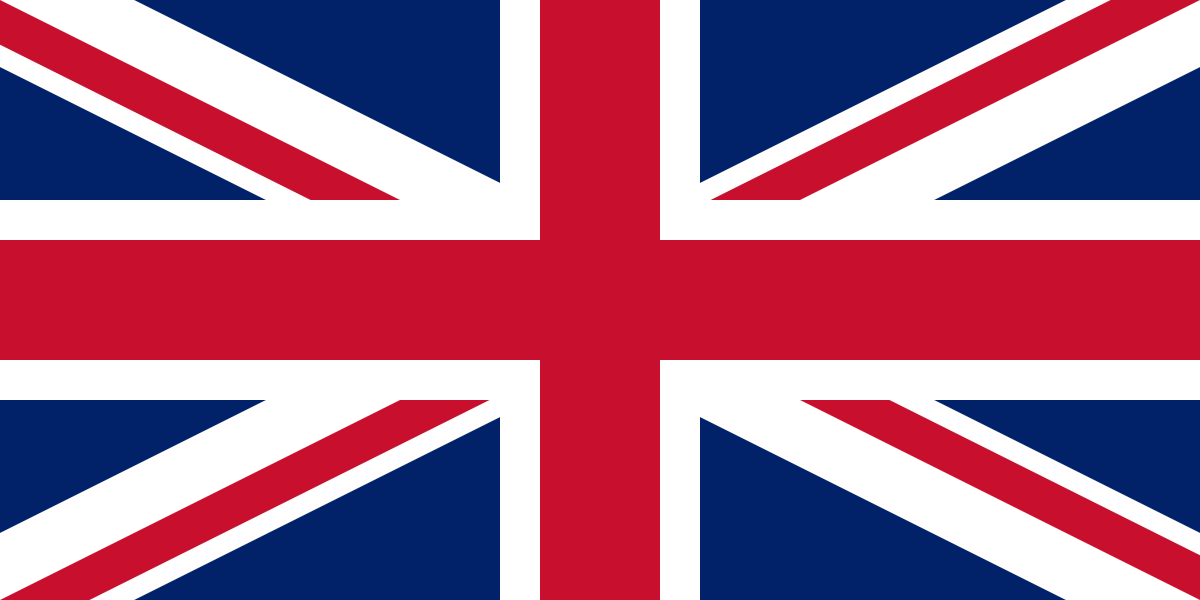
The Union Jack is the National Flag of the United Kingdom of Great Britain
and Northern Ireland, not the flag of England itself.

      What my timeline hopes to achieve is a greater understanding of the relationship between the separate kingdoms and monarchies of England and Scotland, and how the distinct entities became one and the same. It also explains why Elizabeth II is not Queen of England or Queen of Scots because both of those titles became extinct and were abolished upon the union of 1707. She is Queen of the United Kingdom of Great Britain and Northern Ireland (or more simply, Queen of the United Kingdom, Queen of the UK, Queen of Great Britain  and Northern Ireland, Queen of Great Britain, or Queen of Britain), and has only ever been addressed and titled as such. 

     To Elizabeth II the Queen of England shows an ignorance to the fact that England is a part of the United Kingdom, along with Northern Ireland, Scotland, and Wales, and makes it appear as though those areas are nothing more than appendages of England, which is an idea that is patently offensive to people who live in those areas. In general terms, the Northern Irish, Scots, and Welsh view the English as their fellow British countrymen and women, and look to Elizabeth II as their queen. 

     Last year during the Olympics, all of the peoples of Britain came together to support Team GB regardless of what part of the UK the individual athletes came from. However, the Northern Irish, Scots, and Welsh do not appreciate being lumped in as being "English." A recent example of this occurred back in June of this year when Andy Murray - a Scot - became the first British man since 1936 to win at Wimbledon, and the New York Times referred to him as "English," which created a backlash among Scots and people of Scottish descent before it was corrected. 

     Certainly, England has been confused with the UK for a long time, but there has been an increasing awareness of the non-English peoples of the United Kingdom as an integral part of Britain's past, present, and future. When it comes to the monarchy, most timelines I have seen feature only the English monarchs, and tend to ignore the unions that took place in 1603, 1707, and 1801. Even the monarchs after the 1707 Anglo-Scottish union are sometimes referred to as "King and Queens of England", which is not correct.

Map of the United Kingdom and its constituent parts:
England, Northern Ireland, Scotland, and Wales

     This is why producing the timeline was important to me. I want to show that Prince George is destined to be the successor of British monarchs going back to 843 A.D. with Kenneth MacAlpin in Scotland and 871 A.D. with Alfred the Great of England (which further shows the mistake of counting back only to William the Conqueror since English monarchs existed before his 1066 conquest). 

     Indeed, it can be argued that I could have gone further back, but to do so would introduce the fact that England and Scotland were made up of several smaller petty kingdoms. Kenneth I founded a dynasty that would preside over the unification of Scotland into a single state, just as Alfred the Great had a similar effect in England.

     Eventually, England (with Wales) merged with Scotland to become Great Britain, and English and Scottish monarchs became British monarchs. According to my count, Prince George will be the 61st monarch since Kenneth I of Scotland as well as the 61st monarch since Alfred the Great of England. 

     As have said before, this project became more complex and detailed by the day. First, at the completion of the timeline itself, there was an abundance of excessive space in the areas where I had named the royal houses of the monarchs. So I decided to fill up such space with illustrations of the royal coats of arms, emblems, and shields used by successive monarchs over the centuries (courtesy of Sodacan on Wikipedia), as well as illustrations of the national flags of England, Scotland, Great Britain, and the United Kingdom. 

     When that was done, I realized that I perhaps needed to provide explanations for these illustrations, which resulted in an appendix containing detailed information on these various symbols of the British nation and monarchy. Then, another appendix was creating which listed the top ten longest reigning monarchs on British history, complete with images of the kings, queens, and princes who served for 40 or more years. 

     After finishing that, there was still some space on the margins of the Microsoft Excel sheet I was working on, which resulted in the placement of the anthems and patriotic songs of the nations of the United Kingdom, as well as the UK National Anthem, God Save the Queen

     Along the way, many modifications and adjustments had to be made to keep the timeline, text, and images as proportional as possible and without ruining the basic outlines and structure of the timeline, which meant a lot of trial-and-error to ensure that what I saw on the spreadsheet also appeared when I converted it to a PDF format.

     I must stress that the earlier history of Britain, its monarchy, and symbols can be cloaked in a mixture of legend and fact. I tried to base what I said in the timeline on as much fact as possible by explaining legends but also establishing known truths. But like most things in early history, myth, fact, and legend can often be inseparable.


     That being said, I hope that this timeline will help to view the British monarchy in a different light, with it being as much a Scottish institution as an English one. The Scottish and English monarchs (and their respective royal houses) are listed side-by-side before becoming a single British entity. With all of the illustrations and information packed into it, I hope the Timeline can lead to a better of understanding of British royal and national symbols, as well as the history of the monarchy itself and how it came to be. 


   Without further ado, here is my 


     In order to view it correctly, click on the above link, and once the page is loaded, click on the printer symbol below the "File,View, Edit, and Help" tabs, or press the "CTRL" and "P" together. Either of these actions will operate the“Print (PDF)” function. A window prompt may ask you to send the document to a printer. Just click “No” or "Cancel" so you can view the Timeline. If that does not work, you may click "File" and then "Download" to view the timeline. If you are using a mobile device, you may need to use desktop settings to access these controls.

     You can also choose to view the Timeline as it is on the main Google Docs page, but be warned that the process of uploading to Google Docs resulted in the quality of the images being substantially reduced and the text formatting changed from "Times New Roman" to "Arial". I could not find a way to rectify this (and it appears this an ongoing issue for Google Docs). That is why I provided the instructions above to ensure that you see the Timeline properly, and fully appreciate the work that was put into it. 

Photo Credit: Matt Lewis via Wikimedia Commons cc