Showing posts with label Scottish monarchs. Show all posts

Thursday, March 27, 2014

Royal Profile: Charles I of England, Scotland, and Ireland


     King Charles I of England, Scotland, and Ireland was born on November 19, 1600 at Dunfermline Palace, Dunfermline, Scotland.

     He was the second son of James VI of Scotland and Anne of Denmark. His father ascended to the thrones of England and Ireland as James I following the death of Elizabeth I in 1603, becoming the first Stuart king in England and Ireland, as well as the first person to reign over all of Britain. A sickly child, Charles was left behind in Scotland when the rest of his family moved down to London, and was not expected to become king, for that was a destiny reserved for his older brother, Henry Frederick Stuart.

     However, Henry’s death as a result of typhoid fever in 1612 placed Charles in direct line to succeed his father, and he was made Prince of Wales in 1616. Charles eventually overcame his physical shortcomings, and became an avid sportsman, though he was not much taller than 5 feet, 4 inches (which incidentally is the same height of present Queen). He was also religiously devoted, artistically sophisticated, and serious in his academics.

     On March 27, 1625, Charles Stuart succeeded his father as king at the age of 24. Like James VI & I, Charles had a well-defined view of kings as being appointed directly by God, and therefore accountable only to God. James however, recognized how far he could go in imposing his will on Parliament and was a pragmatist in his political and religious dealings. Charles had not the political experience of his father, and he took the belief in divine right and in near-absolute authority much farther than his father had been willing to do.

     In England, the Parliamentarians challenged the king’s foreign policy in having the country involved in the religious struggles of continental Europe, which was being directed by George Villiers, Duke of Buckingham. When the King’s first two English Parliament’s attempted to remove Buckingham, he dissolved them and tried to rule alone, but soon had to call a new Parliament into session so he could obtain funds for his government.

Charles believed in his absolute right to rule in affairs of state and especially church.

     The issue of Buckingham was defused when he was assassinated in 1628, but then the more hotly-Protestant Parliamentarians attempted to force changes to religious policies which they viewed as too Catholic. Charles saw this as a direct challenge to his God-given authority as Supreme Governor of the Church of England, and dissolved his third Parliament. 

     He ruled alone through the 1630’s and relied on other means to raise funds without Parliament, including ship money (a tax placed on people living within 15 miles of the sea). This eleven year period did witness growth in trade and commerce, an expansion of the Royal Navy, peace with Catholic France and Spain, and Charles’s commissioning of great works of art by Anthony Van Dyck and Peter Rubens. But this relatively harmonious period ended with the issue that had started it: the religious policies of the King.

     Charles I was a High Anglican, meaning that he revered the elaborate rituals and symbolism that accompanied the worship service. These were rituals that were more or less carried over from the Catholic liturgy, but with a slight bent with respect toward the Protestant Reformation that had taken place in the previous century throughout Britain. But for some more radical Protestants (i.e., Puritans, Presbyterians, Separatists, etc.), these ceremonies were either too Catholic for their liking or offended them because of it being the state religion. Charles’s marriage to the French Catholic princess, Henrietta Maria, along with his acquiescence to allow her to worship openly and freely only caused more consternation.

     In Scotland, where the effects of the Reformation were more radical, Charles’s attempts to create uniformity of worship throughout Britain proved to be last straw. Here, he was not the supreme governor of the Presbyterian Church of Scotland (or Kirk). In fact, the Kirk was governed by assemblies of clergy, called presbyteries, and the King of Scots was hardly an exalted figure there, unlike in England. (James VI was referred to as “God’s silly vassal” by a Scottish clergyman named Andrew Melville). So when in 1637, Charles, in conjunction with the Archbishop of Canterbury, William Laud attempted to impose Anglican liturgy on the Kirk, it resulted in a religious revolt against the King. It led to the creation of the Covenanters who opposed royal interference in religion, and also started the Bishops’ Wars.

Statue of Charles I on his horse at Trafalgar Square, London.

     The King needed money to put down the rebellion in Scotland, so in 1640 he called his first English Parliament in eleven years, but the opposition led by John Pym in the House of Commons only matters worse. Pym used the parliamentary session to attack the king for his religious and financial policies of the previous decade, and succeeded in having some of Charles’s principal ministers, such as Archbishop Laud removed from office. Charles eventually gave into some concessions in England, such as giving up ship money, and decided to diffuse his Scottish issues by traveling up to Edinburgh to recognize the establishment of Presbyterianism.

     Meanwhile, John Pym’s support became shaky as some MP’s felt that his attacks on the King were going too far. Feeling (mistakenly) emboldened, in January 1642, Charles strode into the Commons to have Pym and four other members arrested on charges of treason (for he believed that some of them colluded with the Scots during the Bishops’ Wars). The five members escaped, but by entering the Commons, Charles broke constitutional precedence and confirmed the worldview of his opponents by appearing to be violent tyrant.

     This event resulted in the English Civil Wars and other conflicts, which along with the Bishops’ Wars, have become collectively known as the Wars of the Three Kingdoms (or the British Civil Wars), and they came to define the latter part of Charles’s reign.

     Twice, Charles and the Royalists were defeated by the Parliamentarian New Model Army, who merely wanted the King to come to the bargaining table with regard to issues of religion and control of the military. Charles, hard-lined as ever in his belief in the divine right of kings, refused the multiple offers made by the army for a new political and religious settlement, which among other things called for an end to enforced state religion.

     Instead, in 1647, he allied himself with the Scottish Covenanters, and it was agreed that a Scots army would invade England, crush the Parliamentarians, and restore Charles to his throne on the condition that he allow Presbyterianism to be established in England as in Scotland.

     King Charles and his Scottish army were defeated at the Battle of Preston in August 1648, and following it, the more radical Parliamentarians (a.k.a. Independents) led by Oliver Cromwell were no longer interested in making deals. They purged the House of Commons of the Presbyterians who wanted to make a deal with the King, leaving the “Rump Parliament” of 50 Independents which declared itself the supreme power of the land, with the power to make laws without the consent of the King or the House of Lords.

     As for Charles, he was put on trial for treason because of his use of arbitrary power for personal gain rather than for the national interest. At the trial in Westminster Hall, Charles refused to state his plea, believing that the tribunal was illegal because no court had jurisdiction over a monarch, but the court countered that his power to govern was limited “by and according to the laws of the land and not otherwise”, and that as such, he could be held on trial.

     That trial eventually convicted Charles and sentenced him to death by beheading, which took place on January 29, 1649 atop a scaffold outside of the Banqueting House of the Palace of Whitehall in the view of the public. Among his last words were: "I shall go from a corruptible to an incorruptible Crown, where no disturbance can be."

Depiction of the execution of Charles I.

     Following the execution, the head was sewn back onto the body, which was placed into a lead coffin and buried in the Henry VIII vault at St. George’s Chapel, Windsor.

     Charles’s legacy has been to show what happens when a monarch overplays his hand, and with the restoration of the monarchy in 1660, most of his successors have careful to rule within the laws and conventions established over the ages.

     Another legacy of King Charles was his patronage of the arts, and he amassed an enormous art collection. His purchased and commissioned works were sold off by Parliament during the Interregnum of the 1650's, though a substantial number of them were recovered for the Royal Collection.

     In the United States, there are several places named in honor of Charles I: the states of North and South Carolina, as well as Cape Charles, Charles River Shire, Charles City County, and the Charles River (which he personally named) in Virginia.


Photo Credit: Σπάρτακος via Wikimedia Commons cc, Elliot Brown via Flickr cc

Wednesday, March 26, 2014

Royal Profile: Malcolm III of Scotland

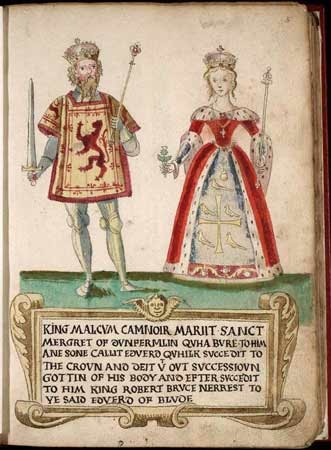
Depiction of Malcolm III and Saint Margaret of Scotland. History
also knows him as Malcolm Canmore (Gaelic for
great head' or 'chief).

     Malcolm was born in 1031 - possibly on March 26th - as the eldest son of Duncan I of Scotland and Queen Suthen.

     His father's reign was not successful, and it ended with the King's death at the hands of his cousin, Macbeth, who seized the throne for himself on August 15, 1040. Malcolm's family unsuccessfully attempted to overthrow Macbeth, and he was sent to a safe haven - possibly in England, at the court of Edward the Confessor.

     In 1057, he returned to Scotland, and at the Battle of Lumphanan in Aberdeenshire, he defeated and killed Macbeth, who was succeeded by his stepson, Lulach, until he too was killed by Malcolm on April 23, 1058. Malcolm was now King of Scots and he was crowned as such two days later at Scone.

     Before taking the throne, it is likely that the King had been married for some time to Ingibjörg, the daughter of a Norwegian nobleman, Finn Arnesson, who was an adviser to Olaf II and Harald III of Norway, as well as Sweyn II of Denmark. Ingibjörg was also the widow of Thorfinn Sigurdsson – the powerful Earl of Orkney. Because much of north and western Scotland was still under Scandinavian, Norse-Gael, and Gaelic control, this marriage helped to secure peace in those areas for King Malcolm. It also produced three sons: Duncan, Donald, and Malcolm.

     Meanwhile, events south of the border would greatly shape the course of Malcolm III's reign. The Norman Conquest of England led by William the Conqueror in the late 1060's and early 1070's resulted in Malcolm granting sanctuary to the Anglo-Saxon royal exiles, including Edgar the Ætheling, who had been elected as King of England after the death of Harold II at the Battle of Hastings and before the takeover by William I on Christmas Day 1066.

     In either 1070 or 1071, Malcolm III married for a second time (following the death of Ingibjörg) to Edgar's sister, Margaret of Wessex, with whom he had eight children. Their names marked a change from the Norse or Gaelic names (i.e., Malcolm, Cináed and Áed) that had been the established tradition previously for Scottish royalty, but also marked out their Anglo-Saxon heritage: Edward was named for Queen Margaret's father Edward the Exile, Edmund for her grandfather Edmund Ironside, Æthelred for her great-grandfather Æthelred the Unready, and Edgar for her great-great-grandfather Edgar and her aforementioned brother. The remaining children from this marriage were Alexander, David, Matilda, and Mary.

     King Malcolm may have believed that his marriage into Anglo-Saxon royalty and the Anglo-Saxon names of his children could have put him in a position to challenge William the Conqueror, or at least undermine his shaky authority by carrying out raids into England on land and sea without consequence. However in 1072, William I's position was strengthened by his Harrying of the North, and he rode to Scotland and forced Malcolm to sign the Treaty of Abernethy, which stipulated that in return for swearing allegiance to William, he was to be given estates in Cumbria, England.

     Nonetheless, Malcolm continued to conduct raids on northern England, with the hope of annexing the northern English counties and pushing Scotland's border further south. In 1080, William sent his eldest son Robert to deal with Malcolm, and a new peace deal was struck, which lasted for over a decade.

     During the reign of William Rufus (William II of England), the peace began to break down again in 1092, but an attempt was made to settle the disputes over lands and estates in Cumbria when a meeting was arranged between Malcolm and Rufus in Gloucester. This failed to materialize when Malcolm was informed that Rufus was not negotiating and that the dispute would be judged by English barons. Malcolm left for home angry and humiliated, and he proceeded to raiding the northern counties again.

     It was on his return journey from one of these raids that Malcolm was ambushed by Robert de Mowbray, Earl of Northumbria, whose lands had been devastated by Malcolm. This incident became known as the Battle of Alnwick, at which Malcolm III of Scotland was killed on November 13, 1093. He was initially buried at Tynemouth Priory, but was re-interred at Dunfermline Abbey next to his queen, Margaret (who was later beatified and is Scotland's only royal saint), during the reign of his son, Alexander I.

     Malcolm was immediately succeeded by his brother as Donald III, who in turn was succeeded by Malcolm's surviving sons - Duncan II, Edgar, Alexander I, and David I. His elder daughter Matilda would marry Henry I of England, and be an ancestor to the English Plantagenet dynasty, beginning with her grandson, Henry II.

      In terms of his legacy, Malcolm - despite his efforts - did little to change to political map of Britain. What he did achieve was the founding of a line of kings who would gradually remove Norse influence and power from Scotland. The royal dynasty to which he belonged, the House of Dunkeld, would rule Scotland for nearly 200 more years.

     Malcolm III of Scotland is a 26th great-grandfather of Elizabeth II of the United Kingdom.

Tuesday, March 25, 2014

Royal Profile: Robert I (the Bruce) of Scotland

Robert the Bruce, King of Scots

     Robert the Bruce was born on July 11, 1274 at Turnberry Castle in Ayrshire, Scotland as the first son of Robert de Brus, 6th Lord of Annandale and Margaret, Countess of Carrick.

     Descending from a noble family of Scoto-Norman and Gaelic stock, he was a fourth great-grandson of David I of Scotland through his father, who held lands in Dumfries and Galloway along the English border - which had been granted to his family by King David. On his mother's side, Robert inherited a Gaelic ancestry through the Earldom of Carrick, and in this mix of Anglo-Norman and Gaelic culture's (typical of southern Scotland and northern England), Robert probably spoke up to three languages: Anglo-Norman French, Gaelic, and early Scots.

     In 1286, Alexander III of Scotland died and the Crown was passed to his granddaughter and Norwegian princess, Margaret. Four years later, the seven year old queen died on the way to Scotland, which initiated a succession crisis during which several competitors lined up to lay their claims to the Scottish throne before Edward I of England, who arbitrated these claims on behalf of the Guardians of Scotland.

     Out of fourteen candidates, only four presented a serious claim to the throne, and one of them was Robert's grandfather - Robert de Brus, 5th Lord of Annandale. In the end, Edward judged in November 1292 that grandfather Robert's first cousin once removed, John Balliol, had a better claim and awarded him the Crown of Scotland.

     Within years, relations between Edward I and John Balliol broke down has Edward continued to assert his overlordship of Scotland. He agreed to hear appeals of cases from Scottish courts and demanded that Balliol appear before him to answer for charges in one particular case. However, the final straw came when Edward made further demands that Scottish nobles provide military service in England's war against France, which provoked the Scots into forming an alliance with the French (the Auld Alliance).

     In this early struggle, the Bruce's supported Edward, in part because they viewed Balliol as a usurper, and took refuge in Carlisle, England with the backing of King Edward. It was also around this time that younger Bruce (and future king) married his first wife, Isabella of Marr, with whom he had one child, a daughter named Marjorie.

A depiction of Robert Bruce with his first wife, Isabella of Marr.

     It was in Carlisle that the Bruce's were attacked in March 1296 by the Balliol-backed Comyn faction of Scottish nobles in what was one of the first blows in the Wars of Scottish Independence. Edward responded to this and the Auld Alliance by invading Scotland, crushing the resistance, and deposing John Balliol as King of Scots, who was taken as a prisoner to the Tower of London.

     Following this, Robert Bruce, 6th Lord of Annandale and Robert Bruce, Earl of Carrick (the future king) were among 1,500 Scots who swore fealty to King Edward, who set up an English administration in Scotland. Within a year however, a revolt broke out and the younger Bruce, aged 22 and possibly under the influence of the Stewart and Wishart families, joined in the patriotic cause against the English.

     Over the next decade, Bruce would change his allegiance several times as the political and military circumstances changed. During this period, he was appointed as a co-Guardian of Scotland, but left the post due to personal differences with a fellow Guardian and political rival, John Comyn. He supported Sir William Wallace's revolt against Edward I, but Edward's invasion of Scotland in 1303 resulted in the country being under his submission again, and all of the nobility - save for Wallace - swore fealty to him. Wallace himself was eventually captured in Glasgow and brought to London, where he was tried and executed. Meanwhile, another English-backed administration was set up, and nobles such as Bruce participated in it. However, King Edward distrusted him, which was reflected in the withholding of lands once promised to Bruce.

     Among the Scottish nobility as well, there were misgivings over Bruce due to his support for both sides in the conflicts. Chief amongst them was his longtime rival, John Comyn, who was more resolute in his opposition to the English, and like Bruce, held a claim to the still-vacant Scottish throne. In the late summer of 1305, Bruce and Comyn swore a secret deal in which Comyn agreed to forfeit his claim to the throne in favor of Robert Bruce upon receipt of the Bruce lands in Scotland should an uprising occur led by Bruce.

The killing Comyn by Bruce
(Engraving by
Henri Félix Emmanuel Philippoteaux)

     At some point, it is believed that Comyn divulged the details of this deal to King Edward, who then moved to arrest Bruce whilst he was at the English court. Bruce received a tip-off about his impending arrest, and fled back to Scotland, where he confronted Comyn in a fateful meeting at the Chapel of Greyfriar's Monastery in Dumfries on February 10, 1306. There, Bruce accused Comyn of treachery and killed him before the High Altar.

     Having crossed this Rubicon, Bruce pressed his claim to the Scottish throne, and six weeks later, he was crowned King of Scots at Scone by Bishop William de Lamberton on March 25, 1306. Traditionally, a member of Clan MacDuff performed the crowning of the monarch, but the closest member of the clan in support of Bruce, Isabella MacDuff, Countess of Buchan arrived too late for the ceremony. A second coronation ceremony was held he next day, in which MacDuff crowned the new King, so as to head off charges of ceremonial irregularity, which could have placed his throne at risk.

A tableau depicting King Robert being crowned at his second coronation by Isabella MacDuff.

     The actions of King Robert resulted in his excommunication by Pope Clement V, and Edward I marched north yet again to bring Robert to account and establish overlordship of Scotland. He defeated Robert at the Battle of Methven in June 1306, seized Robert's lands and gave them to his adherents. Robert and group of nobles fled to the Hebrides, but as fate would have it, Edward I of England - the Hammer of the Scots - died aged 68 on July 7, 1307, and was succeeded by his son, Edward II.

     King Robert and his forces returned to mainland Scotland a few months before Edward's death, and began conducting a fierce guerrilla campaign against the English armies, resulting in significant victories at Glen Trool and Loundon Hill. From there, Robert led another campaign across the west and north of Scotland - defeating his Comyn enemies and their allies, laying waste to their lands, and destroying their significant power base, which was always an obstacle to the King's ambitions.

     In March 1309, King Robert held his first Parliament at St. Andrews and had achieved control over Scotland north of the River Tay by August. His position was further strengthened when the Scottish clergy - in spite of the excommunication by Clement V - acknowledged Robert as the rightful King of Scots.

     Over the next five years, Robert and his nobles not only recaptured English-occupied territories and defeated English forces and their Scottish sympathizers, but they also began making raids into northern England and other places of strategic importance. In the spring and summer of 1314, they gained control of both Sterling and Edinburgh castles.

Statue of King Robert on his horse at Bannockburn.

     Under Edward II, the English attempted to recover their position at Bannockburn. The odds were in their favor as the English army was twice the size of King Robert's forces, but they found themselves decisively routed by the Scots and retreated after two days. This significant battle all but secured Scotland's independence, and to this day, remains a pivotal moment in the history of Scotland in particular and Britain in general.

     From here, Robert initiated more raids in northern England - particularity wreaking havoc in Lancashire and Yorkshire. He also attempted to open a second front in Ireland, where he hoped to forge a pan-Gaelic alliance against English rule. Robert certainly had Gaelic Irish lineage on his mother side, and his second wife (Elizabeth de Burgh, whom he had married in 1302 following the death of Isabella of Marr) came from a noble family that held the Earldom of Ulster in present-day Northern Ireland. However, many chiefs in the southern parts of Ireland did not distinguish between English occupation and Scottish occupation, and were only too glad when Edward Bruce - King Robert's brother - was defeated and killed at the Battle of Faughart 1318, which largely ended the Irish part of these Anglo-Scottish conflicts.

     Two years later, the Declaration of Arbroath was submitted to Pope John XXII. It was a statement of Scotland's independence, and sought the pontiff's recognition of that independence, as well as the lifting of his predecessors excommunication of King Robert for his murder of John Comyn. The Pope initially heeded the document, but was later persuaded to take the English side under Edward II. Robert continued his raids into northern England, partly in response to Edward allowing privateers to attack and seize vessels trading with Scotland.

     Following their defeat at Weardale, the English - having deposed Edward II and now under the governance of his wife Isabella and her lover, Roger Mortimer in the name of Isabella and Edward's son, Edward III - sent envoys to Scotland to open peace negotiations. This resulted in the Treaty of Northampton-Edinburgh of 1328, which recognized Scotland as an independent kingdom with King Robert and his heirs and successors as rightful rulers, and established the Anglo-Scottish border as it had been under Alexander III. The Treaty was signed by Robert in Edinburgh on March 17th, and ratified by the English Parliament on May 3rd. With Scotland's independence came the lifting of the papal excommunication of Robert I in October of that same year.

     However, the recognized King of Scots would not live long in his moment of triumph. For at least the past year, he has suffered from a medical condition which may have been tuberculosis, syphilis, or strokes. In the spring of 1329, he held his final council at his bedside, during which he made gifts to religious houses and orders, and repented for not going on a crusade in the Holy Land.

     On June 7, 1329, King Robert died aged 54 at the Manor of Cardross near Dumbarton, having achieved the recognition of the Bruce claim to the Scottish throne.

The eastern tower of Dunfermline Abbey, where King Robert is buried.
Atop the tower are the carved letters: KING ROBERT THE BRUCE

     In accordance to his wishes, his heart was removed so that it could be taken on a crusade, but this never materialized, and the heart was brought back to Scotland, where it was buried at Melrose Abbey in Roxburghshire, also in pursuant to the King's instructions. His body was embalmed and buried at Dunfermline Abbey beneath the High Altar beside his queen, Elizabeth de Burgh.

     Robert I was succeed by his and Elizabeth's only surviving child as David II of Scotland at the age of five. He died without an heir, and was succeeded by his nephew, Robert Stewart - son of Marjorie Bruce (Robert I's daughter via his first wife, Isabella) and Walter Stewart, 6th High Steward of Scotland - as Robert II, inaugurating the Royal House of Stewart/Stuart.

     King Robert's descendant's include all subsequent monarch's of Scotland, and after the accession of James VI to the English throne in 1603, all monarch's of England, Great Britain, Ireland, and the United Kingdom, including the reigning queen, Elizabeth II, who is his 19th great-granddaughter.


Photo Credit: Kim Traynor via Wikimedia Commons cc, Joe Thomissen via Flickr cc, Dave Conner via Flickr cc 

Wednesday, March 19, 2014

Royal Profile: Alexander III of Scotland

Statue of Alexander III above the West Door of St. Giles Cathedral in Edinburgh

     Alexander was born in Roxburgh on September 4, 1241 as the only son of Alexander II and his second wife, Marie de Coucy. His grandfather was William I (the Lion), one of Scotland's longest-reigning and most illustrious monarchs.

     At the age of seven, Alexander's father died and he succeeded to the Scottish throne as Alexander III on July 6, 1249, and his coronation was held one week later at Scone on Moot Hill.

     His early reign as King of Scots was dominated by a power struggle between the two regents who governed in his name: Walter Comyn, Earl of Menteith, and Alan Durward, Justiciar of Scotia, who eventually patched their difference and agreed to the establishment of a regency that was representative of both men and their factions. On Christmas Day 1051, Alexander was knighted at York by Henry III of England and was married to his daughter, Margaret. The new father-in-law attempted to extract homage from Alexander, so as to recognize Henry as his overlord, but to no avail.

     In 1262, King Alexander reached his majority at the age of 21, and took personal possession of his kingdom. He pledged to continue the program launched by his father to lay claim to the Western Isles (off of Scotland's western coast) from Norway. Hakkon IV of Norway rejected this claim and mounted an invasion force off the coast of the Isle of Arran in 1263. Alexander outwardly sued for peace by calling for negotiations over the future of the Isles, but shrewdly waited until the autumn (with usually bad weather) could begin. Hakkon attacked, and as Alexander expected, a storm came through which damaged the Norwegian fleet and undermined Hakkon's position. Nevertheless, the Norwegians went forward and engaged with the Scots at the Battle of Largs in Ayrshire.

The thistle became Scotland's floral emblem during Alexander's reign

     Prior to the battle taking place, it is believed that the Norwegian soldiers attempted to sneak up on a Scottish encampment by taking their shoes off to reduce noise. One of the soldiers stepped on a prickly thistle and yelled out in pain, resulting in the Scottish soldiers being alerted to the advancing Norsemen. Regardless of the veracity of this account, what is true is that this battle lead to the defeat of the Norwegians and Hakkon was forced to give up the Western Isles and the Isle of Mann to Scotland under the Treaty of Perth of 1266. It is also possible that King Alexander adopted the thistle as Scotland’s floral emblem following the conflict.

     The rest of Alexander's reign was marked by relative peace and prosperity in Scotland. He established good relations with his brother-in-law, Edward I of England, and with his wife (and Edward's sister) Margaret, he attended Edward's coronation at Westminster Abbey on August 19, 1274 . Alexander may have also attended a sitting of the English Parliament as a guest of Edward.

King Alexander seen here as a guest of King Edward at the Parliament of England.

     Alexander III and Queen Margaret had three children: Margaret (who married Eric II of Norway), Alexander, and David, and all three preceded the death of their father. The Queen also died in 1275, and following the death of Prince Alexander in 1284, the Parliament of Scotland voted to make the King's granddaughter, Margaret, the Maid of Norway, his heiress presumptive. 

     At the age of 44, Alexander remarried to Yolande de Dreux - daughter of the Count of Dreux - in the hope of fathering another direct male heir, but he himself perished in a riding accident when his horse stumbled and he fell from a cliff near Kinghorn, Fife on March 19, 1286.

     Upon his death, Margaret, Maid of Norway became Queen of Scots - and the first queen regnant of the British Isles - at the age of three, but died in transit to Scotland four years later. This triggered a succession and constitutional crisis, which resulted in John Balliol ascending to the throne after the adjudication of his and other nobleman's claims by Edward I of England and the Guardians of Scotland.

     Alexander III was buried at Dunfermline Abbey along with his first wife and two sons. His successful and relatively peaceful reign was replaced by more than four decades of political instability, which included the failed reign of John Balliol, English occupation, and the Scottish Wars of Independence. His loss was lamented in the following poem by Andrew of Wyntoun:

Quhen Alysandyr oure kyng was dede,
That Scotland led in luve and le,
Away was sons of ale and brede,
Of wyne and wax of gamyn and gle.
Oure gold was changed into lede,
Cryst, born into vyrgynyte,
Succoure Scotland and remede,
That stat is in perplexyte.


Photo Credit: Kim Traynor via Wikimedia Commons cc, Sodacan via Wikimedia Commons cc


Wednesday, March 5, 2014

Royal Profile: David II of Scotland

David II, the second and last monarch of the House of Bruce

     On this day in 1324, David II of Scotland was born at Dumfermline Palace in Fife as the only surviving son of Robert I of Scotland (the Bruce) and his second wife, Elizabeth de Burgh.

     Not much is known about David Bruce's early life, except that his mother died when he was three years old, and that he was married to the English princess, Joan - the youngest daughter of Edward II - on July 17, 1328. This marriage was one of the terms of the Treaty of Edinburgh-Northampton, in which England guaranteed Scotland's independence.

     Nearly a year later at the age of five, David succeeded to the Scottish throne upon the death of his father as David II, and he and Joan were formally crowned King and Queen of Scots on November 24, 1331.

     As a minor, David could not rule on his own, and so a series of Guardians were appointed to govern Scotland in his name, including his nephew, Robert Stewart, High Steward of Scotland (who was eight years his senior). The English took advantage of the situation, and backed the claim of Edward Balliol, the son of John Balliol, who was the Scottish king best remembered for his weakness and incompetence against Edward I of England during the Wars of Scottish Independence. The younger Balliol invaded Scotland in 1332 and overthrew King David, who was restored to the throne within a year. But following the Scottish defeat by Edward III of England (David's brother-in-law) at the battle of Halidon Hill, the King fled with Queen Joan to France, where they were received by Philip VI.

     In 1341, Robert Stewart and other nobles gained the upper hand in Scotland and it was deemed safe for David to return. He reached his majority the following year and for the first time, was able to take personal possession of his kingdom. However in 1346, he invaded England in support of his French allies (as part of the Auld Alliance), was captured at the Battle of Neville's Cross, and for the next eleven years, was a prisoner of Edward III at several locations, including the Tower of London and Windsor Castle. The King was allowed to return home only after the Scottish Parliament agreed to pay a ransom of 100,000 marks (10,000 per year) to England, under the terms of the Treaty of Berwick.

     The ransom proved to be difficult to pay, even with high rates of taxation, so King David attempted to keep the peace with King Edward by pushing for a Plantagenet (English) heir to Scottish throne, but the Scottish nobility - his nephew and heir Robert Stewart among them - rejected such proposals. Even so, he mistrusted Stewart, and having had no children via the deceased (in 1362) Queen Joan, he remarried to Margaret Dummond, but this union also failed to produce an heir to the throne.

     And so it was that when King David died in 1371, he was succeeded by Stewart as Robert II of Scotland.

     David II had reigned for 41 years, making him the 10th longest-reigning monarch in British history. His main legacy was the strengthening of the Scottish Crown and the reform of the government, which helped to bolster the royal finances and his kingship. This program of consolidating power and the making of Scotland into a modern nation-state was further progressed by Robert II and his successors of the House of Stewart.

     King David is an 18th great-uncle of the reigning monarch, Elizabeth II of the United Kingdom.

Saturday, February 22, 2014

Royal Profile: Robert II of Scotland


Robert II of Scotland

     On this day in 1371, Robert Stewart, Earl of Strathearn ascended to the Scottish throne as King Robert II – the first Stewart monarch of Scotland.

     He was the son of Walter Stewart, 6th High Steward of Scotland and Marjorie Bruce, the daughter of Robert the Bruce, the Scottish king who had decisively defeated Edward II of England and his army at Bannockburn in 1314 as part of Scotland's quest for independence.

     Robert Stewart's early life was mostly occupied by conflict with England. Scotland’s independence was recognized in 1328, but the English – led by Edward III – continued to exert influence on Scottish affairs and backed the claim of Edward Balliol, the son of John Balliol, who was the Scottish king best remembered for his weakness and incompetence against Edward I of England during the Wars of Scottish Independence. At times during this period, Stewart was a Guardian of Scotland during the minority of his uncle, David II (who was eight years his junior), which meant that he was the de facto head of state in Scotland. He was also a Guardian when the King was held captive by the English following the Battle of Neville’s Cross.

     At the time of his accession as King of Scots, Robert II had already begun a program of centralizing power to the Scottish Crown and to end the feudal strife that had stopped Scotland from advancing as a modern state. This aim of consolidation and building up Scotland continued as Robert II had his nobles gradually recapture land still dominated by the English, ended trade with England, and renewed the strategic alliance with France known as the Auld Alliance. However, King Robert wished to avoid all-out war with England, and when the English and French entered into peace negotiations, he wanted to be a party to it. This move was unpopular with the Scottish nobility, and he faced a mutiny that included his own sons, and which resulted in the King having his power stripped away.

     Robert II died in 1390, and was succeeded by his eldest son, John Stewart, Earl of Carrick as Robert III of Scotland.

     One of his lasting legacies is the establishment of the House of Stewart, which continued to preside over Scotland’s transformation from a loose collection of fiefdoms to a unified and modern nation-state. Power was consolidated to Edinburgh as the Scottish Crown gained more authority and influence over the nobility, especially in areas populated by Scandinavians and Gaels.

British Royal Coat of Arms under Queen Anne, the last Stuart monarch

     In 1603, the Stuarts extended their dominion with the accession of James VI to the thrones of England and Ireland as James I, thanks to the 1503 marriage between James IV and Margaret Tudor (the eldest daughter of Henry VII of England and sister to Henry VIII), which made King James the closest living Protestant relative of the childless Elizabeth I. The Stuart dynasty would rule the Anglo-Celtic (British) Isles until 1714 upon the death of Queen Anne, during which significant advances in the arts and sciences took place, and institutions such as the Royal Mail and the Royal Society were established.

     Altogether, the House of Stewart/Stuart reigned for 343 years – longer than any other royal house in British history, and it produced fourteen monarchs (though an eleven-year interregnum occurred in the 1650’s, during which monarchy was abolished as a result of the Wars of the Three Kingdoms). By the end of the Stuart period, England and Scotland had been formally and politically united into the Kingdom of Great Britain.


Photo Credit: Sodacan via Wikimedia Commons cc