Today is St. David's Day, and it is a national day of celebration in Wales.
Saint David is the patron saint of Wales - one of the four patron saints of the British – or Anglo-Celtic– Isles (with the other ones being St. Andrew for Scotland, St. Patrick for Ireland, and St. George for England).
Stained-glass window featuring St. David at the Jesus College Chapel at Oxford
He was born in Wales, and began his ecclesiastical career as a teacher and preacher, and he became widely known throughout the Celtic world. David would go on to found monastic settlements in Brittany, Cornwall, and his native country. There, he established a Celtic monastic community at Glyn Rhosyn in Pembrokeshire, where St. David's Cathedral stands today. Among his well-known miracles was that of causing the ground to rise into a small hill at the spot where he had preached before a large crowd in the town of Llanddewi Brefi, and he eventually became a bishop. St. David lived by example, and had a simple lifestyle which included refraining from meat and alcohol, engaging in prayer, and disavowing personal possessions.
At the time of his death on March 1, 589, he was said to be 90-100 years of age, and was buried at the cathedral that bore his name, where a shrine was erected. The shrine was vandalized by Viking invaders, but was rebuilt in 1275, though its decorative elements were stripped during the Protestant reformation.
St. David's Day celebrations at Cardiff Bay
Commemorations for St. David's Day go back several centuries, but it was not until 2000 that the devolved National Assembly for Wales unanimously voted to make it a public holiday, though it is not a bank holiday where most people officially have the day off.
Parades are held throughout Wales in commemoration of St. David's Day, and the largest of these take place in the Welsh capital city of Cardiff, which is usually attended by the monarch of the United Kingdom or the Prince of Wales.
Charles, Prince of Wales on a visit to Wales
On Friday of this year, Prince Charles visited the Queen's Dragoon Guard's (of which he is Colonel-in-Chief) and watched them conduct training exercises prior to deployment to Afghanistan. He also visited Old Town Hall in Merthyr Tydfil, which is being opened today as an arts and crafts center after an extensive renovation. The visits were made on Friday since St. David's Day falls on a Saturday this year, and the Prince is now spending a private weekend in Wales.
In addition, people take part in eisteddfodau - a Welsh festival of literature, music and performance - and some of the Welsh regiments in the British Army conduct a military tattoo.
Celebrations of the day often include the use of Welsh emblems, such as the leek and daffodil, as well as the flag bearing the cross of St. David - a gold cross against a black field. In 2012, the shrine of St. David was restored again, and rededicated on the patron saint's day that year.
Prince Charles, Prince of Wales will be in Shobdon, Herefordshire to visit the Church of St John the Evangelist.
He will also be in Powys for two engagements. In Presteigne, the Prince of Wales will pay a visit to the Judge's Lodging - a lodging house and shire hall that was once used by judges, but is now a converted museum that offers a view into the Victorian world. At Hay-on-Wye, he will stop by the Maesyronnen Chapel as Patron of the Landmark Trust, a conservation charity that rescues buildings of architectural and/or historical merit and which administers the cottage attached to the Chapel.
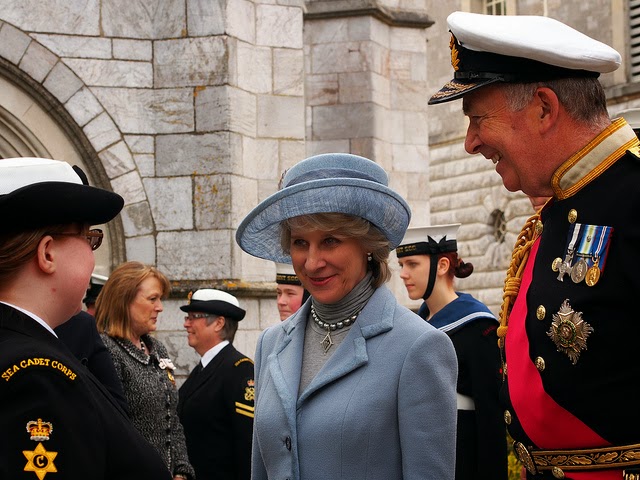
HRH The Duchess of Gloucester
Birgette, Duchess of Gloucester is in the United States. As Honorary President of the Lawn Tennis Association, she will be attending the Davis Cup - the premier international tournament for men's tennis - in San Diego, California through the weekend. Today is Day 1 of the first round. Photo Credit: Victoria
Johnson via Flickrcc and Richard Gough
via Flickrcc
Charles and Camilla visiting a synagogue in Budapest, Hungary in 2010.
The Prince of Wales and Duchess of Cornwall
continued to increase their profile as future king and queen. Their appearance
alongside the Queen at the State Opening of Parliament in May was a clear sign
that Charles is indeed her heir, and that there is no chance of him renouncing
his right to the throne. This comes at a time when more of the Queen’s
ceremonial functions, such as conducting investitures and meeting foreign
dignitaries, are being carried out by the Prince in her stead – creating an
unofficial co-regency of sorts.
In the spring, Charles and Camilla represented the Queen at
the inauguration of the Dutch king,
Willem-Alexander, as well as at the enthronement of the 105th Archbishop
of Canterbury, Justin Welby. In the fall, he and the Duchess took a
nine-day tour of India, where they were warmly received by the people of the
Commonwealth’s largest country which was once the jewel in the crown of the old
British Empire, and it was here where Prince Charles celebrated his 65th
birthday on November 14th, which means that he will be oldest person to accede
to the throne whenever that day should come.
In Sri Lanka, he again stood in for his mother as Head of
the Commonwealth when he opened and attended the Commonwealth Heads of
Government Meeting (CHOGM). As heading up the 53-member Commonwealth of Nations
is not a hereditary position, the appearance at CHOGM may have represented the
Prince’s attempt to convince Commonwealth leaders that he ought to succeed to
the title held by his mother for 61 years.
On top of all this is the Prince carrying out his own
activities and engagements, sometimes on the behalf of the charities,
foundations, and trusts he has created over the years, and he has kept himself
busy by attending to his wide variety of causes, including the environment,
urban regeneration, architecture, and protection of the British countryside.
As for the Duchess of Cornwall, she has been coming into her
own as an integral part of the royal family. She has been conducting engagements
on her own with ease, and has developed a passionate interest in causes such as
literacy and arthritis research. In
the time she has been married to Prince Charles, Camilla has earned the respect
and affection the people through her own brand of regal warmth and openness.
She is not a replacement for Diana - no one can replace her, not even the
Duchess of Cambridge - but she is certainly showing that she is worthy of being
the nation’s next Queen.
Duke and Duchess of Cambridge and Prince
George
William and Kate riding in a carriage procession during the Diamond Jubilee celebrations last year.
It can be fair to
say that the Duchess of Cambridge was probably the most-photographed woman in 2013. The media attention to her pregnancy, as well as what she wore and how
she looked during the pregnancy was unrelenting and frankly nauseating.
Nevertheless, Kate took it in stride and gracefully carried on with her duties
and responsibilities as a member of the royal family. Among other things, she became
volunteer leader with the Scout Association in North Wales, and expanded her patronages
to include the Natural History Museum and SportsAid, a charity that helps to
provide financial assistance for aspiring young athletes.
Meanwhile, Prince
William continued to carry out his duties as a Royal Air Force search-and-rescue pilot in
Anglesey, Wales, and also took on greater amounts of royal workload. He and
Kate visited Scotland, where they teamed up with Prince Charles for a joint
engagement, and took part in activities leading up to the 2014 Commonwealth
Games being held in Glasgow. Along with Prince Harry, they also toured the
Harry Potter film set at Leavesden Studios. In November, Prince William took part in a sing-a-long of Livin' On a Prayer with Taylor Swift and Bon Jovi.
But of course, the
highlight for William and Kate was the birth of their first child, Prince
George of Cambridge on July 22, 2013, which was a joyous moment for them, the
royal family, the British nation, and the world. From the time that birth was
announced,
The world's first look at Prince George.
there were expressions of celebration and happiness for the newest
member of the royal family and the future king of the Commonwealth realms. Amid
all of the fanfare surrounding the occasion, it is difficult to remember that
George is a baby not unlike many others born that day and that William and Kate,
though not ordinary parents, will face challenges in raising George like most
other parents. Of course, George will grow up under an intrusive media
spotlight, but then again, it is clear that his parents want him to live as
normal a life as possible. This is probably why the first official photograph
was taken by Michael Middleton, Kate’s father, at the Middleton family home in Bucklebury,
Berkshire – as opposed to a professional photographer at the Palace.
In October, the
little prince was baptized into the Anglican Church inside the Chapel Royal at
St. James’ Palace by Justin Welby, Archbishop of Canterbury. Wearing the replica
of the christening gown worn by every royal baby since Queen Victoria’s first
child, Victoria in 1840, Prince George was said to have gone through the brief
ceremony without a hitch. Afterward, professional photographs were taken at
Clarence House with George and members of his immediate family, including his
uncles, aunt, parents, grandparents, and great-grandparents. Importantly, for
the first time since Queen Victoria in over a century, there is a photograph featuring the
reigning monarch and three generations of heirs in direct succession.
With the birth of
Prince George and the increasing royal workload resulting from the Queen and
Duke of Edinburgh cutting back engagements, Prince William decided to leave
active duty in the Armed Forces at the end of his commitment for the
search-and-rescue job – having been involved in the rescue of 149 people. In
October, he stood in for the Queen at an investiture in which he knighted two
people, and made tennis player Andy Murray an Officer in the Order of the
British Empire (OBE). William, Kate, and
George have since taken up residence in Apartment 1A in Kensington Palace
(which formerly belonged to Princess Margaret) as they begin their lives in transition to becoming full-time working members of the royal family.
In the coming year,
it has been announced that they will be taking a tour of Australia and New
Zealand in April, and they are expected to expand their charitable activities.
Prince Harry
Prince Harry meeting U.S. Senator John McCain of Arizona
At the beginning of
the year, Prince Harry returned from his 20-week tour of duty in Afghanistan,
and was criticized for comparing life on the battlefield to the war games he
played on the X-Box game console and for saying that to save a life, sometimes
another life has to be taken.
This came on the
heels of the Prince’s nude romp in Las Vegas during the previous summer, and
raised questions about his judgement (with Harry admitting that he was probably being "too much army, and not enough prince"). It also
sparked some debate over the issue of royal finances, and whether the taxpayer
should continue to fund the activities of the monarchy.
However, the rest
of the year was bright for Prince Harry as he proved his worth as a member of
the royal family and as an individual.
In May, he visited
the United States for a week to conduct engagements on the behalf of his
charities and of the UK government.
It was a packed
week in which Prince Harry toured an exhibition on landmine clearance - a cause championed by his mother, Diana - in
the U.S. Capitol Building with fellow military veteran, Senator John McCain and visited the White House,
where First Lady Michelle Obama was hosting a Joining Forces Mother's Day Tea
to honor military mothers. He also paid his respects to the military dead at
Arlington National Cemetery and visited the Walter Reed National Military
Medical Center to meet wounded veterans going under recovery and
rehabilitation.
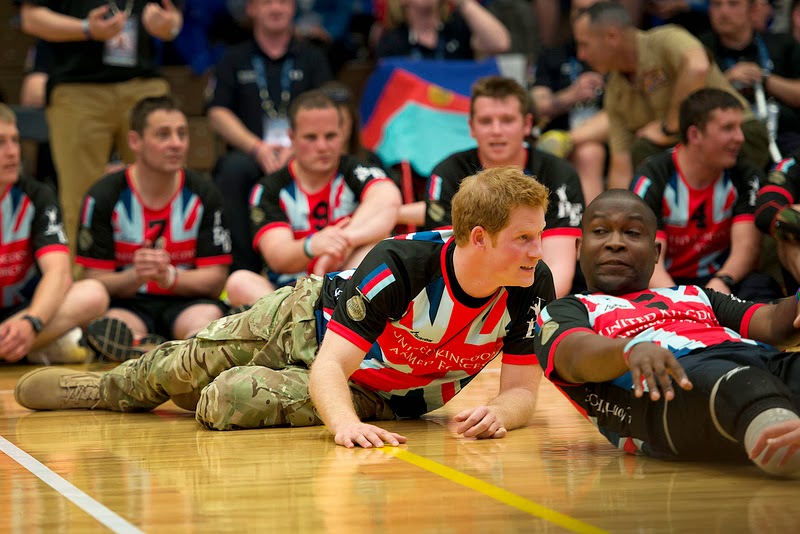
He then traveled to Colorado Springs, where he opened the
2013 Warrior Games at the US Air Force Academy. The Games were created as a way
help injured service members recover and to introduce them to Paralympic sports
and one of its partners is the Royal Foundation of the Duke and Duchess of
Cambridge and Prince Harry. In addition to opening the games, the Prince took
part in a volleyball match with the British team.
In Colorado, the Prince played sit-down volleyball with wounded veterans.
Flying back to the East Coast, he teamed up with UK Prime
Minister David Cameron in New York City at an event to promote the GREAT
campaign, which aims to boost trade and investment in the United Kingdom. Harry
then visited Harlem, where he played baseball (at hit a home run) with a local
community sports program that is in partnership with the Royal Foundation.
In New Jersey, he toured the hard-hit areas of the Jersey
Shore that had been affected by Hurricane Sandy in the previous year, and
commented on the rebuilding projects by saying: “It’s the American spirit,
isn’t it? Everyone getting together and making things right. It’s fantastic.”
Accompanied by Governor Chris Christie, Prince Harry walked along the Atlantic
City Boardwalk and tried his hand at a few carnival games.
At the end of the US tour, he played a game of polo in
Greenwich, Connecticut to raise funds for his charity Sentebale, and expressed
his appreciation for “a wonderful week” and “the extraordinary generosity of
the people of this great nation.”
In October, he attended the International Fleet Review
during his first official visit to Australia. There, he represented the Queen
of Australia and took the salute of the fleet review, which consisted of 40
warships from 17 countries, and which was held to commemorate 100 years since
the arrival of the Royal Australian Navy's first modern warships in Sydney. During
the two-visit, he was greeted by enthusiastic crowds, but also faced a joke
about republicanism from Australia’s pro-monarchy prime minister, Tony Abbot,
who regretted that “not every Australian is a monarchist. But today everyone
feels like a monarchist.” He also said: “You grace us as your family has graced
our nation from its beginning, as the crown is a symbol of our stability,
continuity and decency in public life.”
Toward the end of the year, Harry took part in Walking with
the Wounded, an event in which four teams of wounded and disabled veterans
would race to the South Pole in Antarctica. Prince Harry was Patron of the
expedition and joined one of those teams on the 125 mile trek, which ceased to
be a race as weather conditions deteriorated. Nonetheless, the journey
continued as a joint effort among the teams, and they reached the South Pole after
four weeks on Friday, December 13th, with Harry becoming the first
member of the royal family to reach that location.
Throughout the year, speculation was rife about Prince
Harry’s relationship with Cressida Bonas, a granddaughter of Edward Curzon, 8th
Earl Howe. The couple are said to be “serious”, and the gossip hounds and
newspaper editors are looking forward to another royal wedding, or at least an
engagement in 2014. Personally, I do not believe either will happen for a
simple reason: they have not been together for long time. The royal family has
already witnessed what can happen when a marriage takes place in the modern age
when the couple does not have firm foundations, so Harry and Cressida will
probably be wise to wait it out for at least another year to firmly establish
their roots, and to give Cressida time to contemplate the realities of being
royal.
Prince Philip, Duke of Edinburgh will hold a dinner at
Frogmore House in Windsor, Berkshire for the Outward Bound Trust, and
organization of which has been a long-time Patron. The Trust is an educational
charity which aims to help young people understand their full potential through
outdoor learning in challenging environments.
HRH The Prince of Wales
Prince Charles, Prince of Wales will celebrate the 125th
anniversary of the Brecon and Radnor
Express during a visit to the offices of its sister paper, the Abergavenny Chronicle in Abergavenny,
Gwent, Wales.
Also in Wales, the Prince will visit Tredegar House in Newport,
Gwent as President of the National Trust. Tredegar House is a
17th Century country house that once belonged to one of the greatest
of Welsh families, the Morgans – the same family that produced Captain Henry
Morgan (you know, the one for which the rum is named). The National Trust is a UK conservation
organization that currently holds a 50-year lease to manage the building and to
allow for open access to the public.
Concluding his engagements in Wales, the Prince will visit Ewenny
Priory in Bridgend, South Glamorgan. Once a monastery built during Norman
times, since the Protestant Reformation, it has been a private home for the Tubervill
family. However, the attached Church (known officially as St. Michael and All
Angels Church) is still in use for public access, and the Priory remains an
outstanding example of a religiously fortified church in Britain and Europe.
HRH The Princess Royal
Princess
Anne, Princess Royal will
open Stroud Court Community Trust's
West Bank House in Stroud Court, Gloucestershire. The Trust is a charity that
provides a home and full-time support for adults with autism.
This is the first in a series of articles about royal symbols. Article two about the coats of arms of each of the Queen's realms can be accessed here.
The UK Royal Standard flying from Buckingham Palace, indicating that the Queen is in residence.
Among the most recognizable symbols of the monarchy are the royal
standard’s that are used by Queen Elizabeth II nearly everywhere she goes. These flags
are symbolic of the power of the monarchy and of the pomp and pageantry it
entails.
The Queen has six royal standards that are for the use of
her and her successors in the role of Sovereign of the following countries: the
United Kingdom, Canada, Australia, New Zealand, Jamaica, and Barbados. In
addition, she also uses a version of the UK royal standard when in Scotland. These royal standards are flown when the Queen is in residence at one of the royal palaces, as well as from any non-ecclesiastical building that the Queen is visiting*, so long as it is requested by the owner. The royal standards are also flown from the Queen's car in official capacities and from aircraft carrying the Queen while on the ground.
When the Queen is not present at a royal palace, another flag is usually flown. At Buckingham Palace for example, the Union Flag is flown in place of the UK Royal Standard when the Queen is not there. But before 1997, no flag flew above any royal palace when the monarch was not in residence. When Diana, Princess of Wales died in August that year, the Queen and much of the royal family were on vacation in Scotland at Balmoral, which meant that no flag
The Union Jack and other flags fly over royal palaces when the monarch is not in residence.
flew from the Palace at half-mast, and this caused controversy because it was believed in some quarters that the Queen was not paying proper tribute to her former daughter-in-law. In fact, the royal standards are not flown at half-mast because the Sovereign does not die. A new monarch immediately succeeds to the throne upon the death of his or her predecessor (which gives meaning to the phrase, "the King is dead, long live the King"). During that week in 1997, new protocol was drawn up allowing for the raising of the Union Flag above Buckingham Palace in the absence of the Queen, and the Union Flag could be flown at half-mast in honor of Diana. Subsequently, this practice was repeated for events such as the 9/11 attacks, the 7/7 bombings in London, and the death of Margaret Thatcher.
Royal Standards used in the United Kingdom
Royal Standard of the United Kingdom of Great Britain and Northern Ireland
The Royal Standard of the United Kingdom is used throughout
the UK (except in Scotland) and around the world in non-Commonwealth countries.
Within this banner is nearly 1000 years of history and tradition. Divided into
four quadrants, the standard is actually three ancient standards in one, which
represent the unity of the United Kingdom of Great Britain and Northern
Ireland. The first and fourth quadrants represent the ancient Kingdom of
England, containing three gold lions passant guardant on a red field; the second quadrant represents the
ancient Kingdom of Scotland, with a red lion
rampant against a gold field; the third quadrant represents the ancient
Kingdom of Ireland, containing a winged gold harp on a blue field.
The Royal Standard of the United Kingdom in Scotland.
In Scotland, a distinct version of the UK Royal Standard is
used. This standard features the Scottish red lion rampant against the gold field in the first and fourth
quarters, which displaces the three English lions passant guardant and places them into the second quarter of the
standard. The Irish harp remains unchanged in the third quarter.
Both the UK Royal Standard and the Scottish version have
been in use in their present form since the accession of Queen Victoria in
1837. Under German Salic law, as a woman, she was not allowed to succeed her
uncle William IV in the Kingdom of Hanover, which resulted in the removal of the
Hanoverian representations in the royal standards of the United Kingdom.
Since
then, the two standards have been passed down to each reigning British monarch
without major alterations, and as Britain’s overseas colonies became independent
realms, it became necessary to allow them to have them royal standards of their
own for the use of the monarch.
Royal Standard of Canada
The Royal Standard of Canada
In 1961, Elizabeth II approved of a royal standard for her
personal use as Queen of Canada, and the new standard was revealed in 1962. It
contains the shield from the Arms of Canada, which had been adopted by her
grandfather George V in 1921, and has a layout similar to that of the UK Royal
Standard, but with elements unique to Canada. The first quarter contains the
three gold lion’s passant guardant representing England (and Wales) against a
red field; the second quarter represents Scotland with the red lion rampant on
a gold field; the third quarter contains the gold harp of Ireland against a
blue field; the fourth quarter represents Canada’s French heritage with three gold
fleurs-de-lis on a blue field. Across the bottom are three red maple leaves representing
the modern Canadian nation. In the center of the standard is a blue roundel
within a wreath of gold leaves and roses which contains an E for Elizabeth II which is surmounted by the Crown of St. Edward. This is a device that is featured in all of the royal
standards (except for the ones used in the UK), and which is used by the Queen
in her personal flag as Head of the Commonwealth.
When the Queen is in Canada, the standard is flown from any building in which she is in residence, during state functions, and from vehicles in which she travels. It is also used during functions in which the Queen is representing Canada, such as at Juno Beach in France when the Queen was present for the commeration of the 1944 D-Day invasion of Normandy. This protocol is rarely broken, save for exceptional circumstances. On February 6th of last year, with the Queen's permission, the standard was raised over Rideau Hall, her residence in Ottawa, as well as on Parliament Hill and over the provincial legislatures of Canada, marking the 60th anniversary of her succession to the Canadian throne.
Royal Standard of Australia
The Royal Standard of Australia
The Queen’s royal standard for Australia was adopted in
1962, and is used by her as the Queen of Australia – either while she is in the
country or representing it abroad. It takes its design from the shield within the
Australian Coat of Arms, which itself was approved by King George V in 1912.
The standard consists of six sections representing heraldic badges of the six
Australian states.
The upper left badge represents New South Wales, which bears
the Cross of St. George on a white field with a gold lion in the center of the
cross and a gold star in each of its arms. In the upper middle section is the
badge of Victoria, which contains the five stars of the Southern Cross
surmounted by an Imperial Crown against a blue field. The upper right badge
represents Queensland, consisting of a blue Maltese cross on a white field with
an Imperial Crown inside of it.
In the lower left section is the badge
representing South Australia, which contains a Piping Shrike – an emblematic
bird probably based on the Australian Magpie – on a gold field. The lower
middle section bears the badge of Western Australia, which includes a black
swan against a gold field. In the lower right section is the badge representing
Tasmania, which bears a red lion on a white field.
At the center of the standard is a seven-pointed gold star
representing the states and territories of Australia, and
within the star is a blue disk which contains the Queen’s personal emblem from
her flag as Head of the Commonwealth. Surrounding the standard is an ermine border representing the Australian federation.
Royal Standard of New Zealand
The Royal Standard of New Zealand
The Royal Standard for New Zealand was approved by Elizabeth II
in 1962, and was first used by her has Queen of New Zealand in the following year during her tour of the
country. It is also available for the Queen’s use whenever she is representing
New Zealand abroad. It takes its design from the shield with the New Zealander
Coat of Arms, which was adopted by King George V in 1911. The standard is
divided into four quarters and a central stripe.
In the first quadrant are four red stars against a blue
field that are representative of the Southern Cross; the second quadrant
contains a golden fleece (which is actually a muskox – one of several animals
from which wool, and therefore fleece, can be made) on a red field; the third quadrant
bears a golden wheat sheaf upon a red field; the fourth quadrant consists of
two crossed gold hammers against a blue field, and the central stripe contains two
ships.
On
the shield within the New Zealand Coat of Arms, the central stripe consists of
three ships, but the Royal Standard differs by having the Queen’s personal
emblem superimposed over the middle ship.
Royal Standard of Jamaica
The Royal Standard of Jamaica
The Royal Standard of Jamaica was adopted by Elizabeth II in
1962, and it is used by her as Queen of Jamaica – either while she is in
residence in the country or representing it abroad. Its design is derived from
the shield within the Jamaican Coat of Arms, which were originally granted
under Royal Warrant in either 1661 or 1662 by King Charles II, and likely designed
by William Sancroft, who is more notable for being the 79th
Archbishop of Canterbury.
The
Jamaican standard consists of a Cross of St. George against a white field, and
a gold pineapple is placed on each of its arms. In the center of the cross is
the personal emblem of Elizabeth II.
Royal Standard of Barbados
The Royal Standard of Barbados
Upon its independence from the United Kingdom in 1966,
Barbados decided to retain the monarchy, and as Queen of Barbados, Elizabeth II
approved a new royal standard for the country. The standard is used by the
Queen – either while she is in residence in the country or representing it
abroad. Its design is derived from the shield within the Barbadian Coat of Arms,
which were also issued by the Queen in 1966.
The Barbadian standard is a banner consisting of a gold
field, upon which is a bearded fig tree – a symbol of Barbados – in the center,
and the national flower, the red Pride of Barbados, in the top corners on
either side. At the center of the tree is Queen’s personal emblem.
Personal Flag of Elizabeth II
The Queen’s emblem that is featured on all of the royal
standards (except the ones used in the United Kingdom) was born out her desire
to create a flag that would represent her as an individual, and not as the
monarch of any particular country. This resulted in a flag with a blue field
upon which is a wreath of gold leaves and roses which contains a golden E which is surmounted by the Crown of
St. Edward. The E stands for
Elizabeth II, the crown symbolizes her position and dignity, and the roses represent
the nations of the Commonwealth.
As the nations of the
Commonwealth gained independence, this flag came to represent the Queen as the Head
of the Commonwealth in Commonwealth realms in which a royal standard does not
exist (such as the Bahamas and Tuvalu) and in Commonwealth countries where she
is not head of state. The flag was first used during a 1961 visit to India, which
had become a republic eleven years previously.
It is also used in place of the royal standards when the
Queen is performing duties as Head of the Commonwealth wherever she is present.
For example, when the Queen visits the headquarters of the Commonwealth
Secretariat at Marlborough House in London, her personal flag, not the UK Royal
Standard, is raised above the building.
Wales and the Royal Standard
The common purpose of the royal standards is that they are
symbolic embodiments of the countries they represent. From the golden fleece in
Australia’s standard (representing the country’s wool industry) to the maple
leaf of Canada, the standards are supposed to represent unity within the realms
in which the Queen is head of state. However, for some people, this does not
hold true with regard to the royal standards used in the United Kingdom.
The main Royal Standard used in the UK as well as the
Scottish variant does not include a representation for Wales. The reason why is
because Wales was considered a principality within the Kingdom of England at
the time of the unions with the Kingdom of Scotland and the Kingdom of Ireland.
Hence, on the main Royal Standard, the arms of England appear in the first and
fourth quarters, and Wales is considered to be represented within them. In the
Royal Standard of the UK used in Scotland, the Scottish arms appear in the
first and fourth quarters – again, with no visible Welsh representation.
It is worth bearing note that this symbolic anomaly is not
high on the minds of the Welsh people, nor is it a red letter issue on the
political agenda in Wales and the United Kingdom, but it is something which is
used from time to time by Welsh nationalists as a reason for Wales to secede from
the UK. While such people are not much more than a vocal minority, the fact remains that modern-day Wales is no longer a part
of England, and it ought to be visibly represented in the royal standards and other
national symbols of the United Kingdom – such as the Union Jack – just as are
Scotland, Northern Ireland, and England.
Such
a change would, in this author’s opinion, do much to strengthen and preserve
the integrity of the United Kingdom by giving Wales a more equal standing
alongside its neighbors, which also helps to preserve the integrity of the monarchy, because its strength is derived from the unity - both real and symbolic - of the British nation.
Indeed, the monarchy thrives off of unity. The ceremonial pageantry for which it well-known is something that helps to bind not only the peoples of Britain, but also of the Commonwealth, together. The royal standards used by the Queen are symbolic of the power of the monarchy and the extent to which it fuses a common sense of identity and nationhood, as well as the links - both modern and historical - between the countries it represents.
*Westminster Abbey and other churches that are "Royal Peculiar's" (under the direct authority of the monarch, and not a bishop or archbishop of the Church of England) have the Royal Standard raised above them when the monarch is in residence.