Friday, December 6, 2013

Mandela and the Queen

Nelson Rolihlahla Mandela, OM, AC, CC, OJ, GCStJ, QC, GCH, BR, RSO, NPK
(
18 July 1918 — 5 December 2013)

     Today, the world has lost a true fighting soul who helped to bridge divides to forge the unity of a nation. Nelson Mandela was a man who changed the course of our history – first by being the face of the cruelty imposed by the apartheid regime in South Africa, then by being the reconciling man who worked tirelessly to overcome deep seated bitterness and hatred for the good of South Africa, and finally as the father of a nation emerging from decades of strife and conflict, with the intention of moving on to create a better society for all people. 

     As Head of the Commonwealth, Elizabeth II knows South Africa and knew Mandela very well. Her first overseas visit was to South 
George VI and Queen Elizabeth in South Africa with their
daughters Princess Elizabeth and Princess Margaret.
Africa in the spring of 1947, where she and her sister Princess Margaret accompanied their parents, King George VI and Queen Elizabeth on a tour of what was still a part of the British Empire. At Cape Town on April 21st, Princess Elizabeth gave a radio broadcast to the Empire in which she stated that her whole life would be dedicated to service of the “great imperial family” of nations.
 

     However, in a foreboding sign of things to come, the South African government prevented its king from pinning medals on black serviceman, some of whom had fought for the Empire during the Second World War. George VI was said to have been hostile toward these actions, but as a constitutional monarch, he had no choice but to follow the instructions of his government in South Africa. 
A sign keeping non-white people out of a beach area in Durban.
     When the country later became a republic in 1961, it not only removed Elizabeth II as Queen of South Africa, but it also had to  re-apply for membership within the Commonwealth of Nations as a republic, and sought to do so. But when it became clear that other African Commonwealth members as well as Canada would reject the application over the issue of apartheid, South Africa withdrew its membership altogether. In effect, it was expelled from the Commonwealth and cast a rogue state and a pariah outside of the community of nations. The following year, Nelson Mandela was arrested and imprisoned for treason, beginning what would become a 27 year sentence.

     Throughout the apartheid era – and Mandela’s imprisonment – several Commonwealth countries (especially those in Africa, the
Mandela as he appeared at the time of his imprisonment in 1962.
Caribbean, and Asia) protested against the South African segregationist policies by imposing sanctions and boycotting athletic competitions with teams fielded by the country. They also wanted the Commonwealth to present a united front against apartheid, and desired to have organization-wide embargoes against South Africa. However, the British government under Margaret Thatcher refused to go along with the wishes of much of the Commonwealth, and continued to have links with the South African government. This resulted in a mass boycott of the 1986 Commonwealth Games in Edinburgh, which had the fewest number of attending athletes since the Games in 1950.
 

     The Queen was said to be sympathetic to the plight of the black majority in South Africa (a country so close to her heart), as well as the desire of many Commonwealth countries to do something about it. Some accounts go as far to say that Queen privately expressed 
Anti-apartheid protest in the 1980's.
her frustration at Thatcher’s stance on the apartheid issue, for the Queen feared that the controversy would ultimately tear the organization apart. Yet like her father, she was unable to make her personal feelings known, and so we may never know exactly how she felt about Thatcher, South Africa, and the apartheid issue. However, we do know that Elizabeth II is passionate about the Commonwealth and keeping it together whilst Thatcher did not have such feelings for the organization, and so it’s entirely possible that the two women had frank discussions on issues at stake, including that of Nelson Mandela’s imprisonment.

     When Mandela was finally released in 1990 after 27 years, he and his African National Congress (ANC) political party were allowed to take part in the South African political process, which marked the end of apartheid and the beginning of full democracy. In the following year, Mandela was personally invited by the Queen to attend the heads of government banquet at the 1991 Commonwealth Heads of Government Meeting in Zimbabwe. He had been invited as an observer by Zimbabwean president Robert Mugabe, but was not originally included among the dignitaries at the banquet hosted by the Queen because he was only the leader of the ANC (and not a head of government) and South Africa was not a member of the Commonwealth. But the Queen, possibly sensing the tide of history, told the Secretary-General, “Let’s have him.” This treatment by the Queen towards Mandela possibly helped to legitimize Mandela as a genuine figure with whom business could be done, as opposed to the view of him as a terrorist by the likes of Margaret Thatcher. It was also the beginning of a strong personal friendship between Mandela and the Queen. 

     Following Mandela’s election and inauguration as the first black president of South Africa in 1994, one of his first acts was to restore the country’s place within the Commonwealth of Nations, where today it is a key member. He also sent a letter to the Queen in which he invited her to South Africa for a state visit in the following year. In it, he addressed the Queen as “Madam” (as opposed to “Your Majesty”) and concluded with: “You will be most welcome. NR Mandela.”

Mandela was determined to re-establish South Africa's connections with the Commonwealth.
     The result was one of the most poignant and emotional events of the Queen’s reign: the moment when she arrived in South Africa for the first time in nearly fifty years. At Port Elizabeth, she was greeted by President Nelson Mandela as she disembarked from the Royal Yacht Britannia. 

     Due to the often fractious relationship between the Thatcher government and the Commonwealth during apartheid, it was feared that residual bitterness might envelop the Queen’s visit. As it was, the Queen, as Mandela predicted, was received warmly by cheering and enthusiastic crowds, some of whom held up signs saying, “THANK YOU FOR COMING BACK.” 

     According to Sally Bedell Smith, “Mandela believed that the Commonwealth’s anti-apartheid stance had been vital [in ending apartheid], as was the Queen’s role in keeping the organization unified.” In fact, there had been back-channel communication between the organization and Mandela during his imprisonment, and so Mandela knew of the Commonwealth efforts to put pressure on South Africa to end apartheid (and perhaps also knew of the Queen’s personal opinions on the matter). 

     Following that momentous 1995 visit, the Queen sent a hand-written thank-you letter in which she addresses him in the beginning with the usual greeting of, “Dear Mr. President,” but signed off with the more personal ending of, “Your sincere friend, Elizabeth R,” (as opposed to the usual “Your good friend, Elizabeth R”). 

The Queen was eager to have Mandela for a state visit to the UK.

     A year later, the Mandela returned the favor by accepting the Queen’s invitation for a state visit in the United Kingdom. There, he was greeting by tens of thousands of Britons who cheered him and the Queen on as they shared in a carriage procession to Buckingham Palace. Following this came a lunch at which Mandela stated his admiration for “this gracious lady”, to which the Queen praised him as “this wonderful man.” She later paid tribute to Mandela at the state banquet by saying that he was the head of a country that “has a special place in my heart and in the hearts of the British people.” 

     Instead of hosting a return dinner the following night, Mandela decided to throw a “Two Nations” concert at the Royal Albert Hall that included many musical talents, including South African performers such as Hugh Masekela. During a performance by the all-male a cappella singing group Ladysmith Black Mambazo, Mandela got up to dance to the music. He was followed Prince Philip, Prince Charles, and the Queen, who as noted by the Daily Telegraph, had “seldom been known to boogie in public.” During the visit, the Mandela presented the Queen with a silk scarf, whilst Prince Philip was given a chess set of African warriors. 

     It is also noteworthy that among the world leaders the Queen has known over the decades, Mandela was likely one of the few to know her on a more informal basis. According to Robert Hardman, by 1999, Mandela was staring his correspondence with, “Dear Elizabeth”, and signing them off with, “Please accept, Your Majesty, the assurances of our highest esteem, Nelson.” He also referred to her as “my dear friend, Elizabeth”, and it does indeed appear that Mandela and the Queen had a good relationship based on mutually personal respect for each other. When Mandela and the Queen crossed paths, it was like a meeting between two long-time friends. When one thinks about, in their own way, they have loved and served their respective countries. It does not appear to be known whether the Queen herself referred to Mandela as “Nelson” or more personally by his tribal name, “Madiba.” However, there can be no doubt that his death is personal for the Queen in a way that is normally reserved for close friends and relatives.

     This writer hopes that the Queen will be attending the state funeral for Mandela. She normally does not attend the funerals of politicians, but has made exceptions for people considered to be transformative figures, such as when she appeared at the state funerals for Winston Churchill in 1965 and Margaret Thatcher earlier this year. The Palace has emphasized that “long-haul” travel for the Queen and the Duke of Edinburgh will be reviewed on a case-by-case basis. If the Queen is invited, hopefully the Palace will deem this to be trip worth taking, as I believe it is. 

     Nelson Mandela was indeed a transformative figure who changed the world for the better. He inspired millions with his actions of resistance to oppression and later by his gestures of healing and reconciliation. Whatever anger and bitterness he had was overcome with a determination to let bygones be bygones, forgive his oppressors, and work toward building a new South Africa in which the rights and dignities of all people would be respected – an approach unlike those of several post-colonial black leaders. He did what he believed was right, and had the courage and will to do so, and that will be is lasting legacy. 

     As an American, I can certainly appreciate the parallels between the struggles against Apartheid in South Africa and Jim Crow in the States. The two movements fed off of each other, and led to a better world of racial justice and equality. 

     My personal thoughts and prayers are with Nelson Mandela's family and the people of South Africa, who gave us a truly great and iconic man who will forever live in our hearts and minds, as well as in the arc of history, which as Martin Luther King, Jr. said, “bends toward justice.” 

     May he, the Great Emancipator of South Africa, rest in peace.

Tributes to Nelson Mandela from the Royal family

     Earlier this morning, Buckingham Palace released the following statement: 


The Queen was deeply saddened to learn of the death of Nelson Mandela last night. He worked tirelessly for the good of his country, and his legacy is the peaceful South Africa we see today.

Her Majesty remembers with great warmth her meetings with Mr. Mandela and sends her sincere condolences to his family and the people of South Africa at this very sad time.


     Prince Charles also offered his own tribute:


Mr Mandela was the embodiment of courage and reconciliation. He was also a man of great humour and had a real zest for life. With his passing, there will be an immense void not only in his family's lives, but also in those of all South Africans and the many others whose lives have been changed through his fight for peace, justice and freedom.

The world has lost an inspired leader and a great man. My family and I are profoundly saddened and our thoughts and prayers are with his family.

     And finally, Last night, the Duke and Duchess of Cambridge were attending the premiere of Mandela: Long Walk to Freedom and were informed of Mandela’s death following the screening. Before leaving the theater, Prince William said that it was “obviously extremely sad and tragic news. We’re just reminded of what an extraordinary and inspiring man Nelson Mandela was, and my thoughts and prayers are him and his family.”


Sources:  

Hardman, Robert. Her Majesty: Queen Elizabeth and Her Court. New York: Pegasus Books. 2012. Print (Page 97, 143-144, 301, 315).

Smith, Sally Bedell. Elizabeth the Queen: The Life of a Modern Monarch. New York: Random House. 2012. Print (Pages 38, 350-351, 383-384, 388-389). 


Photo Credit: South Africa The Good News via Wikimedia Commons cc, Robert Cutts via Flickr cc, Guinnog via Wikimedia Commons cc, Paul Weinberg via Wikimedia Commons cc, lasanta.com.ec via Flickr cc, Lzur via Wikimedia Commons cc


Saturday, November 30, 2013

St. Andrew's Day

The flag of Scotland featuring St. Andrew's Saltire
     
     Today is St. Andrew's Day, and it is the national holiday of Scotland.

     Saint Andrew is the patron saint of Scotland - one of the four patron saints of the British – or Anglo-Celtic – Isles (with the other ones being St. David for Wales, St. Patrick for Ireland, and St. George for England).

Carving of St. Andrew at the National Museum of Scotland

     He was a Galilean fisherman, who according to the New Testament was a brother of Simon Peter. He was also a disciple of St. John the Baptist, whose testimony led him and his brother to become disciples of Jesus Christ. As such, Andrew was present at many important events in the New Testament, including the Last Supper, and he is credited with preaching the word of God across Greece and Asia Minor during the 1st Century. According to tradition, Andrew also founded a diocese in  Byzantium that would eventually become the Ecumenical Patriarchate of Constantinople. He was crucified by the Romans in the city if Patras, Greece on an X-shaped cross (Crux decussata or Saltire). The choice of the Saltire was supposedly made by Andrew because he believed himself to be unworthy of being crucified on the same type of cross on which Christ was crucified. Nonetheless, Andrew became a Christian martyr and a saint.

     St. Andrew became the venerated patron saint of many countries and institutions, including Russia, Ukraine, Russia, Greece, Romania, and the Order of the Golden Fleece.

     With regard to Scotland, legend tells us that in 832 a Pictish king – Óengus II – led an army of Picts and Scots into battle against a larger army of Angles (one of the early English peoples) under King Æthelstan, and vowed to make Saint Andrew the patron saint of Scotland if his armies won the battle. On the day of the battle, a white diagonal cross appeared to take shape in the clouds against the blue sky, emboldening the soldiers under Óengus with divine inspiration, and leading them to victory. Saint Andrew then became Scotland’s patron saint, and a its flag (and eventually the Union Flag for the United Kingdom) features a white saltire on a blue field.

Half and half: Scotland's flag provides one-third of the
Union Flag for the United Kingdom. The other two-thirds are
St. George's Cross (for England) and St. Patrick's Cross (for Ireland).

     St. Andrew has also become a place name in several locations in Scotland, including the town of St. Andrews. It is said that a Greek monk by the name of St. Rule was bringing some of saint's remains to Scotland when he got shipwrecked off the coast of a settlement where a church had been built to store the remains, and that St. Andrew's grew from that settlement. It is the home of the University of St. Andrew's which was attended by the Duke and Duchess of Cambridge (or the Earl and Countess of Strathearn as they are known in Scotland).


St. Andrews, Scotland, UK
© Peter Gordon

     Festivals of celebration for St. Andrew's Day have occurred in traditions going back as far as the reign of King Malcolm III, but it was only in 2006 that the day became an official bank (or public) holiday in Scotland under legislation passed by the devolved Scottish Parliament which was given Royal Assent by Queen Elizabeth.

A Pipe and Drum band marches in a parade for St. Andrew's Day in Inverness.

     November 30th is also the date of Barbadian independence, and it is the beginning of a series of winter festivals in Scotland, which culminate on January 25th with Burns Night.

     Throughout Scotland, the day is marked by a celebration of Scottish culture, including traditional food, music, and dances. There are special events at Scottish schools, including storytelling, writing tales, cooking meals, and playing bagpipes. This year, the Queen's Gallery of art at the Palace of Holyroodhouse in Edinburgh (the British monarch's official residence in Scotland) is open free of charge to the public, and features an array of activities for people of all ages to participate.

Palace of Holyroodhouse
© Kim Traynor

     However, the people of Scotland may be forgiven for having a more solemn observance this year due to the tragedy that recently occurred in Glasgow (Scotland's largest city and the UK's fourth-largest city) in which a helicopter crashed into a pub where numerous casualties are feared. My personal thoughts and prayers are with the people affected by this unfortunate incident.


UPDATE: The Queen has released the following statement to the Lord Provost of Glasgow:


I was saddened to learn of the dreadful helicopter crash in Glasgow last night.

My thoughts and prayers are with those who have been bereaved or injured.

I send my thanks to the emergency services and to everyone who helped with the rescue.

ELIZABETH R

30 November 2013


Photo Credit: Kim Traynor via Wikimedia Commons cc, Peter Gordon via Geograph cc, Kim Traynor via Wikimedia Commons cc

Thursday, November 28, 2013

Thanksgiving

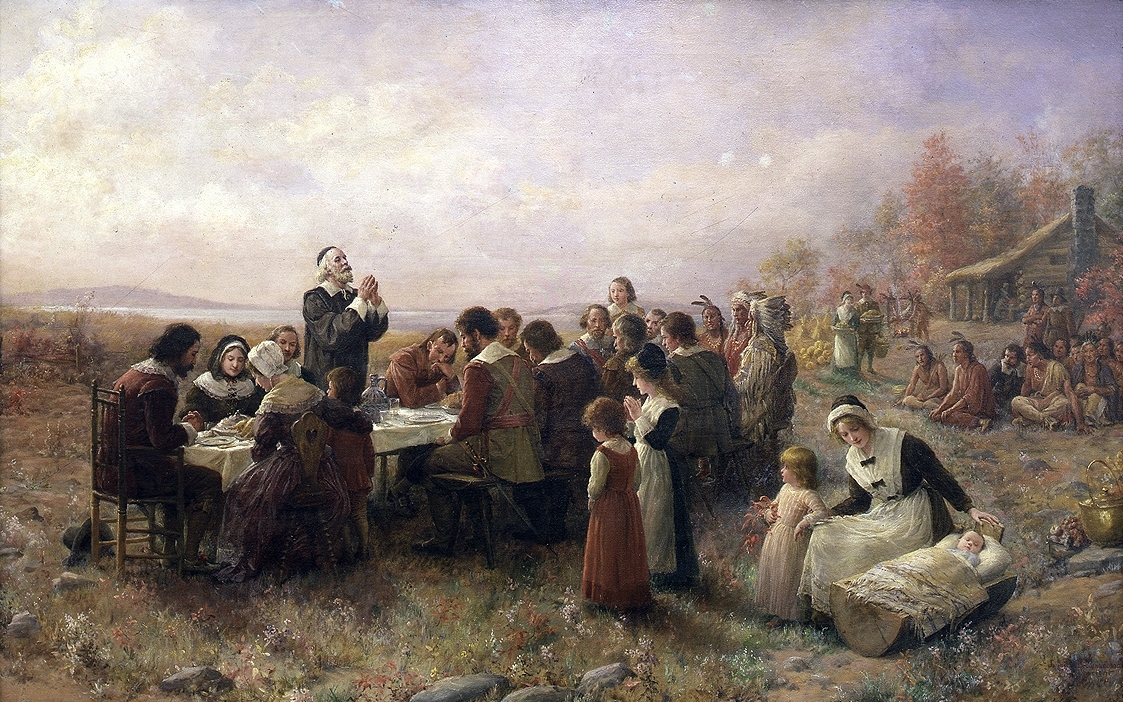
The First Thanksgiving at Plymouth (1914) By Jennie A. Brownscombe
   
     Thanksgiving Day is not observed in the United Kingdom or any of the Commonwealth realms. It is however, a day that we Americans give thanks for good fortune in our lives, just as the English settlers in Plymouth had done after their first harvest with the assistance of the local Native American population.

     For this writer, Thanksgiving is a day reflection, prayer, and spending time with family. With the world running at an ever more dizzying pace, it is good to have holidays such as this one. Sometimes, we do need to slow down and think about our lives, what we are thankful for, and why. I am certainly thankful for my life and good health, as well as thankful for creating this blog and being able to inform people about the monarchy and to give my views and opinions about it, and I am thankful for the people who are reading it.

     With that said, here is George Washington's proclamation of our first Thanksgiving in 1789:


Whereas it is the duty of all Nations to acknowledge the providence of Almighty God, to obey his will, to be grateful for his benefits, and humbly to implore his protection and favor, and whereas both Houses of Congress have by their joint Committee requested me "to recommend to the People of the United States a day of public thanksgiving and prayer to be observed by acknowledging with grateful hearts the many signal favors of Almighty God especially by affording them an opportunity peaceably to establish a form of government for their safety and happiness."

Now therefore I do recommend and assign Thursday the 26th day of November next to be devoted by the People of these States to the service of that great and glorious Being, who is the beneficent Author of all the good that was, that is, or that will be. That we may then all unite in rendering unto him our sincere and humble thanks, for his kind care and protection of the People of this Country previous to their becoming a Nation, for the signal and manifold mercies, and the favorable interpositions of his providence, which we experienced in the course and conclusion of the late war, for the great degree of tranquility, union, and plenty, which we have since enjoyed, for the peaceable and rational manner, in which we have been enabled to establish constitutions of government for our safety and happiness, and particularly the national One now lately instituted, for the civil and religious liberty with which we are blessed; and the means we have of acquiring and diffusing useful knowledge; and in general for all the great and various favors which he hath been pleased to confer upon us.

And also that we may then unite in most humbly offering our prayers and supplications to the great Lord and Ruler of Nations and beseech him to pardon our national and other transgressions, to enable us all, whether in public or private stations, to perform our several and relative duties properly and punctually, to render our national government a blessing to all the people, by constantly being a Government of wise, just, and constitutional laws, discreetly and faithfully executed and obeyed, to protect and guide all Sovereigns and Nations (especially such as have shown kindness unto us) and to bless them with good government, peace, and concord. To promote the knowledge and practice of true religion and virtue, and the encrease of science among them and Us, and generally to grant unto all Mankind such a degree of temporal prosperity as he alone knows to be best.
Given under my hand at the City of New York the third day of October in the year of our Lord 1789.

    
I do not believe that most people can find disagreement with such profound words.

     Happy Thanksgiving Day!

Saturday, November 23, 2013

The Queen's Dedication of the Kennedy Memorial

     For my full article regarding Kennedy and the memorial in his honor in the UK, please click here.    

     In this video, newsreel footage from the dedication of the the Kennedy Memorial in Runnymede, England, United Kingdom on May 14, 1965 - fifteen days before what would have been President John F. Kennedy's 48th birthday. 


     The video begins with Jacqueline Kennedy, John F. Kennedy, Jr., Caroline Kennedy, and other members of the Kennedy family arriving at the site. Then the Queen and Prince Philip arrive with the Kennedy's in a receiving line to meet them. The dedication party then walks up the steps to view the memorial.

     At the stand for dignitaries, the Queen gives her speech to dedicate the memorial. Unfortunately, this video is only showing parts of the speech. In one part, she remarks on how the President and his family have had ties to Britain - going back to period leading up to World War II when his father Joseph P. Kennedy was the American ambassador to the United Kingdom (Court of St. James) and when the future President wrote his book about Britain's predicament in facing Hitler and the Nazi's during the 1930's, Why England Slept. 

     This video also shows the Queen making references to the fact that President Kennedy's older brother, Joseph P. Kennedy, Jr., had died in a plane explosion over East Suffolk while on a mission as a naval aviator during the war, and that his sister Kathleen was buried in Britain.

     Lastly, the Queen is heard giving her closing remarks, in which she bequeaths the land to the United States in memory of President Kennedy.


Friday, November 22, 2013

Remembering JFK

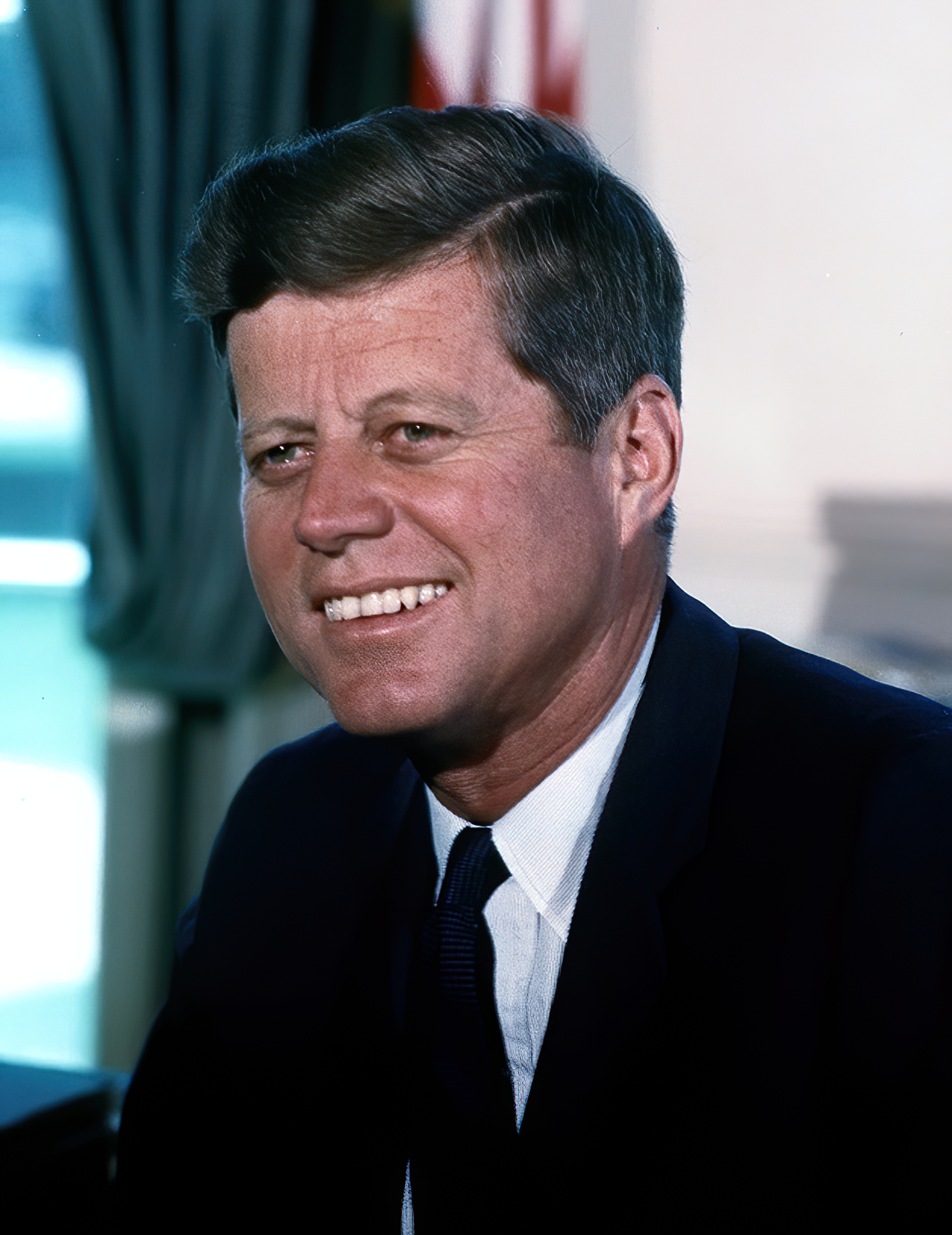
President John F. Kennedy
(1917-1963)
     Fifty years today on November 22, 1963, President John Fitzgerald Kennedy was assassinated in Dallas, Texas. The death of Jack Kennedy was a tragedy for the United States, and indeed for the world.

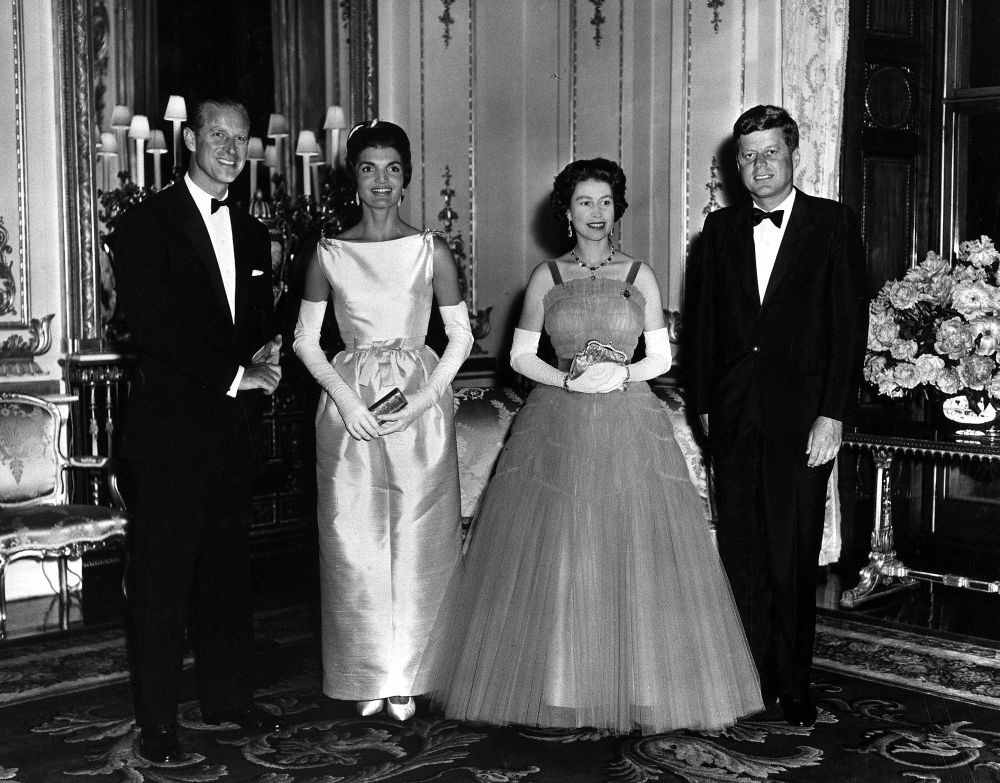
President and Jacqueline Kennedy posing with the
Queen and Prince Philip at Buckingham Palace
     Two years earlier, Queen Elizabeth II and Prince Philip hosted President Kennedy and Jacqueline Kennedy at a dinner at Buckingham Palace. It was private occasion, but nonetheless contained much of the pomp seen at state dinners.

     At the time of the assassination, the Queen was pregnant with Prince Edward, and so the Duke of Edinburgh was sent to represent her at Kennedy's state funeral in Washington.


     Following the tragedy, the Kennedy Memorial Trust was set up to sponsor scholarships for British post-graduate students to attend Harvard University and the Massachusetts Institute of Technology, as well as to establish a permanent memorial to President Kennedy in the United Kingdom. 


     On May 14, 1965, the Queen and Jacqueline Kennedy unveiled the John F. Kennedy Memorial at Runnymede, near the site were King John of England had signed Magna Carta in 1215. Among those in attendance were Caroline and John F. Kennedy, Jr., Senator Robert F. Kennedy of New York, Senator Edward M. Kennedy of Massachusetts, other members of the Kennedy family, Prince Philip, UK Prime Minister Harold Wilson, US Secretary of State Dean Rusk (representing President Lyndon B. Johnson), and Lord Harlech - Chairman of the Kennedy Memorial Trust. 

     The memorial consists of a Portland stone bearing the following inscription:

'This acre of English ground was given to the United States of America by the people of Britain in memory of John F. Kennedy, born 19th May, 1917: President of the United States 1961-63: died by an assassin’s hand 22nd November,1963. 

"Let every National know, whether it wishes us well or ill, that we shall pay any price, bear any burden, meet any hardship, support any friend or oppose any foe, in order to assure the survival and success of liberty": from the inaugural address of President Kennedy, January 1961.' 


Leading to the memorial is a 50-step pathway, and it also contains a hawthorn tree and an American scarlet oak. The sight was once owned by the Crown, but is now United States property, and was chosen to mark Kennedy's dedication to the rights and liberties of all people, the foundations of which were established at Runnymede.

John F. Kennedy Memorial at Runnymede, which was designed by Geoffrey Jellicoe

     At the dedication ceremony, the Queen made the following address:


"Here at Runnymede 750 years ago Magna Carta was signed. Among our earliest Statutes, it has rightly been regarded as the cornerstone of those liberties which later became enshrined in our system of democratic government under the rule of law.

This is a part of the heritage which the people of the United States of America share with us. Therefore it is altogether fitting that this should be the site of Britain’s memorial to the late President John F. Kennedy, for, as leader of his great nation, he championed liberty in an age when its very foundations were being threatened on a universal scale.

We all recall how he welcomed this challenge and gloried in the fact that to his generation had been given the task of defending liberty in such a time of trial. His readiness to shoulder the burden and the passionate enthusiasm which he brought to his labours gave courage, inspiration, and, above all, new hope not only to Americans but to all America’s friends.

Nowhere was this more true than here in these Islands. With all their hearts, my people shared his triumphs, grieved at his reverses and wept at his death.

President Kennedy, together with his family, had many ties with our country. He and they lived among us in that doom-laden period which led up to the outbreak of war. The experience of those days led him to write, when still a young man, a most perceptive analysis of the predicament in which Britain found herself. Ever after he maintained a deep and steady interest in the affairs of this nation whose history and literature he knew and loved so well. His elder brother, flying from these shored on a hazardous mission, was killed in our common struggle against the evil forces of a cruel tyranny. A dearly-loved sister lies buried in an English churchyard. Bonds like these cannot be broken and his abiding affection for Britain engendered an equal response from this side of the Atlantic.

The unprecedented intensity of that wave of grief, mixed with something akin to despair, which swept over our people at the news of President Kennedy’s assassination, was a measure of the extent to which we recognised what he had already accomplished, and of the high hopes that rode with him in a future that was not to be.

He was a man valiant in war, but no one understood better than he that, if total war were to come again, all the finest achievements of the human race would be utterly consumed in the nuclear holocaust. He therefore sought tenaciously for a peace which, as he put it, would enable “men and nations to grow and to hope and to build a better life for their children – not merely peace for Americans, but peace for all men and women; not merely peace in our time but peace for all time.”

Abroad, peace for a shrinking world; at home, a just and compassionate society. These were the themes of his Presidency. But it is his own example as a man that we remember today; his courage, both moral and physical; his dedication to public service; the distinction of heart and mind, the joyful enthusiasm, the wit and style which he brought to all he did; his love of liberty and of his fellow men. All these will continue to inspire us and the generations who succeed us and all those who share the noble traditions of freemen evoked by the name of Runnymede.

This acre of English soil is now bequeathed in perpetuity to the American people in memory of President John Fitzgerald Kennedy who in death my people still mourn and whom in life they loved and admired."

Close-up of the inscription.

     For this author, President Kennedy represents much of what was - and still is - great about America, and the fact that there is a memorial him in Britain that was unveiled by the Queen speaks to power of the Special Relationship between the United States and the United Kingdom. 

     It is unfortunate that we did not see more of President Kennedy, and of what he could have done to lead us to a better and more peaceful future.
     
     May his Eternal Flame continue to shine brightly.


Photo Credit: Ian Taylor via Geograph cc, Graham Horn via Geograph cc