Showing posts with label British Empire. Show all posts

Thursday, July 3, 2014

The International Appeal of the British Monarchy

The extended Royal Family on the Buckingham Palace balcony in 2012.
Image Credit: Carfax2 via Wikimedia Commons cc

     The British monarchy is the most well-known and widely-recognized monarchy in the world. No other such institution can claim to have something even close to what this monarchy has in terms of news coverage, notoriety, and international respect. Queen Elizabeth II herself has become an icon of representing the best of Britain. She and members of her family make headlines across the world, for good reasons and not-so-good reason, and it is almost assured that a large-scale event involving the monarchy will be broadcast to every corner of the globe.

     Certainly, the monarchy has been at first a recurring, and now a constant, presence of my life. From the death of Diana to the birth of Prince George and beyond, the British monarchy has always been there with its ability to be relevant to many people, no matter where they live. This includes many Americans, whose identity is partly bound up by its independence from Britain and the rejection of hereditary monarchy.

     There are several reasons for why the British monarchy still captures the attention of the world. Such typical reasons include the fascination with what members of the Royal Family are wearing at any given time, the pageantry and ceremony, the history going back over a thousand years, the constitutional and legal nature of the institution, as well as its force for uniting the people.

The Queen's longevity is another factor in the monarchy's popularity, but the King of Thailand has been monarch longer than Elizabeth II by two years.
Abuk SABUK via Wikimedia Commons cc (Mosaic by Helen Marshall)
     However, none of these reasons get to the heart of why the British monarchy has global influence and how it got this influence.

     It is not as though this monarchy is the only one left in the world, for there are still several functioning monarchies from the Netherlands to Saudi Arabia to Japan, and they have their own ceremonies, lengthy histories, and other attributes usually linked to the monarchy in the United Kingdom of Great Britain and Northern Ireland.

     The natural response would be that in Britain, the monarchy is at the center of national life; that is thickly woven into British society; that ceremonial and pomp is done better in Britain than any other country, and that this monarchy still has a role – however reduced – in government.

     Indeed, this is something a bit more unique, but it only justifies the monarchy’s reach within the United Kingdom itself, and still does not explain why hundreds of millions – possibly billions – of people around the world have tuned in to watch Royal weddings and funerals, as well as being on pins and needles for Royal birth announcements, or why when people speak of the “Queen”, they likely mean the Queen of the United Kingdom of Great Britain and Northern Ireland – Elizabeth II, making her arguably the most famous woman in the world.

     This leads me to believe that there is one catch-all reason for this phenomenon: the British Empire, which has been long gone, but whose legacy still casts a long shadow over Britain and her former colonies.

The British Empire at its height in 1921.
 
     At its height, the British Empire was the largest empire in human history, covering a quarter of the world’s land surface and containing nearly a third of its population. This meant that the British monarch, his or her family, and their actions and movements were front page news for a substantial part of the world’s population by virtue of the position of the Crown in places such as Canada, Australia, New Zealand, India, and South Africa.

     As time went on and those countries gained self-governance within the Empire, and later outright independence, some of them decided to retain the monarchy as a system of governance. Today, Queen Elizabeth is head of state in 15 independent countries outside of Britain. The Crown in those countries has its own unique character, with Her Majesty simultaneously being Queen of Canada, Queen of Australia, Queen of Jamaica, etc, and several institutional have “Royal” in their name (i.e., Royal Canadian Navy).


The Commonwealth of Nations. All member states recognize Elizabeth II as Head of the Commonwealth, but the red countries are the members of the organization that share allegiance to Elizabeth and her heirs and successors as head of state (and are informally known as Commonwealth Realms). The blue countries are the members that either have their own indigenous monarchies, or are republics. Many of them were once independent realms, including India, Pakistan, Kenya, and South Africa.


     But what about the former colonies that either became republics or have home-grown monarchies?
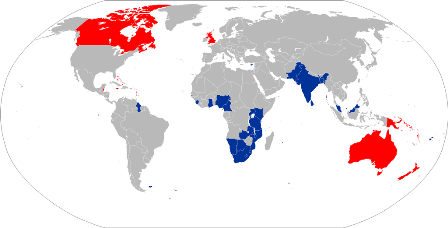
     Out of the Empire came the Commonwealth of Nations, a voluntary organization which currently contains the 16 countries with the British monarch as head of state (known as Commonwealth realms), 32 republics (i.e., India, Pakistan, and South Africa), and 5 independent monarchies (i.e., Malaysia and Lesotho). Elizabeth II is recognized as “the symbol of the free association of [the] independent member nations” in her role as Head of the Commonwealth, and she and her family make regular visits to these countries.

     With the Commonwealth and the shared monarchy between 16 countries, the British Royal Family still commands attention and notoriety across a wide swath of the world. One only needs to review the recent tour of Australia and New Zealand by the Duke and Duchess of Cambridge and Prince George, as well as the tour of Canada by Prince Charles and Camilla to see why the monarchy still matters in those countries alone. Therefore, it should not be surprising to see the coverage of the Royal Family on a large scale. 

     But how does one explain America and her love-affair with the British monarchy, especially given the events of 1776?

     Well it’s important to remember that the war for independence had more to do with the actions of the British Parliament rather than George III, but he nevertheless became the face of tyranny and oppression. In spite of this however, many Americans had respect and affection for the King – even if they had issues with his Parliament, which is why several Founding Fathers wanted a status within the Empire like that of Canada and other colonies in the 19th and 20th centuries, in which there was autonomy from Britain, but the British monarch remained head of state.

Britain and America.
 
     Even after independence, we have not really shed our social links and commonalities with Britain, so the monarchy still retains a special place, and this was evident when George VI and Queen Elizabeth (the Queen Mother) became the first reigning British monarchs to visit our shores and the American people turned out to warmly welcome them. The American media – which has come to shape the coverage of world events – has covered Royal events in a wall-to-wall fashion and the people have been tuning in time after time.

     The result is that the British Royal Family in some respects is now the world’s royal family, and this is a testament to the long shadow cast by Britain and the Empire on which the sun never set.

Tuesday, December 24, 2013

History of Christmas Broadcasts


Queen Elizabeth II delivering her Christmas Message last year.
    
     One of the most enduring traditions of the modern monarchy is the Queen’s Christmas Message which is broadcasted on Christmas Day in the United Kingdom and throughout the Commonwealth of Nations. Begun in 1932 as a radio broadcast by King George V, it is now delivered by his granddaughter Elizabeth II on television, radio, and the Internet. 

     The message is significant because unlike most speeches the Queen gives throughout the year, this one is not written by elected officials and their staffs. Instead, it is a message that conveys the Queen’s personal thoughts on current issues and concerns of the day, as well as her reflections on the Christmas season and its meaning to her and to the people of the Commonwealth. It also acts a summary of events of a personal, national, and global nature that have affected the Queen and her viewers/listeners over the past year. 

     In this respect, the format of the annual broadcast has not changed since the first one was delivered by George V almost 81 years ago. 

     The idea of the Christmas broadcast was the brainchild of Sir John Reith, the founding director-general of the British Broadcasting Corporation (BBC), which had been in existence for only a decade. Sir John wanted a live message delivered by the King-Emperor to the British Empire as way of inaugurating the BBC Empire Service, but George V was hesitant about using the relatively untested medium of radio. He was eventually persuaded to go ahead with it, and temporary studio was set up at Sandringham House – the royal family’s private winter retreat. He also took a few lessons and practice sessions in front of the microphone in preparation for the live broadcast over what was then called the “wireless.” 

George V delivering the first royal Christmas broadcast.

     At 3:05 PM on Christmas Day 1932, King George V gave out the first royal Christmas broadcast to his Empire – using a speech which had been written by Rudyard Kipling and began with the line: “I speak now from my home and from my heart to you all.” He went on to say, “I speak now from my home and from my heart to you all; to men and women so cut off by the snows, the desert, or the sea, that only voices out of the air can reach them”, which was an acknowledgment of how the new radio technology was able to bring people together in a common unifying experience. 

     As it was, the King’s Christmas broadcast proved to very popular – listened to by a global audience of over 20 million from the UK to India and Australia to Canada. The King would go on to give a Christmas broadcast every year for the remainder of his reign. 

     When George V died in 1936, he was succeeded by his eldest son as Edward VIII, but he abdicated the throne before he could relay a broadcast himself. In this aftermath of the Abdication Crisis, Edward’s younger brother George VI did not give a Christmas broadcast that year, but did give one at the end of his coronation year in 1937. In it, he thanked the nation and Empire for their unity and support as he assumed the reins of kingship. 

George VI - seen with Queen Elizabeth and Eleanor Roosevelt - helped to maintain the spirits of the people in Britain and the Empire during the war.

     Such unity and support was needed more than ever during World War II, and it was George VI who, through the power of the microphone, provided reassurance and a sense of continuity to his peoples across the Empire as the war dragged on. His broadcasts helped to maintain and boost morale on the home front and within the armed forces in the face of dark and difficult times with statements like this: “A new year is at hand. We cannot tell what it will bring. If it brings peace, how thankful we shall all be. If it brings us continued struggle we shall remain undaunted.” 

     By the end of the war, the Christmas broadcast had become firmly integrated into the traditions of Britain, the Commonwealth, and the monarchy. George VI continued to deliver them live until 1951, when his ill health forced him to record the message in intervals which were spliced together for the actual broadcast. In it, he thanked the peoples of the British Commonwealth and Empire for their sympathy and support during his illness, and talked about his recovery and hopes for the New Year. 

     As it was, this was the King’s last Christmas message, for he died on February 6, 1952. George VI was succeeded by his 25 year old daughter Elizabeth, who delivered her first Christmas message at the end of year by speaking about the now 20 year old tradition she was carrying from her father and grandfather, and promised to continue their work of binding the peoples of the Empire and Commonwealth together. Elizabeth II also thanked her subjects for their support in the year of her accession, and asked for their continued support and prayers for her with regard to the upcoming coronation in 1953. 

     Five years later in 1957, the message was delivered for the first time on television. It was broadcasted live from Sandringham on Christmas Day, and in it, the Queen commemorated the 25th anniversary of the first broadcast by George V. This message added a new dimension to the annual speech, for it allowed the people of Britain and the Commonwealth to see the Queen speaking to them from her home to theirs, and Elizabeth II expressed her hope that this new medium would allow her messages to be more personal and direct – overcoming what she admitted was a remoteness about her, despite being constantly seen in film and print. She mentioned how she and her family, like other families around the world, gather around to watch television, and displayed the fact that her family also observed the Christmas season by decorating their home. 


     The Sovereign made mention of her overseas activities that year – including the opening of the new Canadian Parliament as the Queen of Canada, and her visits to the United States, Portugal, Denmark, and France as Queen of her realms and as Head of the Commonwealth. She also relayed her welcome to the Commonwealth’s newest independent members, Ghana and Malaya (now Malaysia), and made it clear of her devotion to this brotherhood of nations, and the British Islands from which it originated. She touched on the broad theme of preserving timeless ideals values such as the importance of religion, morality, honesty and self-restraint and spoke of the need for courage to stand up for what is right, true and honest, and expressed her hope for the emerging Commonwealth to be built and cherished on these and ideals and values. According to her, there were cynics who did not care much for these values, considered them to be old-fashioned, and were ready and willing to throw them away. Branching out from this theme, the mission of Britain and the Commonwealth from the Queen’s perspective was to boldly take these timeless ideals and carry them proudly into the future and to show the world that they can be relevant to new times and with the changing technology that among other things allowed people to watch the Queen that day. 

     Themes addressed by the monarch have been an important part of the message. They are developed months in advance as the Queen and her advisors take stock of the events going on in the world and attempt to connect them to a greater meaning for people (including the Queen herself) to reflect upon. Common themes of Christmas messages include faith and religion, family and community, unity and togetherness, service to others, duty and responsibility, and hopes for a better new year. Events such as royal births and anniversaries, natural disasters, terrorist attacks, feats of human achievement, contributions to society, and moments of national celebration (i.e., the London Olympics last year) have been highlighted in previous broadcasts over the years. 

     The broadcasts themselves were once live, but have been prerecorded since 1960, so that the film could be transported to all of the overseas Commonwealth realms in time for Christmas Day and aired at a convenient time for each realm. Even with the advent of high-speed communication, the broadcast is recorded so as to include footage from various royal occasions and other events that were significant through the previous year. (One can therefore think of the broadcast as a national highlight reel.) In addition, the pre-recorded sessions have allowed for flexibility in choosing the location for the broadcast. Filming usually takes place at Buckingham Palace, though Sandringham and Windsor Castle have also been used, and in 2003, the Queen used the Household Cavalry Barracks in Windsor to highlight the sacrifices being made in Iraq and Afghanistan by British and Commonwealth servicemen and women. 

     Until 1997, the BBC – which had pioneered the idea of the annual message – produced all of the broadcasts. In that year, it was decided to start a two-year rotation with ITV to (in words of the Palace), "reflect the composition of the television and radio industries today." Sky TV was added to the rotation in 2011, and it produced the first 3D broadcast of the Christmas message last year. In addition, the broadcast has been viewable on the Internet since 1997, and past messages have also been uploaded. Nevertheless, it is still originally aired at 3:00PM in Britain and it posted online after the original broadcasts have been completed throughout the Commonwealth.

The Queen views the broadcast as her chance to speak to her people directly in her own words.

     All told, the broadcasts last up to 10 minutes, during which the Queen has not only summarized the events of the past year, but has also brought attention to, and her perspectives on, developments such as the changing roles of women, an increasingly multi-faith Britain, and rapidly evolving technologies. As Head of the Armed Forces, she also does her bit to remind her peoples that many servicemen and women cannot be with their families for Christmas because they are abroad serving their country. Having been a mother who has had two sons who served actively in the military, and now as a grandmother with a grandson doing the same, the Queen probably understands what it this must feel like.

     The broadcasts from time to time also include the Queen’s personal thoughts, concerns, and experiences that are related back to things that her peoples are also thinking and going through in their own lives. She spoke of the blessings of life when her mother celebrated her 90th birthday in 1990, and twelve years later shared her personal feelings of facing up to the twin losses of her mother and Princess Margaret within weeks of each other during her Golden Jubilee year. 

     With regard to the jubilee’s – Silver in 1977, Golden in 2000, and Diamond in 2012 – the Queen used the Christmas broadcast to thank her peoples for their participation in the jubilee events and making the jubilee years successful and memorable. 

     Just as with the Jubilees, the traditional Christmas broadcast provides a sense of continuity for the nation and Commonwealth. Viewing a familiar face year after year who provides a calm reassurance of stability in an ever-changing has become firmly embedded in the Christmas traditions of many families throughout the Commonwealth, including the Windsor’s, who with the exception of the Queen, gather around at Sandringham to watch the broadcast at 3:00PM. 

     In the United States, we do not have an equivalent to this tradition. Various presidents have issued statements and proclamations about Christmas and what it means to them as well as the nation at large. However, our presidents are partisan politicians, and though a Christmas message may attempt to speak for the entire country, there will be many people who will (rather unfortunately) not listen, watch, or read anything the President has to say because of his policies and/or political affiliation. 

     In contrast, the Queen’s Christmas Broadcast is her opportunity to speak directly to her people and to engage with them on events and occurrences that took place over the past year. It is also the chance for her to express her personal thanks and appreciation for the public that has given her its blessing over the decades. In so doing, she maintains and reinforces her and the monarchy’s role as the focus of unity in the United Kingdom and the wider Commonwealth. It has shown itself to be one of the more endurable aspects of the modern monarchy.

Photo Credit: Lzur via Wikimedia Commons cc

Sunday, December 15, 2013

Madiba, the Queen, the Commonwealth, and a Final Farewell

     
     This is updated version of a previous posting that was done on Mandela, with new references and information relevant to Mandela's life and his relationship with the Queen and the Commonwealth. 

Statue of Nelson Mandela in Parliament Square, London.

     Today, the world said its final farewell to a true fighting soul who helped to bridge divides and forge the unity of a nation. Nelson Mandela was a man who changed the course of our history – first by being the face of the cruelty imposed by the apartheid regime in South Africa, then by being the reconciling man who worked tirelessly to overcome deep seated bitterness and hatred for the good of South Africa, and finally as the father of a nation emerging from decades of strife and conflict, with the intention of moving on to create a better society for all people. 

     At the state funeral service held in Mandela's native village of Qunu, Prince Charles represented his mother, not just as monarch of the United Kingdom and her overseas realms, but also as Head of the Commonwealth. In this role, the Queen is the ceremonial figurehead of an organization that encompasses a third of humanity and whose members are linked by culture, language, history, and shared values of democracy, human rights, and the rule of law. 

     As Head of the Commonwealth, Elizabeth II knows South Africa and knew Mandela very well. Her first overseas visit was to South 
George VI and Queen Elizabeth in South Africa with their
daughters Princess Elizabeth and Princess Margaret.
Africa in the spring of 1947, where she and her sister Princess Margaret accompanied their parents, King George VI and Queen Elizabeth on a tour of what was still a part of the British Empire. At Cape Town on April 21st, Princess Elizabeth gave a radio broadcast to the Empire in which she stated that her whole life would be dedicated to service of the “great imperial family” of nations.
 

     However, in a foreboding sign of things to come, the South African government prevented its king from pinning medals on black serviceman, some of whom had fought for the Empire during the Second World War. George VI was said to have been hostile toward these actions, but as a constitutional monarch, he had no choice but to follow the instructions of his government in South Africa. 

     Following the coronation of his daughter (in which South Africa was included among the countries in the Coronation Oath) in 1953, she gave delivered the annual Christmas broadcast, where she made a distinction between the old Empire and the new Commonwealth of Nations by saying that, “The Commonwealth bears no resemblance to the empires of the past. It is an entirely new conception built on the highest qualities of the spirit of man: friendship, loyalty, and the desire for freedom and peace.” 

     Furthermore, she added: “To that new conception of an equal partnership of nations and races I shall give myself heart and soul every day of my life.” 

     Perhaps those qualities and ideals espoused by the Queen were reasons why South Africa, with its Apartheid policies, decided to 
A sign keeping non-white people out of a beach area in Durban.
become a republic
in 1961.
The system of government-enforced racial segregation was incompatible with the modern constitutional monarchy, which has traditionally served as the guarantor of rights and liberties of all people. So the country not only removed Elizabeth II as Queen of South Africa, but it also had to re-apply for membership within the Commonwealth of Nations as a republic, and sought to do so. But when it became clear that other African Commonwealth members as well as Canada would reject the application over the issue of apartheid, South Africa withdrew its membership altogether. In effect, it was expelled from the Commonwealth and cast a rogue state and a pariah outside of the community of nations. The following year, Nelson Mandela was arrested and imprisoned for treason, beginning what would become a 27 year sentence.

     Throughout the apartheid era – and Mandela’s imprisonment – several Commonwealth countries (especially those in Africa, the Caribbean, and Asia) protested against the South African 
Mandela as he appeared at the time of his imprisonment in 1962.
segregationist policies by imposing sanctions and boycotting athletic competitions with teams fielded by the country. They also wanted the Commonwealth to present a united front against apartheid, and desired to have organization-wide embargoes against South Africa. However, the British government under Margaret Thatcher, viewing Mandela and his African National Congress (ANC) political party as terrorists, refused to go along with the wishes of much of the Commonwealth, and continued to have links with the South African government. This resulted in a mass boycott of the 1986 Commonwealth Games in Edinburgh, which had the fewest number of attending athletes since the Games in 1950.

     The Queen was said to be sympathetic to the plight of the black majority in South Africa (a country so close to her heart), as well as the desire of many Commonwealth countries to do something about it. Some accounts go as far to say that Queen privately expressed 
Anti-apartheid protest in the 1980's.
her frustration at Thatcher’s stance on the apartheid issue, for not only did the Queen oppose the segregationist policy, but she also feared that the controversy would ultimately tear the organization apart. Yet like her father, she was unable to make her personal feelings known, and so we may never know exactly how she felt about Thatcher, South Africa, and the apartheid issue. However, we do know that Elizabeth II is passionate about the Commonwealth and keeping it together whilst Thatcher did not have such feelings for the organization, and so it’s entirely possible that the two women had frank discussions on issues at stake, including that of Nelson Mandela’s imprisonment.

     When Mandela was finally released in 1990 after 27 years, he and the ANC were allowed to take part in the South African political process, which marked the end of apartheid and the beginning of full democracy. In the following year, Mandela was personally invited by the Queen to attend the heads of government banquet at the 1991 Commonwealth Heads of Government Meeting in Zimbabwe. He had been invited as an observer by Zimbabwean president Robert Mugabe, but was not originally included among the dignitaries at the banquet hosted by the Queen because he was only the leader of the ANC (and not a head of government) and South Africa was not a member of the Commonwealth. But the Queen, possibly sensing the tide of history, told the Secretary-General, “Let’s have him.” This treatment by the Queen towards Mandela possibly helped to legitimize Mandela as a genuine figure with whom business could be done, as opposed to the view of him as a terrorist by the likes of Margaret Thatcher. It was also the beginning of a strong personal friendship between Mandela and the Queen. 

     Following Mandela’s election and inauguration as the first black president of South Africa in 1994, one of his first acts was to restore the country’s place within the Commonwealth of Nations, where today it is a key member. He also sent a letter to the Queen in which he invited her to South Africa for a state visit in the following year. In it, he addressed the Queen as “Madam” (as opposed to “Your Majesty”) and concluded with: “You will be most welcome. NR Mandela.”

Mandela was determined to re-establish South Africa's connections to the Commonwealth.
     The result was one of the most poignant and emotional events of the Queen’s reign: the moment when she arrived in South Africa for the first time in nearly fifty years. At Port Elizabeth, she was greeted by President Nelson Mandela as she disembarked from the Royal Yacht Britannia. 

     Due to the often fractious relationship between the Thatcher government and the Commonwealth during apartheid, it was feared that residual bitterness might envelop the Queen’s visit. As it was, the Queen, as Mandela predicted, was received warmly by cheering and enthusiastic crowds, some of whom held up signs saying, THANK YOU FOR COMING BACK. 

     According to Sally Bedell Smith, “Mandela believed that the Commonwealth’s anti-apartheid stance had been vital [in ending apartheid], as was the Queen’s role in keeping the organization unified.” In fact, there had been back-channel communication between the organization and Mandela during his imprisonment, and so Mandela knew of the Commonwealth efforts to put pressure on South Africa to end apartheid (and perhaps also knew of the Queen’s personal opinions on the matter). 

     Following that momentous 1995 visit, the Queen sent a hand-written thank-you letter in which she addresses him in the beginning with the usual greeting of, “Dear Mr. President,” but signed off with the more personal ending of, “Your sincere friend, Elizabeth R,” (as opposed to the usual “Your good friend, Elizabeth R”). 

The Queen was eager to have Mandela for a state visit to the UK.
 
     A year later, the Mandela returned the favor by accepting the Queen’s invitation for a state visit in the United Kingdom. There, he was greeting by tens of thousands of Britons who cheered him and the Queen on as they shared in a carriage procession to Buckingham Palace. Following this came a lunch at which Mandela stated his admiration for “this gracious lady”, to which the Queen praised him as “this wonderful man.” She later paid tribute to Mandela at the state banquet by saying that he was the head of a country that “has a special place in my heart and in the hearts of the British people.” 

     Instead of hosting a return dinner the following night, Mandela decided to throw a “Two Nations” concert at the Royal Albert Hall that included many musical talents, including South African performers such as Hugh Masekela. During a performance by the all-male a cappella singing group Ladysmith Black Mambazo, Mandela got up to dance to the music. He was followed Prince Philip, Prince Charles, and the Queen, who as noted by the Daily Telegraph, had “seldom been known to boogie in public.” During the visit, the Mandela presented the Queen with a silk scarf, whilst Prince Philip was given a chess set of African warriors. 

     It is also noteworthy that among the world leaders the Queen has known over the decades, Mandela was likely one of the few to know her on a more informal basis. According to Robert Hardman, by 1999, Mandela was staring his correspondence with, “Dear Elizabeth”, and signing them off with, “Please accept, Your Majesty, the assurances of our highest esteem, Nelson.” He also referred to her as “my dear friend, Elizabeth”, and it does indeed appear that Mandela and the Queen had a good relationship based on mutually personal respect for each other. When Mandela and the Queen crossed paths, it was like a meeting between two long-time friends. According to former British Prime Minister Gordon Brown, Mandela personally called the Queen and opened with, “Hello Elizabeth. How's the Duke? 

     When one thinks about, in their own way, they have loved and served their respective countries, for they both came from a generation that tended to place larger interests above one's self. It does not appear to be known whether the Queen herself referred to Mandela as “Nelson” or more personally by his tribal name, “Madiba.” However, there can be no doubt that his death was personal for the Queen in a way that is normally reserved for close friends and relatives. 

Prince Charles attending the state funeral for Mandela.

     This writer is disappointed that the Queen is not be attending the state funeral for Mandela. In my previous post about Mandela, I said that I had hoped that the Palace would deem this to be a trip worth taking. However, it is understandable that the Palace is trying to keep “long-haul” travel for the Queen and the Duke of Edinburgh to a minimum, as they are now approaching Mandela's own age. Also, it is not as if the Prince of Wales is not a suitable substitute for the Queen. He has met Mandela several times, and built a good relationship with him as well, and his appearance at the funeral will mean a lot to people who look to the Queen as a symbol of unity in the wider Commonwealth, of which Charles may one day lead. Mandela would surely have appreciated this gesture.

     Nelson Mandela was indeed a transformative figure who changed the world for the better. He inspired millions with his actions of resistance to oppression and later by his gestures of healing and reconciliation. Whatever anger and bitterness he had was overcome with a determination to let bygones be bygones, forgive his oppressors, and work toward building a new South Africa in which the rights and dignities of all people would be respected – an approach unlike those of several post-colonial black leaders. He did what he believed was right, and had the courage and will to do so, and that will be is lasting legacy.

     As an American, I can certainly appreciate the parallels between the struggles against Apartheid in South Africa and Jim Crow in the States. The two movements fed off of each other, and led to a better world of racial justice and equality. 

     On this day, we will do well to remember Mandela and his contributions, and strive to take the world closer to his vision - one step and one day at a time. That would be a fitting tribute to a iconic man who will forever live in our hearts and minds, as well as in the arc of history, which as Martin Luther King, Jr. said, bends toward justice.” 

     May he, the Great Emancipator of South Africa, rest in peace.


Sources:

Hardman, Robert. Her Majesty: Queen Elizabeth and Her Court. New York: Pegasus Books. 2012. Print (Page 97, 143-144, 301, 315).

Smith, Sally Bedell. Elizabeth the Queen: The Life of a Modern Monarch. New York: Random House. 2012. Print (Pages 38, 350-351, 383-384, 388-389).  


Photo Credit: Warko via Wikimedia Commons cc, Robert Cutts via Flickr cc, Guinnog via Wikimedia Commons cc, Paul Weinberg via Wikimedia Commons cc, lasanta.com.ec via Flickr cc, Lzur via Wikimedia Commons cc, GovernmentZA via Flickr cc

Thursday, December 12, 2013

Imperial Pomp: The Delhi Durbar of 1911


The Delhi Durbar of 1911. George V and Queen Mary are seated upon the dais under the large canopy.


     On this day in 1911, King George V and Queen Mary attended their Durbar in Delhi as Emperor and Empress of India, which took place following their coronation as King and Queen of the United Kingdom and the British Dominions.

     Previous durbar’s had been held in 1877 (for Queen Victoria) and 1903 (for Edward VII), but this was first occasion in which the reigning monarch was present for the event.

     The Durbar was basically a gathering of the Indian princes, nobleman, landed gentry, British colonial administrators, and other important persons who came to pay homage to the Emperor and Empress. One of its purposes was to cement and reaffirm the relationship between the princes’ of India and the British Crown, for the British Raj depended on the support of these native rulers.

     For the momentous event, a new crown was specially commissioned for George V because the existing Crown Jewels that had been used for his coronation in London could not be removed from the UK.

TIM The Emperor and Empress of India.

     Designed and manufactured by long-time crown jewelers Garrard & Co., the Imperial Crown of India weighs 2.13 lbs and is formed from a gold-laminated frame that features 6,100 diamonds. There are 16 alternating clusters of diamond lozenges, sapphires, and emeralds along the diamond-encrusted band, above which are four fleurs-de-lis (containing emeralds) alternating with four crosses-pattée (containing rubies). Rising from here are eight half-arches cast in a pattern of stylized leaves and buds, which taper toward the center and terminate in scrolls under a monde that is surmounted by a cross-pattée containing an emerald.

George V and Queen Mary seated on the dais for the Durbar.

     Despite the intense heat, King-Emperor George and Queen-Empress Mary wore full robes and other regalia (including the crown) throughout the 3 ½ hour outdoor ceremony, which was attended by over 100,000 people, during which the King-Emperor made the surprise announcement that India’s capital would be moved from Calcutta to Delhi. A ceremony for laying the foundation stones for New Delhi was held three days later.

     In addition to the Durbar, there were several other official ceremonies the lasted from December 7th to December 16th, including the appearance of Their Imperial Majesties on the balcony at the Red Fort, where they received the greetings of over half a million common people. 

George V and Queen Mary looking out over the crowds from the Red Fort balcony.

     For their participation in the Durbar, 26,800 men and officers of the British and Indian Armies were awarded Delhi Durbar Silver Medals of 1911. One-hundred Indian princes’ and high-ranking government officials received gold versions of these medals.

     The 1911 Durbar was arguably the biggest imperial pageant held during the existence of the British Empire. Certainly, Britain’s power as a world leader was at its height during the late 19th and early 20th centuries, and the Durbar was an expression of that power. It was also the personal desire of the King-Emperor George V to be seen by thousands of his Indian subjects halfway across the world where no reigning British monarch had yet stepped foot.

     In time, it would prove to be the last Durbar to be held. When Edward VIII succeeded his father in January 1936, a Durbar could not be planned since Edward abdicated in less than a year. His brother George VI announced in 1937 that he looked forward to his Durbar as soon as it was possible to do so, but the coming of World War II and Indian independence prevented this from occurring.

The Imperial Crown of India

     As for the Imperial Crown of India, it was taken back to the UK and placed with the Crown Jewels at the Tower of London, where it remains on display to this day as a reminder of Britain’s imperial power.


Photo Credit: Pietro & Silvia via Flickr cc