Showing posts with label Magna Carta. Show all posts

Tuesday, December 24, 2013

Royal Birthday Profile: King John of England

John, King of England

     On this day in 1166, King John of England was born. He was the youngest son of Henry II of England and Eleanor of Aquitaine, and as such was not expected to inherit his father's possessions and territories. But rebellions by John's older brothers resulted in him becoming King Henry's favorite son, and he was appointed Lord of Ireland in 1177 and given other lands in England and France. Upon the death's of three of his brothers and his father, John became heir to the throne during the reign of his last surviving brother, Richard I (the Lionheart), and when Richard died in 1199, John succeeded to the Crown.

     He became embroiled in conflicts with the French king, Philip II, which resulted in John losing much of his family's Continental empire, including Normandy, Anjou, and Brittany in northern France by 1204. For the first time since the Norman Conquest, the King of England was that and not much else. John would spend the next ten years attempting to retake these lands, but to no avail.

     Worse, he got into a confrontation with Pope Innocent III over the appointment of Stephen Langton as Archbishop of Canterbury, which resulted in England being laid under an interdict in 1208, which prevented priests from saying Mass, marrying couples, and burying corpses. In response, John confiscated Church lands from officials who followed the orders of the interdict. For this, and John's continued intransigence on the appointment of Stephen Langton, Pope Innocent had John excommunicated in 1209, and may have invited Philip II of France to invade England and depose John. Eventually in 1213, John agreed to accept Langton as Archbishop, compensate the Church for lost revenues from the confiscated land, and to surrender ultimate authority for England and Ireland to the Pope while paying an annual cash tribute of 1,000 marks (£ 666) to lease it back.

     Meanwhile, his fruitless wars in France had sent taxes spiraling and resulted in the loss of French lands belonging to English barons. John's submission to the pope also soured the attitudes of the power brokers who could make or break him, and in 1215, they forced him to sign Magna Carta (the Great Charter) with the aim of restraining the King's power. The document not only contained clauses regarding the liberties and political rights of free people, but it also included sharp teeth which allowed the barons to overrule John and to use force if he showed any sign of backsliding from Magna Carta.

     John then had his new superior overlord, Pope Innocent, to have the charter declared null and void. The barons were subsequently outraged at the King's faithlessness and a civil war broke out in which they invited Louis, the son of the French king, to take the English throne for himself. But on October 18, 1216, King John died, and the rebellion ended with the accession of his nine-year-old son, Henry III.

     King John has been much-maligned by past and contemporary historians for his conduct and actions against the Church, in France, and with the barons. To be fair, he was a good administrator in the mechanics of government and his reign did see through the continued development of English common law. Also, his moment of humiliation - the signing of Magna Carta - is considered an important step in the constitutional evolution of the United Kingdom, with its emphasis on defining the relationship between monarch and people by establishing constraints upon the monarch's powers and the acknowledging of the people's rights and liberties.

     Nevertheless, this action was viewed as a climb down on the part of the king, and his name has been treated with suspicion ever since, which is probably the reason why there has not been a reigning English or British king named John.

Friday, November 22, 2013

Remembering JFK

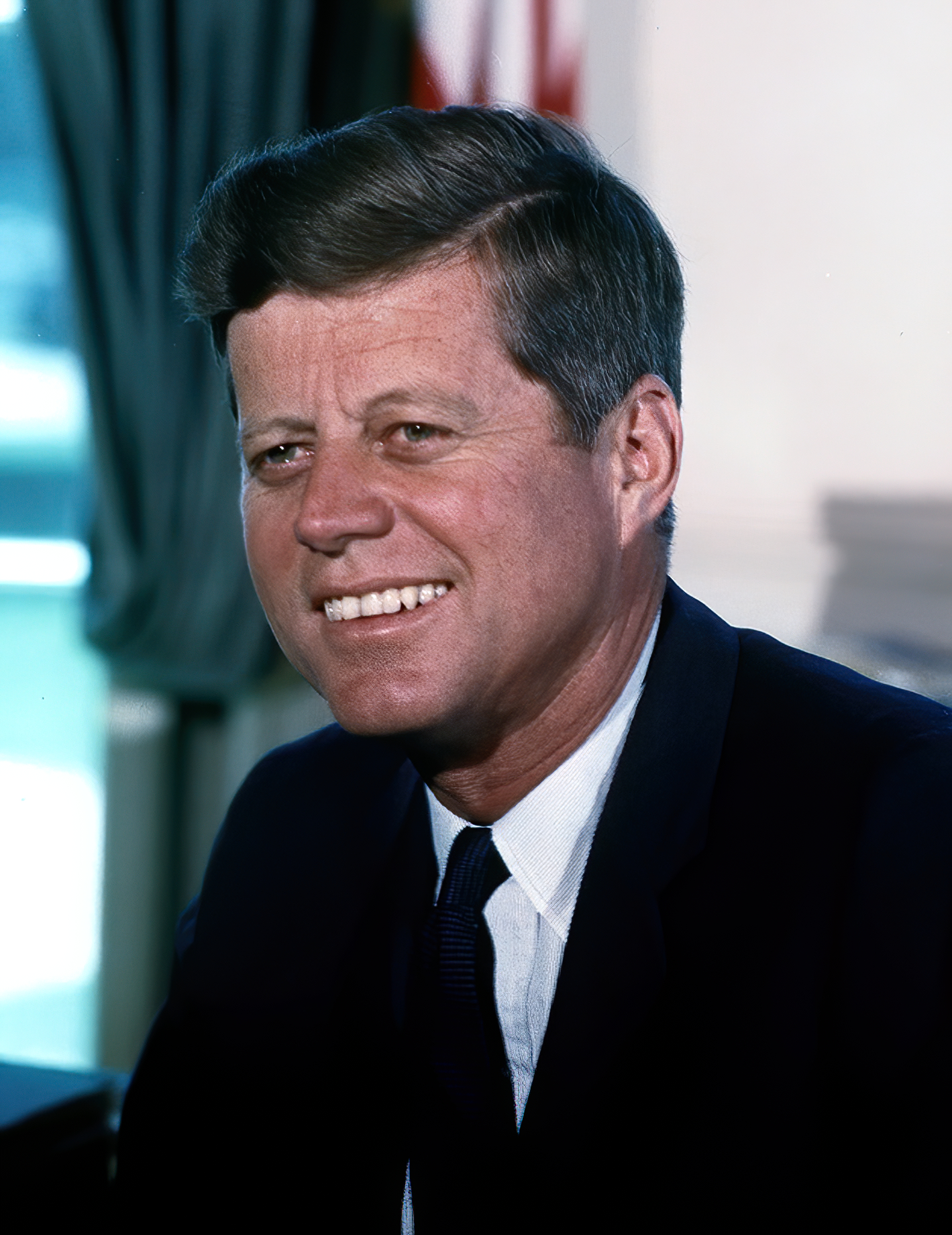
President John F. Kennedy
(1917-1963)
     Fifty years today on November 22, 1963, President John Fitzgerald Kennedy was assassinated in Dallas, Texas. The death of Jack Kennedy was a tragedy for the United States, and indeed for the world.

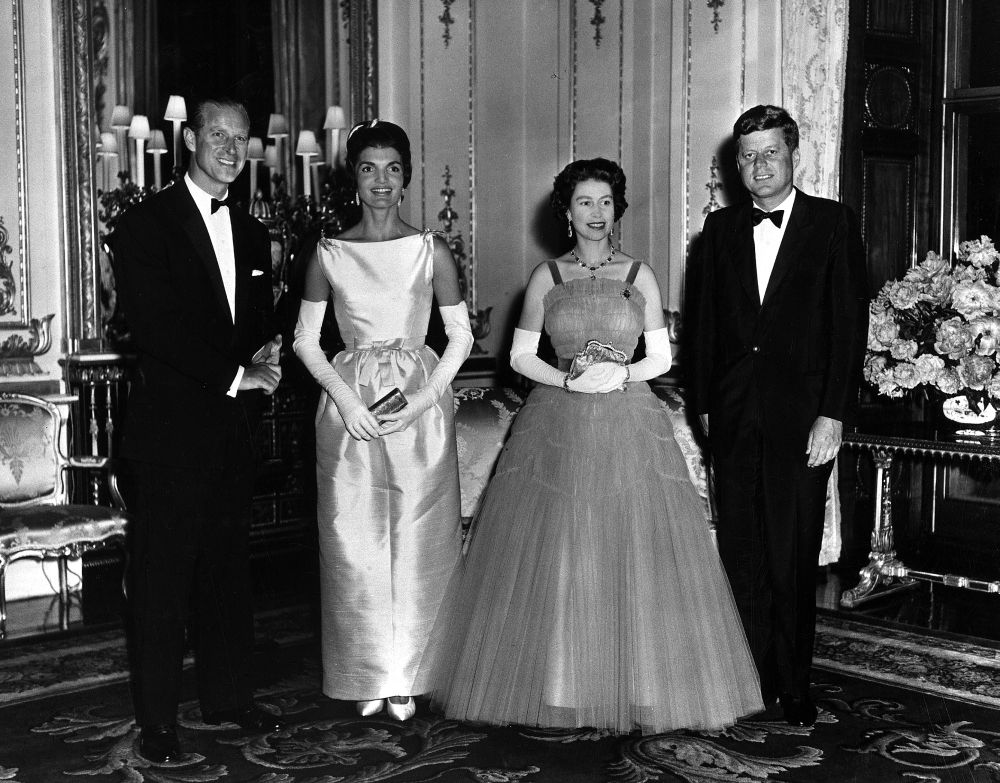
President and Jacqueline Kennedy posing with the
Queen and Prince Philip at Buckingham Palace
     Two years earlier, Queen Elizabeth II and Prince Philip hosted President Kennedy and Jacqueline Kennedy at a dinner at Buckingham Palace. It was private occasion, but nonetheless contained much of the pomp seen at state dinners.

     At the time of the assassination, the Queen was pregnant with Prince Edward, and so the Duke of Edinburgh was sent to represent her at Kennedy's state funeral in Washington.


     Following the tragedy, the Kennedy Memorial Trust was set up to sponsor scholarships for British post-graduate students to attend Harvard University and the Massachusetts Institute of Technology, as well as to establish a permanent memorial to President Kennedy in the United Kingdom. 


     On May 14, 1965, the Queen and Jacqueline Kennedy unveiled the John F. Kennedy Memorial at Runnymede, near the site were King John of England had signed Magna Carta in 1215. Among those in attendance were Caroline and John F. Kennedy, Jr., Senator Robert F. Kennedy of New York, Senator Edward M. Kennedy of Massachusetts, other members of the Kennedy family, Prince Philip, UK Prime Minister Harold Wilson, US Secretary of State Dean Rusk (representing President Lyndon B. Johnson), and Lord Harlech - Chairman of the Kennedy Memorial Trust. 

     The memorial consists of a Portland stone bearing the following inscription:

'This acre of English ground was given to the United States of America by the people of Britain in memory of John F. Kennedy, born 19th May, 1917: President of the United States 1961-63: died by an assassin’s hand 22nd November,1963. 

"Let every National know, whether it wishes us well or ill, that we shall pay any price, bear any burden, meet any hardship, support any friend or oppose any foe, in order to assure the survival and success of liberty": from the inaugural address of President Kennedy, January 1961.' 


Leading to the memorial is a 50-step pathway, and it also contains a hawthorn tree and an American scarlet oak. The sight was once owned by the Crown, but is now United States property, and was chosen to mark Kennedy's dedication to the rights and liberties of all people, the foundations of which were established at Runnymede.

John F. Kennedy Memorial at Runnymede, which was designed by Geoffrey Jellicoe

     At the dedication ceremony, the Queen made the following address:


"Here at Runnymede 750 years ago Magna Carta was signed. Among our earliest Statutes, it has rightly been regarded as the cornerstone of those liberties which later became enshrined in our system of democratic government under the rule of law.

This is a part of the heritage which the people of the United States of America share with us. Therefore it is altogether fitting that this should be the site of Britain’s memorial to the late President John F. Kennedy, for, as leader of his great nation, he championed liberty in an age when its very foundations were being threatened on a universal scale.

We all recall how he welcomed this challenge and gloried in the fact that to his generation had been given the task of defending liberty in such a time of trial. His readiness to shoulder the burden and the passionate enthusiasm which he brought to his labours gave courage, inspiration, and, above all, new hope not only to Americans but to all America’s friends.

Nowhere was this more true than here in these Islands. With all their hearts, my people shared his triumphs, grieved at his reverses and wept at his death.

President Kennedy, together with his family, had many ties with our country. He and they lived among us in that doom-laden period which led up to the outbreak of war. The experience of those days led him to write, when still a young man, a most perceptive analysis of the predicament in which Britain found herself. Ever after he maintained a deep and steady interest in the affairs of this nation whose history and literature he knew and loved so well. His elder brother, flying from these shored on a hazardous mission, was killed in our common struggle against the evil forces of a cruel tyranny. A dearly-loved sister lies buried in an English churchyard. Bonds like these cannot be broken and his abiding affection for Britain engendered an equal response from this side of the Atlantic.

The unprecedented intensity of that wave of grief, mixed with something akin to despair, which swept over our people at the news of President Kennedy’s assassination, was a measure of the extent to which we recognised what he had already accomplished, and of the high hopes that rode with him in a future that was not to be.

He was a man valiant in war, but no one understood better than he that, if total war were to come again, all the finest achievements of the human race would be utterly consumed in the nuclear holocaust. He therefore sought tenaciously for a peace which, as he put it, would enable “men and nations to grow and to hope and to build a better life for their children – not merely peace for Americans, but peace for all men and women; not merely peace in our time but peace for all time.”

Abroad, peace for a shrinking world; at home, a just and compassionate society. These were the themes of his Presidency. But it is his own example as a man that we remember today; his courage, both moral and physical; his dedication to public service; the distinction of heart and mind, the joyful enthusiasm, the wit and style which he brought to all he did; his love of liberty and of his fellow men. All these will continue to inspire us and the generations who succeed us and all those who share the noble traditions of freemen evoked by the name of Runnymede.

This acre of English soil is now bequeathed in perpetuity to the American people in memory of President John Fitzgerald Kennedy who in death my people still mourn and whom in life they loved and admired."

Close-up of the inscription.

     For this author, President Kennedy represents much of what was - and still is - great about America, and the fact that there is a memorial him in Britain that was unveiled by the Queen speaks to power of the Special Relationship between the United States and the United Kingdom. 

     It is unfortunate that we did not see more of President Kennedy, and of what he could have done to lead us to a better and more peaceful future.
     
     May his Eternal Flame continue to shine brightly.


Photo Credit: Ian Taylor via Geograph cc, Graham Horn via Geograph cc