Showing posts with label Tudor. Show all posts

Sunday, February 2, 2014

Moments of Royal History - February 2nd

1141 - Forces under King Stephen are defeated at the Battle of Lincoln

Stephen, King of England

     During a period known as the Anarchy, a civil war waged in England between King Stephen and his cousin Matilda, Countess of Anjou. Stephen succeeded his uncle, Henry I, as King of England in 1135 despite Henry's choice of his daughter Matilda (who was his only legitimate child) as his heir. Matilda pressed her claim to the throne, and at Lincoln, her forces under her half-brother, Robert, Earl of Gloucester decisively defeated King Stephen and his armies in and around the city. Stephen was captured and imprisoned at Bristol, and this allowed Matilda the opportunity to become Queen, though she was not officially proclaimed as such, and would be defeated herself within a few months.

1461 - Yorkist victory at the Battle of Mortimer's Cross

The White Rose of the House of York and the Red Rose of The House of Lancaster

     In this battle of the Wars of the Roses, the Yorkist army of Edward Plantagenet, Duke of York faced the Lancastrian forces of Sir Owen Tudor and his son, Jasper Tudor, Earl of Pembroke, who were loyal to King Henry VI. Owen Tudor, a Welsh soldier, was the second husband of Catherine of Valois, the widow of Henry V, and therefore the King's step-father.

     On the day of the battle, the Duke of York and his supporters were said to have seen a meteorological phenomenon known as parhelion at the break of dawn, which three suns appeared to be rising. Duke Edward took this to represent the Holy Trinity, with the implication that God was on their side, and later took the on the image of the Sun in Splendor as a personal emblem. Sure enough, the battle was decisively won by the Yorkists, and it resulted in a rout of the Lancastrian forces and the execution of Owen Tudor. In just over a month, Edward, Duke of York would march into London and be crowned as Edward IV of England.

1901 - Funeral of Queen Victoria


     The late Queen's coffin had been moved by the Royal Yacht Alberta from the Isle of Wight to mainland Britain on February 1st. 

     On February 2nd, it was carried on a horse-drawn gun carriage through the streets of London, baring the Imperial State Crown, orb, scepter, and the Collar of the Order of the Garter. A large crowd lined the streets to pay their final respects to the Queen as the procession went through. Included in it were King Edward VII of the United Kingdom, Kaiser Wilhelm II of Germany, King George I of the Hellenes (Greece), King Carlos of Portugal, King Leopold II of the Belgians, Archduke Franz Ferdinand of Austria-Hungary, Grand Duke Michael Alexandrovitch of Russia, as well as the Crown Princes of Germany, Romania, Greece, Denmark, Norway and Sweden, and Siam. Indeed, it was one of the last great gatherings of European royalty before World War I would see the toppling of many of these crowned heads.

     At Windsor, the horses became restless and unruly, resulting in sailors pulling the gun carriage to its final destination of St. George's Chapel at Windsor Castle, where the funeral was held. Two days later, Victoria was laid to rest next to Prince Albert at the Frogmore Mausoleum in Windsor.

Tuesday, January 28, 2014

Royal Moments in History - January 28

1457 - Birth of Henry VII of England

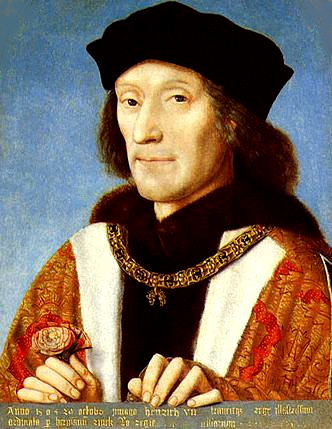
Henry VII holding the Tudor Rose.

     Henry Tudor was born at Pembroke Castle in Wales to Edmund Tudor, Earl of Richmond and Lady Margaret Beaufort, who was only thirteen years old at the time she gave birth. During this period, the Wars of the Roses between the House of Lancaster and the House of York was two years old. The Tudor's were descended from the ruling Lancastrian's, and Edmund - who was twice the age of his wife - was captured by Yorkist forces and died of illness while in captivity before Henry was born. When the Yorkists seized the throne under Edward IV, Henry Tudor was sent to live in France for his own safety. 

     Eventually, Henry would return to England to defeat Richard III at the Battle of Bosworth and become Henry VII, the first monarch of the House of Tudor. His 24 year reign was known for its restoration of political stability following the Wars of the Roses, but also for Henry's avarice and financial greed toward its end. He was peacefully succeeded by his eldest surviving son, Henry VIII in 1509.


1547 - Death of Henry VIII and the accession of Edward VI

Henry VIII of England and Ireland

     90 years following the birth of his father, Henry VIII died aged 55 at the Palace of Whitehall in London. The King had become obese in his later years, especially after a jousting accident in 1536 which resulted in a festering leg wound that robbed him of much physical activity. His last words were allegedly, "Monks! Mocks! Monks!", which may have been a reference to the monks he had evicted during the Dissolution of the Monasteries. Henry was interred next to his third wife Jane Seymour at St. George's Chapel in Windsor Castle.

Edward Tudor, Prince of Wales in a portrait taken in the year before his accession.

     On that same day, Henry's only legitimate son succeeded to the throne as Edward VI at the age of nine. During his reign, the Church of England took on a firmly Protestant identity as the Mass, celibacy, and other Catholic traditions were abolished. As such, Edward was England's first Protestant king, for though his father had broken with Rome, he remained Catholic and never renounced Catholic doctrine (except for papal supremacy) and ceremony. Edward's authority as monarch was exercised by a regency council throughout his reign since he never came of age, and he died at the age of fifteen in 1553.

Saturday, January 18, 2014

Royal Marriage and the Birth of the Tudors


This marriage was symbolized by the creation of the Tudor Rose.
     
     The marriage of Henry VII and Elizabeth of York on January 18, 1486 helped to seal a dynastic union between the House of Lancaster and the House of York, the two rival English royal houses that had fought for the throne for around 30 years in an on-and-off conflict known as the Wars of the Roses – so named due to the representative floral emblems: the White Rose of York and Red Rose of Lancaster. Both houses were branches of the Plantagenet dynasty, but they disagreed who had a greater claim to the throne. The war initially resulted in the Yorkists taking the Crown and killing off most of the Lancastrians, but a distant Lancastrian claimant named Henry Tudor – a man of Welsh descent who had lived in exile in France for several years – landed in Pembrokeshire, Wales with a small army to take on Richard III. At the Battle of Bosworth in 1485, Tudor and his army killed Richard and decisively defeated his forces, making Richard III the last Yorkist king and the last of the Plantagenet monarchs, which had ruled in England since 1154.

     Bosworth was a victory for the Lancastrians, and Henry Tudor was soon crowned as Henry VII of England. But in order to place his status on solid footing, the new King had to make good on his promise to marry Elizabeth of York, the eldest daughter of Richard III’s brother, Edward IV. This arrangement was the handiwork of Lady Margaret Beaufort, mother of Henry VII, and Elizabeth Woodville, wife and Queen consort of Edward IV.

     Upon King Edward’s death in 1483, he was succeeded by his son Edward V, who at the age of twelve needed a Lord Protector  (or Regent) to act in his name during his minority. His uncle Richard, Duke of Gloucester was chosen for this role, but Richard eventually had Edward and his younger brother (also named Richard) placed under his custody in the Tower of London – where they have become known through history as the Princes in the Tower. The brothers, who were the only surviving sons of Edward IV, were eventually never seen in public again, and it has been suggested that their uncle Richard had them murdered, which cleared his path to the throne as Richard III.

     With her sons likely dead, Queen Elizabeth made contact with Lady Margaret Beaufort through an intermediary, and the two women made common cause against King Richard. Between them, it was agreed that Elizabeth would support Henry Tudor’s bid for the throne, and that Margaret would consent to the marriage of her son to Elizabeth’s daughter, Elizabeth of York, who was Edward IV’s daughter, had a better claim to the throne than Richard.

     Henry pledged to marry Elizabeth in December 1483, and when he became king, he honored this commitment. With this marriage, the Wars of the Roses came to an end, and the rival houses of Lancaster and York were united into the new House of Tudor. This was symbolized by the creation of the Tudor Rose, a combination of the Red Rose of Lancaster and the White Rose of York, which remains the representative floral emblem of England and is often seen together with the other floral emblems of the United Kingdom – the thistle for Scotland, the shamrock for Northern Ireland, and the leek for Wales. 

     The House of Tudor itself would reign in England for the next 118 years and produced five of its monarchs.

Friday, January 3, 2014

Royal Profile: Catherine of Valois

Queen Catherine

     On this day in 1437, Catherine of Valois died in London at the age of 35.

     She was the daughter of King Charles VI of France and Isabeau of Bavaria, and was married to Henry V of England in 1420 when he was recognized as her father's heir in France as a result of Henry's victory over the French at the Battle of Agincourt and the Treaty of Troyes. At the time of the union, Henry was 34 whilst Catherine was just 19, and she was taken to England to be crowned as Queen consort in 1421. At the end of that year, she gave birth to a son named Henry, who became Henry VI as an infant due to his father's death in August 1422. 

     Catherine eventually entered into a relationship with a Welshman named Owen Tudor, who was in the service of Henry V's steward, Sir Walter Hungerford and may have fought at the Battle of Agincourt in 1415. Tudor was closer in age to Catherine than was Henry V, and they were supposed to have married in 1428 or 1429. It is not known if this marriage were legal at the time or if it even happened since no surviving documents attest to its occurrence. They had four children, who were declared legitimate by Parliament and their half-brother, Henry VI. The eldest of those children, Edmund Tudor, was named Earl of Richmond and became the father of Henry Tudor, who would eventually become Henry VII of England.

     Queen Catherine died soon after childbirth in 1437, and was buried in Westminster Abbey.

Sunday, December 8, 2013

Royal Birthday Profile: Mary, Queen of Scots


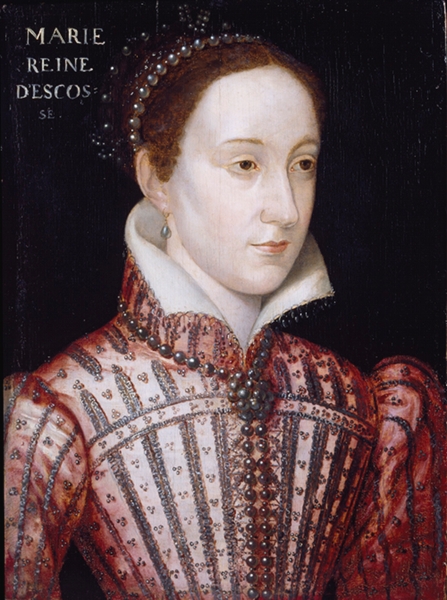
Queen Mary I of Scotland


     On this day in 1542, Mary Stewart was born to King James V of Scotland and Mary of Guise. She was James’s only surviving legitimate child, and became Queen of Scots upon his death six days later, making her the youngest monarch in British history. She was also one of the most consequential, for without her, the monarchy and Britain as we know it today, may not have come into existence.

     Throughout the annals of history, Mary, Queen of Scots has been portrayed in a negative yet captivating light – as an adulteress, seductress, possible accomplice to murder, and figurehead of a conspiracy against her cousin, Elizabeth I of England and Ireland.

     Whereas Elizabeth became Queen in her 20's, Mary succeeded to the Scottish throne when her father was killed in battle. She was eventually sent to live in France because she was married as a child to the heir to the French throne. Mary was briefly Queen consort of France upon her husband's accession as Francis II in July 1559. On his death the following year, she returned to Scotland, where she eventually married her cousin, Henry Stuart, Lord Darnley, with whom she had a son named James. Their marriage became estranged, in part due to Darnley's unreliability, vanity, and violent streak aggravated by a drinking problem. When Darnley was assassinated, there was suspicion that Mary might have been an accomplice - especially after she married (for the third time) the man who was suspected of plotting the murder. Mary was forced to abdicate the throne and fled to England to seek sanctuary. There, she was held prisoner and a trial was held on the issue of Darnley's death, which resulted in no definitive ending. Mary was kept in England for the remainder of her life, which was hardly a comforting prospect for Elizabeth I.

     Queen Elizabeth had feared her royal cousin, for Queen Mary 
Elizabeth feared that her Scottish cousin would
become the figurehead of Catholic opposition to her.
had a legitimate claim to the English and Irish thrones through her grandmother – Margaret Tudor – who was the eldest daughter of Henry VII of England and sister to Henry VIII, who had Elizabeth through his second wife, Anne Boleyn. Mary was also a Catholic, and became a focal point around the opposition toward the established Protestant church, of which Elizabeth was Supreme Governor. Elizabeth’s fear was that Mary would lead a Catholic uprising against her, with the ultimate goal of attaining the throne for herself. When Mary was implicated in the Babington plot to depose Elizabeth, she was put on trial, convicted of treason, and beheaded in 1587.
 

     In contrast to Mary, Elizabeth is viewed as a just, stable, and moral leader who put her country before her personal life. She was the Virgin Queen who commanded the respect of people throughout Europe (including the pope who had excommunicated her) and inspired men to fight in her name. And yet, Queen Mary succeeded in one area where Queen Elizabeth did not: producing an heir.

James VI & I

     Her only child, James Stuart, became King of Scots in 1567 at barely over one year old following his mother’s forced abdication. In 1603, Elizabeth I died and James VI of Scotland, as her closest Protestant relation (first cousin, twice removed), became James I of England and Ireland – thereby uniting the crowns of the British Isles under a single monarch for the first time. This eventually resulted in the political mergers of England (including Wales), Scotland, and Ireland into a single country – the United Kingdom. 

     So in an ironic twist of fate, though Mary, Queen of Scots had failed to gain the English throne, her son did so, and in so doing had helped to forge a new, unified, and modern Britain with a single royal line. To this day, the current royal family is directly descended from Queen Mary I of Scotland – with Elizabeth II of the United Kingdom being Mary’s 10th great-granddaughter. 

Ironincally, Elizabeth II's direct ancestor - Mary, Queen
of Scots - was executed on the orders of Elizabeth I.

     Simply put, without Mary, Queen of Scots, the British monarchy and the British nation as we know them today may never have come into existence. For all of her personal faults, she did produce an heir to the Scottish throne, who eventually went on to succeed to the other thrones of Britain, and in doing so, changed the course of British history.

Wednesday, August 28, 2013

Royal Surnames and House Names: Part I


     In a my posting about why the Duchess of Cambridge is not "Princess Catherine", I stated that Prince Philip’s surname is Mountbatten, which he adopted from his maternal relatives in the United Kingdom. This raises the issue of the royal family’s surname. The royal house is called Windsor but Prince Philip’s surname is Mountbatten. What’s going here? Why isn’t there a surname for William, Kate, and George on the birth certificate? Has royalty ever used surnames?

     Well, to explain this requires some background information on surnames in general. Up until the 12th and 13th centuries, surnames were generally rare and given (first) names were used. But people also became known by their profession (Miller, Smith, etc.), location or place (Stirling, Farmworth, O’Brien, etc.), nickname based on appearance, temperament, and personality (Gutman, Daft, etc.), or in relation to somebody else (McDonald, Fitzgerald, Johnson, etc.). Eventually, these became the surnames used to differentiate people with the same given name from one another, so that John the Miller, Thomas of Stirling, and Henry, John’s son became John Miller, Thomas Stirling, and Henry Johnson.

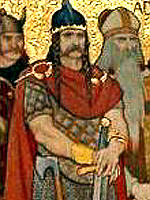
Kenneth MacAlpin, the man whose family would usher in a more united Scotland.

     With regard to the history of the monarchy, royal house names (which may or may not be used as a personal family surname) followed in much the same way, with locations, place names, nicknames, achievements, and relations being used to name royal families.  The first royal house in my British monarch’s timeline, the Scottish House of Alpin was named from Kenneth I’s father, Alpin. Kenneth is known today as Kenneth MacAlpin, which means “Kenneth, son of Alpin.” 

William II was known as William Rufus.
Rufus means "red", and William
had a red-faced appearance.
     In England, its first royal family was the House of Wessex,  named from the Kingdom of Wessex, whose kings came to dominate the other English kingdoms and established a unified English state. Similarly, the Normans were known from their ancestral land, Normandy. Yet these were not surnames, and individual members of the early royal houses were known by personal epithets, nicknames, and territorial designations (Edmund Ironsides, Edward the Confessor, William the Conqueror, William Rufus, Stephen of Blois, John Lackland, etc). But the members of 

Richard Plantagenet, the founder
of the House of York
.
the House of Plantagenet became the first royal family in England to be known by a surname in their own time. It was a nickname given to Geoffrey, Count of Anjou – the father of Henry II of England – because his emblem was a planta genista (or Scotch broom shrub). He is retroactively referred to as Geoffrey Plantagenet, but it was not until the 15th Century when the name was used by Richard Plantagenet, 3rd Duke of York, as a personal surname. During his time, the Plantagenet dynasty was divided between two rival braches – Richard’s House of York and Henry VI’s House of Lancaster, but members from both factions continued to use the Plantagenet name as a means of emphasizing  their status and claims to the throne.


     Meanwhile in Scotland, the Stewart family ascended to the throne in 1371. The Stewart name was derived from the family’s hereditary office of High Steward of Scotland. A steward was a 
Robert II, seen here with his
second wife Euphemia, was the first
Stewart monarch of Scotland.
position like that of a modern-day governor or deputy, who was appointed by the monarch to represent them in certain situations and act in their stead, if necessary. The first man to hold the title was Walter Fitz-Alan, whose surname meant “son of Alan.”  He was succeeded by his son, Alan Fitz-Walter (“son of Walter”), who was in turn succeeded by his own son, Walter, who decided to adopt the name of his title as his personal surname, which became Steward and eventually, Stewart (
Stiùbhairt in Gaelic). It was Walter Stewart, 6th High Steward of Scotland who married Marjorie Bruce, daughter of Robert I of Scotland, and had a son through her named Robert. Robert Stewart, Earl of Strathearn
a title now held by Prince William eventually became the heir to the Scottish throne after his uncle, David II, and succeeded him as Robert II, the first monarch of the House of Stewart (which probably became the first royal house in Britain to derive its name from a personal family surname).

     Back in England, the Wars of the Roses ended with the defeat of the Yorkist king, Richard III by the Lancastrian claimant, Henry 
Henry Tudor, who became Henry VII
of England, founded the House of Tudor.
Tudor. The Tudor surname was of Welsh origin (and a variant of "Theodore"), and Henry was a matrilineal descendant of Rhys ap Tewdwr, an 11th Century Welsh king.
It was Owen Tudor (Owain ap Tewdwr), Henry’s grandfather, who had a relationship with Henry V’s widow, Catherine of Valois, which produced Edmund Tudor, who was therefore a half-brother of Henry VI. Edmund married Lady Margaret Beaufort, a great-great-granddaughter and Lancastrian descendant of Edward III. This union produced Henry Tudor, who escaped into exile in France after what seemed to be the final defeat of the Lancastrians by their Yorkist cousins, who know controlled the throne of England. But in 1485, Henry Tudor, Earl of Richmond, mounted an invasion which would eventually oust Richard and result in him being proclaimed Henry VII of England and establishing the House of Tudor, which would rule in England until 1603. 

James VI & I brought the Stuart's to new heights by
uniting the crowns of Britain...

     In that year, Queen Elizabeth I, Henry’s granddaughter by his son and successor Henry VIII, died without an heir to the English and Irish thrones. She was succeeded by James VI of Scotland, a great-great-grandson of Henry VII through his eldest daughter, Margaret Tudor who had married James IV of Scotland. Now, James VI of Scotland became James I of England and Ireland, thereby bringing the British Isles under the personal rule of a single monarch for the first time. The Stewarts of Scotland had by this time changed the spelling of their name to the French form – Stuart, to symbolize the Auld Alliance with France. James’ first son was Henry Fredrick Stuart, who was Prince of Wales, Duke of Rothesay, and heir to James’ thrones. But he predeceased his father, so his younger brother Charles Stuart 
...but his son Charles I lost it all (including his head).
became their father’s heir, and he was proclaimed as Charles I in 1625. Charles of course, is infamous for being the only British monarch to be tried and executed by his subjects. In his death warrant, signed by the leading English parliamentarians (including Oliver Cromwell), he was referred as Charles Steuart, King of England, having stood and been convicted of high treason. The Stuarts lost their thrones, first in England, then in Ireland and Scotland as the parliamentarians and their army took over the British Isles and abolished the monarchy in favor of a republic. For 11 years, they were in exile in continental Europe before being restored to their British kingdoms in 1660 under another Charles Stuart, Charles II. 


     The Stuart family held on to the thrones of Great Britain (England and Scotland merged in 1707) and Ireland until 1714, 
George I, the first British monarch of the House of Hanover,
which would reign in Britain for nearly 200 years.
when Queen Anne died without an heir. She was succeeded by her German cousin and great-grandson of James VI & I, Georg Ludwig, who became King George I of Great Britain and Ireland. Even though George was 52nd in line to the throne upon his accession, he was the first Protestant in the line of succession.
In Germany, George was Prince-Elector of Hanover, and his dynasty in Britain became known as the House of Hanover (or the Hanoverians). Yet Hanover was not their surname, and it’s doubtful that they ever had one. Contemporary historians have applied the name Guelph as the Hanoverian surname, because it is the name of their 
Queen Victoria, the last British Hanoverian monarch,
whose surname through Prince Albert was likely Wettin.
ancestral house, the House of Welf (with Guelph being the English translation of the German Welf). Queen Victoria was the last monarch of this house, and she married Prince Albert of Saxe-Coburg and Gotha, resulting in their children being members of Albert’s house, which was named for his territorial designation and ancestral homeland. But once again, this was not a personal surname, which the College of Heralds determined to be Wettin (or von Wettin), the name of the royal house from which the Saxe-Coburg’s descended. Victoria never used it, and neither did her son, Edward VII, who reigned as the first monarch of the House of Saxe-Coburg and Gotha when he acceeded to the throne in 1901.


     In short, personal surnames were used by some, but not all, royal families in Britain, and surnames were inconsistently, if ever, used. Everyone belonged to a royal house, but the name of the royal house was not necessarily the personal family surname (i.e., members of the Houses of York and Lancaster referring to themselves as Plantagenet), if indeed a surname existed at all. Certainly the Hanoverians who brought in a formal system of titling members of their house as prince or princess by birth from their native Germany eschewed surnames altogether since it was believed that persons with such a dignity did not need to have one anyway. It was also assumed that royalty married each other, and that once again, surnames were not required as birthright princely titles were handed down from generation to generation. In other words, members of a royal house were to be individually referred to by their titles, and collectively by the name of the royal house to which they belonged. But beginning with George V during the slaughter of the World War I, this would change.

I discuss this change and more in Part II, which concerns the reigning House of Windsor.

Photo Credit: Tastepaper123 Wikimedia Commons cc