Showing posts with label George I. Show all posts

Friday, August 1, 2014

Last of the Stuarts; First of the Hanoverians

     300 years ago today, a Queen died and was succeeded by a King.

     But this was no ordinary change of the guard for the British monarchy. Indeed, this day marks one of the most significant turning points in the history of Britain and its ancient and venerable institution. It marked the end of one royal dynasty which had gone through much social, political, and religious upheaval, and the beginning of another, which paved the way to the development of the modern pattern of British governance that we know today.


Statue of Queen Anne, the last Stuart monarch, outside of St. Paul's Cathedral.
Image Credit: Peter Weis via Wikimedia Commons cc

     It had been over twelve years since Queen Anne had acceded her brother-in-law, William III & II, to the thrones of England, Scotland, and Ireland. During that period, her armies had won many a great victory in Continental Europe during the War of the Spanish Succession under the command of her leading captain-general - John Churchill, Duke of Marlborough, whose greatest triumph was arguably the defeat of the French at the Battle of Blenheim.

     However, Anne's finest hour may have been the moment when two of her kingdoms - England and Scotland - were joined together to form a new country under the name of Great Britain, and it was the United Kingdom of Great Britain that rose to new heights to become the greatest power in Europe, and which was on its way to becoming a world power.

     But for all of the public achievement, Anne was unable to do the one thing required of every sovereign: producing an heir to the throne. Having gone through 17 pregnancies (from 1684 to 1700) via her husband, Prince George of Denmark, only one child - Prince William, Duke of Gloucester, survived infancy, but he was in precarious health throughout his life, and died aged 11 in 1700. The result was that there was nobody to succeed Anne, who was heir to the throne following her brother-in-law King William.

William III & II and Mary II.

     William himself became King during the Protestant-led Glorious Revolution of 1688-89, in which William's Catholic father-in-law and uncle - James VII & II - had fled Britain and was more or less deposed. Under the English Bill of Rights and the Scottish Claim of Right, William and his wife, Mary (James' eldest daughter) were made joint monarchs of England, Scotland, and Ireland. If they died without heirs, then the crowns would pass on to Anne - the younger daughter of King James - and her heirs. The point was to prevent the restoration of James and (after his death in 1701) his only surviving son, James Francis Edward Stuart, who were now exiled in France.

     In 1694, Queen Mary died aged 32 without having produced an heir, and William ruled alone until his death in 1702. With the passing of Prince William two years earlier, the prospect of a Catholic Stuart restoration seemed imminent, so in 1701, the English Parliament passed the Act of Settlement, which barred Catholics from succeeded from the throne, as well as anybody married to a Catholic. It also provided that in lieu of any legitimate heirs by either William or Anne, Sophia of Hanover and her heirs would inherit the throne of England.


The Act of Settlement, which largely governs succession to the British Crown to this day.
Image Credit:
Torsten Bätge via Wikimedia Commons cc

     Sophia of Hanover was a daughter of Elizabeth Stuart, who in turn was the only surviving daughter of James VI of Scotland and I of England and Ireland. She was married to the German Duke of Brunswick-Lüneburg and Elector of Hanover and had a grown son, Georg Ludwig, who by this time had succeeded to his hereditary titles and offices. Though there were over 50 Catholic's ahead of them, Electress Sophia and her son were the first Protestant's on the list, and that was all that mattered.

     In England the issue of the succession was settled, but in Scotland, whilst there were similar feelings towards having a Catholic king, there was also a sense of loyalty to the Stuart family, who had originated from Scotland and reigned in that country since 1371.

Flag of Scotland

     In response to the English, the Scots Parliament passed – and Queen Anne granted Royal Assent to – the Act of Security in 1703, which declared that the next monarch of Scotland should be Protestant and of the royal line, but should not be the same person who succeeded Anne to the Crown of England (probably in the hope that James Stuart would convert), unless the English granted freedom of trade to Scottish merchants within England, Ireland, and the overseas colonies.

Flag of England

     With the ball back in England’s court, it then passed – with Anne’s assent – the Alien’s Act of 1705, which declared that all Scots were to treated as aliens in England (save for those already living there) unless Scotland either repealed the Act of Security or agreed to a union with England. The Scots chose the latter option, and a set of commissioners from both countries were appointed by the Queen, who met in London to hash out an agreement.

     The result was the 1707 unification of Britain into a single country under a single parliament and a single crown, which was governed under the terms of the Act of Settlement - ensuring that there would be a Protestant Hanoverian succession throughout the island nation.

The original Union Flag of Great Britain.

     This island nation of Great Britain - Britannia - would go on to emerge as a leading world power, but Queen Anne would not long savor this triumph. Plagued by ill health throughout her life, she became increasingly corpulent and lame in her later years, and her end finally came on August 1, 1714. Her heir, Electress Sophia of Hanover, had died on May 28th of that year following a collapse resulting from running to shelter during a storm.

     This meant that Sophia's eldest son, Georg Ludwig (with his name Anglicized as George Louis) was proclaimed King of Great Britain and Ireland. George I - great-grandson of James VI & I - arrived in Britain on September 18th and was crowned at Westminster Abbey on October 20th.

First of the Hanoverian's - George I of Great Britain and Ireland

     His accession and coronation marked the end of the House of Stuart - which had ruled for 343 years - and with it, the theory of Divine Right, in which many of its members believed. It was this belief in Divine Right and Absolutism, and the very rejection of these principles by the British people, which arguably cost Charles I and James VII & II the throne, and led to the creation of a limited - or constitutional - monarchy in which the monarch respects the will of Parliament and observes limitations on his or her authority.

     With George I being German, not knowing English, and more interested in foreign affairs and the affairs of his native Hanover, he left the day-to-day business of running Britain to trusted and capable ministers, one of whom, Robert Walpole, emerged in 1721 as the first Prime Minister. As the century went on, it would be relationships between the early Hanoverian monarchs (George I, his son - George II, and great-grandson - George III) and Parliament that would decisively change the way Britain was governed.

     The monarchy itself took on a German identity, and even though every monarch beginning with George III was born and raised in Britain and spoke English as their first language, members of the Royal Family continued marrying Germanic royalty and practiced German customs. This would continue for the next 200 years until the House of Windsor was born in 1917, and it was from this royal line begun by George I that we have the reigning monarch - Elizabeth II.

     Indeed, the arrival of the Hanoverian's in 1714 changed the trajectory of the monarchy and of Britain.

Wednesday, August 28, 2013

Royal Surnames and House Names: Part I


     In a my posting about why the Duchess of Cambridge is not "Princess Catherine", I stated that Prince Philip’s surname is Mountbatten, which he adopted from his maternal relatives in the United Kingdom. This raises the issue of the royal family’s surname. The royal house is called Windsor but Prince Philip’s surname is Mountbatten. What’s going here? Why isn’t there a surname for William, Kate, and George on the birth certificate? Has royalty ever used surnames?

     Well, to explain this requires some background information on surnames in general. Up until the 12th and 13th centuries, surnames were generally rare and given (first) names were used. But people also became known by their profession (Miller, Smith, etc.), location or place (Stirling, Farmworth, O’Brien, etc.), nickname based on appearance, temperament, and personality (Gutman, Daft, etc.), or in relation to somebody else (McDonald, Fitzgerald, Johnson, etc.). Eventually, these became the surnames used to differentiate people with the same given name from one another, so that John the Miller, Thomas of Stirling, and Henry, John’s son became John Miller, Thomas Stirling, and Henry Johnson.

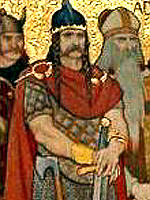
Kenneth MacAlpin, the man whose family would usher in a more united Scotland.

     With regard to the history of the monarchy, royal house names (which may or may not be used as a personal family surname) followed in much the same way, with locations, place names, nicknames, achievements, and relations being used to name royal families.  The first royal house in my British monarch’s timeline, the Scottish House of Alpin was named from Kenneth I’s father, Alpin. Kenneth is known today as Kenneth MacAlpin, which means “Kenneth, son of Alpin.” 

William II was known as William Rufus.
Rufus means "red", and William
had a red-faced appearance.
     In England, its first royal family was the House of Wessex,  named from the Kingdom of Wessex, whose kings came to dominate the other English kingdoms and established a unified English state. Similarly, the Normans were known from their ancestral land, Normandy. Yet these were not surnames, and individual members of the early royal houses were known by personal epithets, nicknames, and territorial designations (Edmund Ironsides, Edward the Confessor, William the Conqueror, William Rufus, Stephen of Blois, John Lackland, etc). But the members of 

Richard Plantagenet, the founder
of the House of York
.
the House of Plantagenet became the first royal family in England to be known by a surname in their own time. It was a nickname given to Geoffrey, Count of Anjou – the father of Henry II of England – because his emblem was a planta genista (or Scotch broom shrub). He is retroactively referred to as Geoffrey Plantagenet, but it was not until the 15th Century when the name was used by Richard Plantagenet, 3rd Duke of York, as a personal surname. During his time, the Plantagenet dynasty was divided between two rival braches – Richard’s House of York and Henry VI’s House of Lancaster, but members from both factions continued to use the Plantagenet name as a means of emphasizing  their status and claims to the throne.


     Meanwhile in Scotland, the Stewart family ascended to the throne in 1371. The Stewart name was derived from the family’s hereditary office of High Steward of Scotland. A steward was a 
Robert II, seen here with his
second wife Euphemia, was the first
Stewart monarch of Scotland.
position like that of a modern-day governor or deputy, who was appointed by the monarch to represent them in certain situations and act in their stead, if necessary. The first man to hold the title was Walter Fitz-Alan, whose surname meant “son of Alan.”  He was succeeded by his son, Alan Fitz-Walter (“son of Walter”), who was in turn succeeded by his own son, Walter, who decided to adopt the name of his title as his personal surname, which became Steward and eventually, Stewart (
Stiùbhairt in Gaelic). It was Walter Stewart, 6th High Steward of Scotland who married Marjorie Bruce, daughter of Robert I of Scotland, and had a son through her named Robert. Robert Stewart, Earl of Strathearn
– a title now held by Prince William – eventually became the heir to the Scottish throne after his uncle, David II, and succeeded him as Robert II, the first monarch of the House of Stewart (which probably became the first royal house in Britain to derive its name from a personal family surname).

     Back in England, the Wars of the Roses ended with the defeat of the Yorkist king, Richard III by the Lancastrian claimant, Henry 
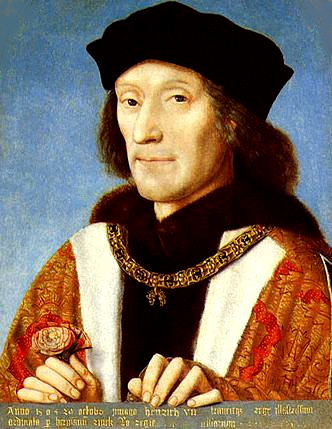
Henry Tudor, who became Henry VII
of England, founded the House of Tudor.
Tudor. The Tudor surname was of Welsh origin (and a variant of "Theodore"), and Henry was a matrilineal descendant of Rhys ap Tewdwr, an 11th Century Welsh king.
It was Owen Tudor (Owain ap Tewdwr), Henry’s grandfather, who had a relationship with Henry V’s widow, Catherine of Valois, which produced Edmund Tudor, who was therefore a half-brother of Henry VI. Edmund married Lady Margaret Beaufort, a great-great-granddaughter and Lancastrian descendant of Edward III. This union produced Henry Tudor, who escaped into exile in France after what seemed to be the final defeat of the Lancastrians by their Yorkist cousins, who know controlled the throne of England. But in 1485, Henry Tudor, Earl of Richmond, mounted an invasion which would eventually oust Richard and result in him being proclaimed Henry VII of England and establishing the House of Tudor, which would rule in England until 1603. 

James VI & I brought the Stuart's to new heights by
uniting the crowns of Britain...

     In that year, Queen Elizabeth I, Henry’s granddaughter by his son and successor Henry VIII, died without an heir to the English and Irish thrones. She was succeeded by James VI of Scotland, a great-great-grandson of Henry VII through his eldest daughter, Margaret Tudor who had married James IV of Scotland. Now, James VI of Scotland became James I of England and Ireland, thereby bringing the British Isles under the personal rule of a single monarch for the first time. The Stewarts of Scotland had by this time changed the spelling of their name to the French form – Stuart, to symbolize the Auld Alliance with France. James’ first son was Henry Fredrick Stuart, who was Prince of Wales, Duke of Rothesay, and heir to James’ thrones. But he predeceased his father, so his younger brother Charles Stuart 
...but his son Charles I lost it all (including his head).
became their father’s heir, and he was proclaimed as Charles I in 1625. Charles of course, is infamous for being the only British monarch to be tried and executed by his subjects. In his death warrant, signed by the leading English parliamentarians (including Oliver Cromwell), he was referred as Charles Steuart, King of England, having stood and been convicted of high treason. The Stuarts lost their thrones, first in England, then in Ireland and Scotland as the parliamentarians and their army took over the British Isles and abolished the monarchy in favor of a republic. For 11 years, they were in exile in continental Europe before being restored to their British kingdoms in 1660 under another Charles Stuart, Charles II. 


     The Stuart family held on to the thrones of Great Britain (England and Scotland merged in 1707) and Ireland until 1714, 
George I, the first British monarch of the House of Hanover,
which would reign in Britain for nearly 200 years.
when Queen Anne died without an heir. She was succeeded by her German cousin and great-grandson of James VI & I, Georg Ludwig, who became King George I of Great Britain and Ireland. Even though George was 52nd in line to the throne upon his accession, he was the first Protestant in the line of succession.
In Germany, George was Prince-Elector of Hanover, and his dynasty in Britain became known as the House of Hanover (or the Hanoverians). Yet Hanover was not their surname, and it’s doubtful that they ever had one. Contemporary historians have applied the name Guelph as the Hanoverian surname, because it is the name of their 
Queen Victoria, the last British Hanoverian monarch,
whose surname through Prince Albert was likely Wettin.
ancestral house, the House of Welf (with Guelph being the English translation of the German Welf). Queen Victoria was the last monarch of this house, and she married Prince Albert of Saxe-Coburg and Gotha, resulting in their children being members of Albert’s house, which was named for his territorial designation and ancestral homeland. But once again, this was not a personal surname, which the College of Heralds determined to be Wettin (or von Wettin), the name of the royal house from which the Saxe-Coburg’s descended. Victoria never used it, and neither did her son, Edward VII, who reigned as the first monarch of the House of Saxe-Coburg and Gotha when he acceeded to the throne in 1901.


     In short, personal surnames were used by some, but not all, royal families in Britain, and surnames were inconsistently, if ever, used. Everyone belonged to a royal house, but the name of the royal house was not necessarily the personal family surname (i.e., members of the Houses of York and Lancaster referring to themselves as Plantagenet), if indeed a surname existed at all. Certainly the Hanoverians – who brought in a formal system of titling members of their house as prince or princess by birth from their native Germany – eschewed surnames altogether since it was believed that persons with such a dignity did not need to have one anyway. It was also assumed that royalty married each other, and that once again, surnames were not required as birthright princely titles were handed down from generation to generation. In other words, members of a royal house were to be individually referred to by their titles, and collectively by the name of the royal house to which they belonged. But beginning with George V during the slaughter of the World War I, this would change.

I discuss this change and more in Part II, which concerns the reigning House of Windsor.

Photo Credit: Tastepaper123 Wikimedia Commons cc