Monday, November 18, 2013

Prince Charles, CHOGM, and the next Head of the Commonwealth

     Prince Charles took yet another step in his apprenticeship as his mother’s heir. 

     On November 15th, the day after he celebrated his 65th birthday, he opened the 2013 Commonwealth Heads of Government Meeting (CHOGM) in Colombo, Sri Lanka in the place of the Queen, who is Head of the Commonwealth.

     CHOGM has its origins in the First Colonial Conference of 1887, at which there was a gathering of the leaders from the self-governing dominions within the British Empire. From
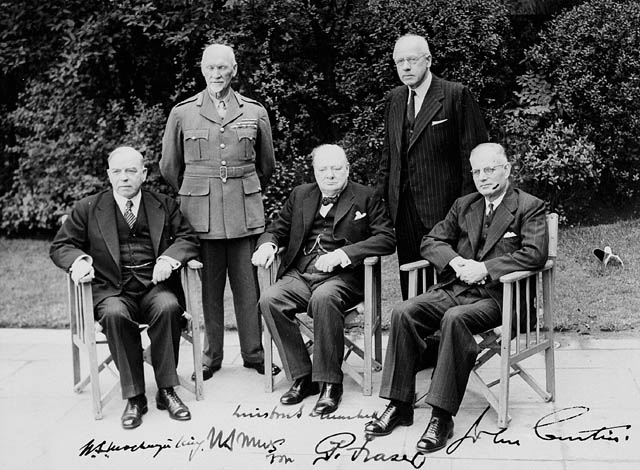
Commonwealth Prime Ministers' Conference, 1944.
Image Source: Library and Archives Canada
1907, they became known as Imperial Conferences, but as the dominions became independent, the word “imperial” was dropped, and from 1944 to 1969, the meetings became known as the Commonwealth Prime Ministers’ Conference. Through the 1960’s the rapid process of decolonization resulted in an influx of former colonies becoming Commonwealth members – many of them with elected presidents or hereditary monarchs of their own, which meant that the term “prime ministers’” no longer applied to some leaders. The result was that the meetings – which had been held in London – began to rotate to other Commonwealth cities beginning with Singapore in 1971, and in that same year, the name was changed for the last time to the Commonwealth Heads of Government Meeting.
 

     The purpose of the meetings is to discuss critical issues affecting individual member states and the wider Commonwealth, and to create common policies and solutions to deal with them. Among the issues brought up at this summit were the concerns over human rights in Sri Lanka, as well as electoral crisis in the Maldives.

     With regard to Sri Lanka, the island nation has been dogged by allegations of human rights abuse during and after its 27 year civil war, which ended in 2009. The government has been particularly accused of war crimes against the ethnic Tamil population in the northern part of the island, as well as intimidating journalists. President Mahinda Rajapaksa has denied such allegations, but has refused international inquires, believing that such investigations are an intrusion into domestic affairs. Commonwealth leaders from Canada, Mauritus, and India - the largest Commonwealth country - boycotted the summit in protest, but others such as British Prime Minister David Cameron have opted to engage with Sri Lanka in addressing such issues. South Africa's president, Jacob Zuma, shared lessons on political and social reconciliation to the government, citing his own country's work toward reconciling its black majority and white minority. 

     In doing what Prime Minister Cameron and President Zuma did, they showed how these summits can be used resolve critical issues, as well as to provide a forum for addressing the core values and goals of the organization, and to renew the traditional bonds between these countries of the old Empire.

     At the summits, there are two main sessions: the executive sessions and the retreats. Executive sessions are formal business gatherings for the heads of government at which notes are taken and a wide group of people take part and/or observe. Retreats are informal gatherings at which only the heads of government, their spouses, and one other person (security, personal aide, other government official, etc.) may attend, and it is here where the attendees can speak frankly and openly without advisors, so that issues may be resolved. 

     Also at CHOGM meetings are cultural and social events designed to involve the local population of the host country, as well as civic society organizations such as the Commonwealth Family that help to forge better links and greater understanding among Commonwealth peoples. There are also other meetings outside of the regular proceedings, such as the gathering of foreign ministers (officials in charge of foreign policy), the Commonwealth Ministerial Action Group, and Commonwealth Business Council.

Head of the Commonwealth


     The Prince of Wales’s presence at the CHOGM is significant because it is the first time that he has represented the Queen in her role as Head of the Commonwealth at these meetings, which the Queen has not missed since 1971.

     Back then, she missed that meeting on the advice of British Prime Minister Edward Heath because of a dispute over Britain 
The Queen attending the 2011
CHOGM in Perth, Australia.
selling arms to South Africa. This time, Palace officials stated back in March that the Queen’s absence was the result of reviewing “long-haul” traveling taken by her. It was, probably for the first time, an acknowledgment that the Queen’s advancing age will limit her capacity to carry out certain engagements, especially ones that require traveling over long distances. This does not necessarily mean that the Queen will never again travel to destinations such as Australia and Canada, but it does mean that trips that were once taken without reservation are now going to be reviewed on a case-by-case basis, and that other members of the royal family will be expected to deputize for her. 

     For Prince Charles, it was his highest profile appearance in the Queen’s stead. It continued a "transitioning" process by which the Prince performs more of the Queen's ceremonial duties, and it took place at the organization that the Queen holds dear to her heart: the Commonwealth of Nations. Elizabeth regards this role as one of her most important, as she and the Commonwealth have grown together. She takes the role seriously and has a passionate interest in Commonwealth affairs. As such, she has been credited as being the glue that has kept the organization – comprising 53 countries and 2.245 billion people – together for the past six decades.

The Commonwealth of Nations. The organization spans all of the continents and covers over 11,566,870 square miles, almost a quarter of the land area across the world. It has an estimated population of 2.245 billion, almost a third of the world population, and in 2012, it produced a nominal GDP of $9.767 trillion, representing 15% of the world GDP when measured in purchasing power parity (PPP). When taken as a whole, the Commonwealth represents the second largest nominal GDP and GDP PPP in the world.

     Born from the days of Empire, the Commonwealth was gradually created as colonies gained self-governance
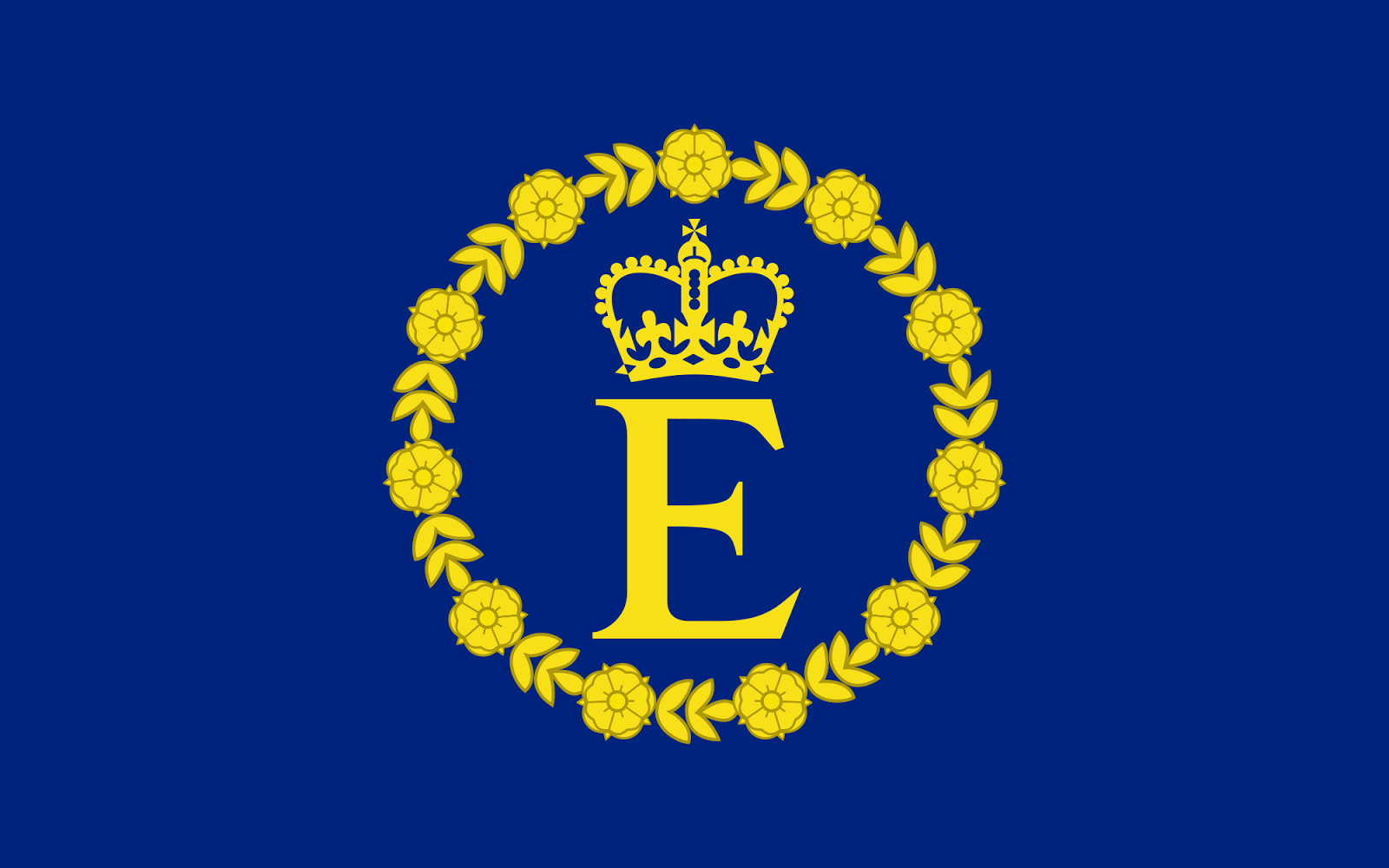
No crowns or royal shields. The Commonwealth flag
represents the fact that the Commonwealth is not a
hereditary Crown institution, and that being
Head of the Commonwealth is separate and
distinct from that of being monarch.
and independence from London. Up to 1949, British monarchs evolved from being the unitary head of the Empire to being the head of state of all independent countries within the British Commonwealth of Nations. In that year, Ireland voted to become a republic, an action which automatically severed its membership in the organization, and India was expressing republican sentiments as well, but did not want to break all ties with the British monarch and the other Commonwealth countries. This resulted in new membership criteria being drawn up in London which allowed members to be republics, so long as they recognized King George VI – the present Queen’s father – as Head of the Commonwealth. The London Declaration also renamed the organization as the Commonwealth of Nations, marking the birth of the “New Commonwealth” which became predominately composed of countries which no longer owed allegiance to the Crown, but accepted the monarch as “a symbol of the free association of [the] independent member nations.”
 

     But according to Robert Hardman, no one said anything about passing the title on. When Elizabeth II succeeded her father in 1952, the Indian Prime Minister, Jawaharlal Nehru, sent her a telegram welcoming her as Head of the Commonwealth, and everyone simply followed along (which technically means that this was the only position to which Elizabeth was “elected”). Back then, it was probably difficult to think of anyone else succeeding to that title. Britain still had many imperial possessions around the world in 1952, and there were probably conflations between the Empire and the Commonwealth, with many people believing that the new Queen ought to have the same international standing as her predecessors.

     61 years on, Elizabeth II has certainly enjoyed an international status affording to few other world leaders thanks to her role in
The personal flag of Elizabeth II which she uses in her role as
Head of the Commonwealth, especially when traveling in
Commonwealth countries that are not realms of the Crown.
the Commonwealth. Most Commonwealth countries and leaders have expressed their appreciation for the Queen as Head of the Commonwealth. They have direct lines of communication to the Queen (meaning that they do not have to go through the British government), and she has visited almost every Commonwealth country. The leaders also appreciate the fact that she takes a keen interest in the affairs of the organization as well as individual member states, but upon the Queen’s death, they will have to decide who will succeed to the title. Given the historic link between the Crown and the Commonwealth, it is easy to assume that Prince Charles will be selected to succeed his mother, but again, this is not a given.
     The Prince of Wales’s appearance at the CHOGM can therefore be seen as preparing the ground for him to succeed to his mother’s title. His address opening the summit was not so much a campaign speech as it was a declaration of his hopes and aspirations for the future of the Commonwealth. The speech was also his own statement of support for the organization, which he praised for its ability to evolve to meet the needs of its members. Charles called on the nations of the Commonwealth to increase cooperation in creating solutions to vital issues such as poverty, climate change, economic development, and connectivity among people. He invoked the aforementioned Jawaharlal Nehru (with whom he shares a birthday), who believed that the Commonwealth ought to provide a “touch of healing” to solving the problems facing the modern world. Avoiding any direct mention of the political issues currently swirling around Sri Lanka, the Prince instead praised the island nation for its strength and character following the 2004 tsunami.

     Respecting the delicate balance of tense political issues is part of the job for the Head of the Commonwealth, who must represent unity and be above the fractious political fray. While the politicians in attendance (including Prime Minister Cameron) were seen jeered and heckled by some protesters, Charles and Camilla received a warm reception. The closest encounter with politics occurred behind the scenes in the form of the one-on-one discussions the Prince had with each of the prime ministers and presidents – just as the Queen would do if she had been there.

     Later at the banquet – held in a ballroom named the King’s Court – Prince Charles shared his personal connections with the Commonwealth and its people, such as when Kwame Nkrumah of Ghana gave Charles a set of bow-and-arrows, and he had the audience in laughter over a story about water-skiing with Dom Mintoff from Malta (which was announced as the host for the next CHOGM in 2015).

     The banquet and the opening ceremony also featured the appearance of the Commonwealth Mace, a gift given to the Queen by the Royal Anniversary Trust in 1992 upon the occasion of the 40th year of her accession. With 18 karats of gold and the enameled flags of the Commonwealth countries decorating it, the mace appears to represent the power of the Crown at an organization where the top job is technically not a Crown office.

     Nevertheless, before this summit, leaders were already expressing some support for continuing the link with the Crown.
Julia Gilliard, the Queen's 12th Australian
Prime Minister, who was also the first female
prime minister of the country.
Back in March, the then Australian Prime Minister, Julia Gilliard, gave her own tribute to the Queen, and stated that she was “sure the Queen’s successor as monarch will one day serve as Head of the Commonwealth with the same distinction as Her Majesty has done.” On Commonwealth Day that month, Commonwealth Secretary-General Kamalesh Sharma acknowledged the Queen’s service as the Head of the Commonwealth, applauded Charles’ role in the organization, and elaborated on “a foundation of friendship and continuity” in association with the royal family. He also stated that the “Crown has symbolized the free association of our nations and our peoples.” In her response, the Queen said that she appreciated the “kind and generous sentiments, and for [the] thoughtful words about the link between the Crown and the Commonwealth and its enduring value.” At the Commonwealth banquet,
Sharma went on to say that the support given by Prince Charles “deepens the Commonwealth’s links to the Crown. Such heartfelt enthusiasm brings a foundation of friendship and continuity.”

     The Commonwealth – this club of former imperial relations means a lot to the Queen, who has done much to keep it together in 
Kamalesh Sharma, the
Commonwealth Secretary-General.
spite of squabbles between members (especially during the disputes with South Africa's apartheid policy). The bi-annual summit helps to bring the peoples of the far-flung Commonwealth together and to achieve greater cooperation and understanding amongst each other, resulting in ever-closer relationships among peoples and their respective countries. It is also a celebration of commonly-shared aspirations and values, as well as the hopes for a brighter future in voluntary association with one-another. It is the Queen, as Head of the Commonwealth, who helps to provide a sense of stability and continuity for the organization and its people, which helps to strengthen deep bonds.
Commonwealth leaders have expressed their desire to stay together and to use the organization as a vehicle for providing assistance to countries like Sri Lanka that are through political and social difficulties.

     And with his presence at the CHOGM, Charles may have gone a long way in carrying on his mother’s legacy by securing the position of Head of the Commonwealth when his time comes.


Photo Credit: GovernmentZA via Flickr cc, Bastin8 via Wikimedia Commons cc, Foreign and Commonwealth Office via Flickr cc, DilatoryRevolution via Wikimedia Commons cc  

Sources:
  • Hardman, Robert. Her Majesty: Queen Elizabeth and Her Court. New York: Pegasus Books. 2012. Print (Page 336).

Friday, November 15, 2013

Prince Charles at 65

Charles, Prince of Wales during a visit in Jersey in 2012.

     No other heir to the throne has waited as long as he has done. No other heir in history has lived under the near-constant glare of the media spotlight, nor mocked for his idiosyncrasies. No other heir has arguably ever come under such close scrutiny for both his private and public actions, nor created as much controversy as the result of such actions. 

Prince Charles with his father and mother, the Queen and Prince Philip, and his sister Princess Anne at Buckingham Palace in the 1950's.

     His Royal Highness Prince Charles Philip Arthur George, Prince of Wales and Earl of Chester, Duke of Cornwall, Duke of Rothesay, Earl of Carrick, Baron of Renfrew, Lord of the Isles, Prince and Great Steward of Scotland turned 65 years old yesterday, the age for retirement for many people (as well as when a pension can be drawn, which will be donated by the Prince to charity). However, he has not even begun to take the reins of the job for which he was born.

     Being the heir to the throne is an unenviable position, for it carries no official responsibilities. Indeed, Britain’s unwritten 
Prince Charles at Andrews Air Force Base in the USA, 1981.
constitution is silent on what the heir actually does. In addition, the hereditary and customary titles held by Charles are mostly ceremonial and carry no official constitutional standing. Much like the Vice President of the United States, the heir to the thrones of the Commonwealth realms has three primary duties: to support the head of state, act in that person’s stead when necessary, and to succeed such person in the event that he or she dies. In the case of the Vice President, at least he or she is in office for a limited period of time (and gets to preside over the US Senate). But the role of heir lasts for as long as the reigning monarch is living, and without a defined constitutional role, Charles – like other heirs before him – has had to carve out a role for himself.
      
     The Prince of Wales has done so by going beyond the traditional royal boundaries of merely recognizing voluntary and charitable efforts. Indeed, he has pushed such boundaries by engaging in charity work and being a vocal campaigner on issues that 
are important to him, such as the environment, sustainability, 
Among other things, the Prince's Trust sponsors
the "Team Program" - a 12 week program which
helps 16-25 year old's to build skills and confidence.
Here, these young people completed a course
in partnership with the West Midlands Police.
energy efficiency, urban regeneration, architecture, alternative medicine, the armed forces, and giving disadvantaged and troubled youth a fresh start. Where there is a gap in the voluntary sector, he feels they need to fill that void. In addition to being the patron of over 400 charities, there is a core network of 25 trusts and foundations - described by journalist Robert Hardman as “Britain's most extensive multi-cause charitable network” – which the Prince himself runs and for which he raised around £141 million ($224 million) from April 2012 to March 2013 – with his staff describing him as a “charitable entrepreneur.” Among the most important these bodies is the Prince’s Trust, which has given 650,000 young men and women financial and practical assistance to start a business or get into a desired career. Its beneficiaries have included Idris Elba from The Wire and James Somerville, co-founder of the design company Attik. Prince Charles has also carved out a role in which he uses what he calls “convening power” – the ability bring people together at a table to discuss issues, resolve differences, and take action.


     Among the issues where the Prince has used his “convening power” has been in the area of interfaith dialogue. As the future Supreme Governor of the Church of England, he is a confirmed and practicing Anglican, but like his mother, he also worships in the Presbyterian Church of Scotland when he is north of the (Anglo-Scottish) border. However, he has long realized that Britain – though still mostly Protestant – has become a multi-faith country, and that he cannot afford to ignore millions of his future subjects 
Charles and Camilla visiting a synagogue.
who practice a faith different from that of Protestant Christianity. He has
attended Catholic masses, and the Archbishop of Westminster – Vincent Nichols – has remarked that Charles appears “thoroughly at home” while visiting Westminster Cathedral. Earlier this year, he was the keynote speaker at the World Islamic Economic Forum, and opened his address with the Arabic phrase, As-salamu alaykum which means “peace be with you.” He is also patron of the Oxford Centre for Islamic Studies, whose director, Farhan Nizami has described the Prince as “a friend of Muslims.” Within the Jewish community, he has forged close ties with Jonathan Sacks, who recently stepped down as Chief Rabbi, and just yesterday, he attended a service at an Indian synagogue.  Having studied both religions, he believes that they have much in common with Christianity by having universal truths, and desires to build bridges to span the chasms between them. 

     This may explain why the Prince stated in 1994 that he would rather see himself as “Defender of Faith”, not “Defender of the Faith” – a title used by English and British monarchs since Pope Leo X granted it to Henry VIII of England in 1521 – when he accedes the throne. It is also expected that his coronation, while still being an Anglican Christian ceremony, will include a role for representatives of other faiths. Indeed, it does appear that the Prince’s belief in the universality of faith in all of its forms endears him to many Britons in an age when faith is seen as old-fashioned and hogwash. 

     It is the Prince’s faith that probably also guides him on environmental issues, nature, sustainability, and architecture. He has been speaking out on the issues regarding climate change before it became front-and-center on the political agenda, and has 
Dumfries House, which was saved
in part by the Duke of Rothesay.
campaigned to save the British countryside from excessive development brought about by urban sprawl. To this end, he has been an advocate of the redevelopment of urban areas and of adapting older buildings to new uses. For example, Charles led a £45 million consortium which purchased Dumfries House and its surrounding estate in Ayrshire, Scotland before it was sold off and broken up. After much restoration work, the not only is the house open for tours of its contents, but the estate has been reactivated into a working farm producing meat and dairy for a local supermarket, as well as providing research, educational, and training opportunities – which in turn has helped to stimulate economic activity in the area. 

     More controversially, he has spoken against modernist architecture – most famously referring to a proposed extension of the National Gallery in London as “a monstrous carbuncle on the face of a much-beloved friend.” He has also personally intervened  in projects using modern architecture, leading to some such projects (such as the redevelopment of the Chelsea Barracks in London) either being scrapped or significantly changed to incorporate more traditional forms for architecture. 

     For the Prince, architecture and development are part of his greater environmental agenda. He believes in sustainability, making the interests of humans coexist with those of nature, and taking 
Charles has been a long-time advocate for sustainable
development. Here he is with students taking part in
a course on sustainable urbanism which he founded.
action on climate change. With this in mind, he recently attacked "corporate lobbyists" and skeptics for turning the Earth into a “dying patient”, and during a 2011 address to the European
Parliament, he accused such skeptics of playing a “reckless game of roulette” and having a “corrosive” effect on public opinion with regard to belief (or lack thereof) in the seriousness of  climate change. In a display of the use of his “convening power”, in 2009 he gathered every head of government from the G20 Summit (which was being held in London) and was able to extract $6 billion in rainforest relief. Close to home, he has pursued an interest in horticulture and created an eco-friendly environment at his personal estate at Highgrove in Gloucestershire, England. He is also a proponent of using organic products, and produces a range of food and drink items under the name “Duchy Originals” (named after the Duchy of Cornwall, which is held in trust by the Prince in his role as Duke of Cornwall). For his part, Charles has stated that the birth of Prince George has reinforced his views on the environment, as well as his conviction that he must do something to help preserve the planet and the natural world created by God for future generations. 

     Over the years, much has been made about the Prince’s advocacy, and whether it is constitutionally permissible for the heir to the throne to speak out on issues which may be controversial, such as his opposition to genetically modified food and his support for access to homeopathic remedies at medical facilities owned and  operated by the National Health Service. His meetings with and 
Prince Charles meeting with the UK's leading politicians:
Prime Minister David Cameron (right), Deputy PM Nick
Clegg (center), and Opposition Leader Ed Miliband.
ministers and civil servants - some known as “black spider memos” due to the Prince's handwriting - have led to accusations of royal “meddling” in matters of public policy from city/town planning to fox hunting. Some ministers - including former prime minsters Tony Blair and John Major - and supporters of the Prince insist that he does nothing more than express his views on issues affecting the country of which he will one day be king. Ministers can refuse to meet Charles, and if they do have a meeting with him, they are under no obligation to take his views and opinions into consideration when they are making public policy decisions. Other people have expressed concern that Charles, by virtue of his position, can project undue influence on policies affecting the nation in a way that most people cannot, and that such influence by an unelected person should not be permissible (which sounds rather suspect when one considers the politicians who serve the interests of their special interest paymasters, who for the most part happen to be unelected). Then there are those who believe that the principle of having a non-partisan monarch is extended to the monarchy in general, and that any political interventions would be seen as taking sides and can damage the long-term future of the monarchy. 

     Another issue that has dogged the Prince and has brought the future of the monarchy into question is that of his private life, and in particular, his first marriage to Diana, Princess of Wales, and his second marriage to Camilla, Duchess of Cornwall.

      Certainly, the collapse of his first marriage provided much fodder for the media for the media to portray Charles as cold and 
The nadir for Prince Charles and the monarchy
was probably in the wake of the death of Diana.
aloof in contrast to the warm and in-touch Diana. Worse still were the revelations of infidelity and Diana herself questioning the Prince’s fitness for kingship, which was the last straw and brought the marriage to an end. Then came Diana’s tragic death in 1997 and the royal family’s initial reluctance to give Diana a farewell that many British people felt she deserved, which was perceived as having a lack of compassion for the dead princess. This was the probably the darkest hour for the monarchy since the abdication crisis in 1936 and for Prince Charles in particular, who now faced open hostility to the idea of him attaining the throne. From here was a gradual process of earning back the respect of the people. 

     Part of that process has included overcoming the obstacles resulting from the Prince’s relationship with the then-Camilla Parker Bowles. Diana reportedly referred to her as “the Rottweiler” and pointed out that she was the third person who was crowding up 
Eight years on, and these two have formed a solid
partnership as a happy and contented couple.
her marriage with Charles. Public opinion squarely blamed Camilla for the failure of that marriage, and did not want Charles to marry her, nor for her to become his Queen. After coming out publicly as a couple however, Charles and Camilla slowly began making to the idea of a marriage more acceptable, especially as Camilla’s profile was increased – being seen with Charles and the Queen at public engagements, which indicated the royal seal of approval. As it was, the marriage did take place in 2005, and in eight years, has appeared to be a successful and happy one. For a man who has had difficulties in his private and public life and has been described as being married to his desk, the marriage to the Duchess of Cornwall has provided some comfort and stability. One only needs to see them together to understand how well they get on with each other.
Camilla herself has now become fully integrated into the machinery of monarchy and has earned the respect and affection the people through her own brand of regal warmth and openness. She is not a replacement for Diana - no one can replace her, not even the Duchess of Cambridge - but she certainly coming into her own as an asset for the monarchy.


     So what is this author’s overall verdict on Prince Charles? Is he an old crank with reactionary ideas? Or, is he a visionary with a long-term view who is ahead of his time? 

     Quite simply, he is man who desires to use his status to good use. According to Time magazine, it was a diplomat by the name of Christopher Soames who “pointed out that few people reject an invitation to meet the heir to the throne, especially if a fancy dinner and highfalutin guests are added to the mix.” Since then, he has used his royal status to bring awareness to causes important to him, and to get people with money and influence to fork over wads of cash to fund his charitable pursuits, which in turn helps to raise more awareness and goes toward providing assistance to people and causes that are in need of it. 

     It is this author’s opinion that it is probably a good thing that the heir to the throne takes an active interest in issues that affect the United Kingdom and the lives of its people. After all, he will be king one day, and it is sensible that he would like to have a firm grasp of 
The Prince shaking hands with a crowd.
what the government does, as well as how and why it does it, which is something that his mother did not have upon her accession at the age of 25. If anything, his time as heir is different from that of Edward VII, who was prevented by his mother Queen Victoria being allowed to take a part in the affairs of state. Some sources who have served in government (Tony Blair's former press secretary Alastair Campbell among them) have alleged that from time to time, the Prince has had to be told to exercise restraint in his interventions by various people, including by Blair himself at one point. But so long as Charles avoids actually endorsing political parties or stumping on the campaign trail for one party or the other, it does not appear that he is overstepping his boundaries. Writing for the Australian, Kate Mansey and Peter Conradi said that the Prince now  
“has a member of his staff seconded to the Cabinet Office [the department supporting the Prime Minister and the Cabinet] and one of its civil servants is working for him...which means that the government will learn his views and he can better understand what it is working on.”
Similarly, his charity work is an outlet for him to do something productive (and often out of the limelight), rather than twiddling with his thumbs. It may still be a very long time before he succeeds the Queen (especially given her good health), so it is better for him reach out and put his money where his mouth is, instead of being seen as aloof and living off of inheritance with no sense of social responsibility. He is a sensitive man, but has a burning conviction on making his views known on issues of national importance. If anything, unlike politicians who tend to act in short-term electoral interest, the Prince takes a long-term view on how policies effect people, and has expressed frustrations about political figures who try to take the easy way out of critical issues by applying band-aids (or in some cases, ignoring problems), as opposed to solving them with sustainable and long-lasting solutions. 

Coat of Arms of Charles, Prince of Wales. Ich Dien means "I serve"

     However, once he does become king, Charles will likely have to curb his advocacy activities. He himself admitted as such, when he told Robert Hardman of the Daily Mail that he may not be able to champion his favorite causes “in the same way” when the constraints of kingship are placed on him. (According to Time magazine, he is already in the process of consolidating his charities into stronger entities that can go on with less of his direct leadership.) It must be remembered that in exchange for the status of being head of state, British monarchs have given up most political power to elected officials. This allows the monarchy to have the moral authority of being the focus of unity and stability for the British nation, and this is partially the reason why the monarchy has remained popular and relevant to the present day. The Prince of Wales will have to be careful. As king, he will have the right to be informed of what the government is doing, as well as the right to ask questions and demand answers from the prime minister and other members of the government. However, he ought to be wise in choosing his causes - so as not to cause division by blatant political partisanship on his part. There are anti-monarchists in Britain who are hoping that Charles will overreach himself (like a previous king named Charles) and provide the spark for their movement to abolish the monarchy. 

     For now though, the Prince will carry on was he has been doing for over 60 years. Indeed, as the Queen continues to age, he will be seen more often in her stead. Last year, he carried out 657 engagements on behalf of himself and his mother. Earlier this year, he attended the State Opening of Parliament at his mother’s side and this week, he will represent her at the Commonwealth Heads of Government Meeting (CHOGM) in Sri Lanka. All of these actions are seen as beginning a transition in which the Prince takes on some of the Queen’s ceremonial duties, such as investitures and meeting foreign dignitaries, resulting in a co-regency of sorts. They are also seen as preparing Charles for kingship as well as the public and the wider world for the reality that he will be king.


     According to a recent Time magazine, aides to the Prince say that he is in no rush to become king, and if anything, is already feeling the weight of the crown like something akin to a prison 
More than anybody else, Charles understands that in order to
gain the throne, he will have to lose someone very dear to him.
sentence. But
other “royal sources” have in the past claimed that he is chomping at the bit for the crown and is impatient each day that he waits. The truth probably lies somewhere in between. As was stated earlier, being the heir the throne is an unenviable position since it carries little formal authority or responsibility, other than deputizing for the reigning monarch. Not merely wanting to be “a presence,” he has had to struggle to find a role for himself, all the while dealing with chaos in his personal life that has spilled out into the public realm. Now, having reached retirement age, he has in many ways found his role as the heir and has found happiness in his personal life. Perhaps this is a reason why Charles is not in a hurry to be king (aside from the fact it requires the death of his mother). Right now, he can define his position as heir to the throne as he wishes, but as king, he will likely be heavily defined by that position, and severely circumscribed by it.  

     Even so, with his long apprenticeship, he will be well-prepared to ascend to the throne because of the work he has done, which 
He's sailing through calmer waters these days.
gives him personal insights into the lives of his people, gives
him  relevance in modern society. It is true that he is going to be the oldest person to inherit the throne, but that fact ought to give reassurance that the monarchy will be in good and seasoned hands when the time comes. He has weathered through personal and public chaos in his life, questions about his fitness to reign, criticisms of his advocacy, and suggestions that he ought to bow out in favor of William. Now, he appears more at ease with himself and new polling reveals that the majority of Britons want Charles III (or George VII) to be their next king. After waiting for so long, it will be interesting to see the direction in which he takes the monarchy, so that it can continue to be relevant going forward. 

     Let us hope that he has many more happy birthdays, and that he continues to work hard in the service of his country and the Commonwealth.


Photo Credit: Dan Marsh via Wikimedia Commons cc, BiblioArchives/LibraryArchives via Flickr cc, West Midlands Police via Flickr cc, Gordon Brown via Wikimedia Commons cc, M3peti via Wikimedia Commons cc, SFU Public Affairs and Media Relations via Flickr cc, Simon Jones via Flickr cc, Worthy FM via flickr cc, Trinidad-News.com via Flickr cc, Sodacan via Wikimedia Commons cc, Birmingham Culture via Flickr cc, Victoria Johnson via Flickr cc 

Monday, November 11, 2013

Remembrance Day

     At 11:00 AM on November 11, 1918, the guns fell silent across Europe. Today, two minutes of silence is observed throughout Britain and the Commonwealth at the 11:00 hour in memory of those who gave their lives in World War I and in other past military conflicts. 

Across the Commonwealth, poppies are worn to commemorate soldiers who have died in war.

     It is a day known as Remembrance Day in the United Kingdom and other Commonwealth countries. Originally Armistice Day on both sides of the Atlantic, it initially commemorated the moment when the armistice between Germany and the Central Powers and the Allied nations (Britain, America, Canada, etc.) took effect, which ended the fighting in World War I. In the United States, November 11th is now known as Veterans Day, although the more equivalent holiday is probably Memorial Day in May, since it commemorates those who died in service while Veterans Day commemorates the service of all military veterans.

     In the United Kingdom, the actual day of observance is held on Remembrance Sunday, the second Sunday in November which is closest to November 11th, and the first day of observance was commemorated by King George V in 1919.

The Cenotaph in Whitehall
     Yesterday, national remembrance was observed at the Cenotaph on Whitehall Street in London in a solemn ceremony that has changed little since 1919. In attendance were the Queen and other members of the royal family, along with Prime Minister David Cameron, Deputy Prime Minister Nick Clegg, and Opposition Leader Ed Miliband, as well as all living past Prime Ministers – Sir John Major, Tony Blair, and Gordon Brown. There were 40 high commissioners representing Commonwealth nations and several political and state dignitaries, as well as over 10,000 military veterans representing conflicts from World War II to recent engagements in Afghanistan, Iraq, and Libya. In addition, this year's ceremony marked the inclusion, for the first time, of 41 members of the British Resistance Movement (a.k.a., Churchill's Secret Army), who were tasked with going underground and continuing to fight in the event of a Nazi invasion of Britain.

Field of Remembrance at Westminster Abbey, 2007

     The Remembrance Sunday ceremony was led by the Bishop of London, Richard Chartres and began with a two-minute moment of silence at 11:00, which ended with a shot from a cannon in St. James’s Park and a bugler playing Last Post. Following this, wreaths of red poppy flowers were laid at the Cenotaph by the Queen, the Duke of Edinburgh, the Duke of Cambridge, Prince Harry, and other leading dignitaries. Poppies have become a prime symbol of Remembrance Day because of the trench warfare that was fought in the poppy fields of Flanders in Belgium which were made famous in Canadian John McCrae’s poem, In Flanders Fields. In the lead-up to Remembrance Day, the Royal British Legion and other organizations across the Commonwealth sell paper and/or plastic poppies to help fund their work in providing support to current and former members of their respective Armed Forces and their dependents. After the conclusion of yesterday's service, members of the armed forces – past and present – marched down Whitehall in a parade.

The Canadian Scottish (Princess Mary's) Regiment marching in a Remembrance Day parade in 2010.

     Other Remembrance Sunday services were held throughout Britain, including large gatherings in Birmingham, York, Bristol, and Portsmouth. In Scotland, First Minister Alex Salmond and Secretary of State for Scotland Alistair Carmichael laid wreaths at St, Giles Cathedral in Edinburgh; Welsh remembrance was held at the Welsh National War Memorial in Cardiff. In Northern Ireland, the Irish Republic's Taoiseach (Prime Minister) Enda Kenny laid a wreath at the war memorial in Enniskillen, while Northern Irish First Minister Peter Robinson with the Secretary of State for Northern Ireland Theresa Villiers and the Irish Republic’s Deputy Prime Minister Eamon Gilmore attended a ceremony in Belfast. 

     Overseas, other members of royal family took part in additional events and ceremonies.

     Prince Andrew, along with Secretary of State for Defense Philip Hammond laid wreaths during a service at Camp Bastion at Helmand Province in Afghanistan which honored the 446 armed forces personnel that have been killed in the Afghan conflict. In India, Prince Charles and the Duchess of Cornwall – who are on a nine day tour of the largest Commonwealth country – marked Remembrance Sunday by attending a church service in Mumbai and meeting some of India’s last surviving veteran of the Second World War, including Madahukar Dongre, the last living holder of the Burma Star in India. 

     Remembrance Day is very significant for the Queen and the royal family, for the Queen is Head of the Armed Forces. The British Armed Forces have counted many members of the family among their ranks, including Prince Philip (Royal Navy), Prince Charles (Navy), Prince Andrew (Navy), Prince William (Royal Air Force), and Prince Harry (British Army). Elizabeth II herself served as an automobile driver and mechanic in the Auxiliary Territorial Service (ATS) during the closing months of World War II. 

Princess Elizabeth as a 2nd Subaltern in the ATS.
Image Source: Imperial War Museum
     As Head of the Armed Forces, the Queen pays tribute to all of the people who have died in her name, as well as in the names of her predecessors. On a personal level, she also probably honors the memory of the uncle she never met – Fergus Bowes-Lyon, an elder brother of her mother, who was killed in action during the First World War, as well as another uncle – Prince George, Duke of Kent, who died in a plane crash over Scotland during World War II as an RAF pilot in 1942. 

     Indeed, all of us ought to be remembering those who have served in the armed forces on both sides of the Atlantic and died in past and present conflicts. The work of such people usually goes on without much fanfare and is rather under-appreciated in our everyday lives. A day like this one gives people a chance to reflect on the sacrifices made to ensure that we have “everyday lives” and to be thankful for their heroism, especially when some of them have made the ultimate sacrifice in the defense of liberty and freedom.

     May God bless the United States, United Kingdom, and the Commonwealth, and may the bonds between our nations be forever strong and enduring.

Uncle Sam and Britannia