Showing posts with label Princess Beatrice. Show all posts

Sunday, March 23, 2014

15 Facts About Princess Eugenie of York


A list of important facts about one of the Queen's granddaughters.


1. Princess Eugenie was born on March 23, 1990 at Portland Hospital in London.

2. She is the second child and younger daughter of Prince Andrew, Duke of York and Sarah, Duchess of York, as well as the sixth grandchild of Queen Elizabeth II and Prince Philip, Duke of Edinburgh. This makes her a first cousin of Prince William and Prince Harry.

3. Her full title, style, and name is: Her Royal Highness Princess Eugenie Victoria Helena of York, and she was the first Royal baby to have a public baptism - which occurred on December 23, 1990 at the Church of St. Mary Magdalene, Sandringham under Peter Nott, Bishop of Norwich.

4. She is named after Victoria Eugenie of Battenberg (a granddaughter of Queen Victoria) and Princess Helena (Queen Victoria's third daughter and fifth child).

5. Eugenie is the first British princess to bear the name "Victoria" since George V's sister, Princess Mary (whose full name was Victoria Alexandra Alice Mary).

6. The Princess suffered from scoliosis, and successfully underwent back surgery to correct the condition at the Royal National Orthopedic Hospital in London.

7. For her primary and secondary education, Eugenie attended Upton House School and Coworth Park School, before going to St. George’s School in Windsor, and then moving on to Marlborough College (attended also by the Duchess of Cambridge) in Wiltshire from 2003 to 2008. She completed A-Levels in Art, English Literature, and History of Art. 

8. After taking a gap year, the Princess enrolled at Newcastle University, where she took up a Combined Honours BA in English Literature, History of Art and Politics, and graduated in 2012 with a 2:1 degree (upper second-class honors).

Coat of Arms of Princess Eugenie of York

9. Since graduation, Princess Eugenie has been pursuing a career in the art world, and is currently in New York City working for the art and designs action house, Paddle8.

10. Though not a full-time working member of the Royal Family, Eugenie has appeared at several public royal gatherings, such as Trooping the Colour (to mark the Queen's Official Birthday), and the events commemorating the Diamond Jubilee.

11. Her first patronage was the Royal National Orthopedic Hospital's Redevelopment Appeal, lending support to other people going through similar scoliosis treatments like her. In June 2012, she raised money for the hospital and the Marylebone Cricket Club Foundation as one of around 3,000 cyclists to take part in Nightrider, a 100 km bicycle ride through London. For her support and patronage, an accommodation unit at the hospital will be named Princess Eugenie House.

12. Princess Eugenie is an ambassador for the Teenage Cancer Trust and a member of the Committee of the Young Marlburian Foundation (in connection with her former school, Marlborough House).

13. In January 2013, the Princess and her elder sister Beatrice visited Germany to undertake a series of engagements. In Berlin, they promoted British business as trade envoys on behalf Her Majesty’s Government. They also represented the Queen at the reopening of Herrenhausen Palace, where their ancestor, George II was born in 1683. The Hanoverian palace was bombed by the Royal Air Force during the Second World War, and had recently gone through a massive restoration project.

14. Eugenie and Beatrice are the only granddaughters (out of four) of the Queen to bear the title of Princess of The United Kingdom of Great Britain and Northern Ireland and the style of Royal Highness. Their elder cousin, Zara Tindall, was born from the female line (Princess Anne), and carries no title since her father had none to pass on. Their younger cousin, Lady Louise Mountbatten-Windsor - though born from the male line - is styled as the daughter of an earl (at the wish of her parents, the Earl and Countess of Wessex).

15. The Princess is currently seventh in line to the thrones of the United Kingdom and the other 15 Commonwealth realms.


Photo Credit: VinnieLDA via Flickr cc, Sodacan via Wikimedia Commons cc

Monday, March 3, 2014

Royal Overexposure?

     On Thursday, February 27th, Princess Beatrice had her Twitter account formally verified (@yorkiebea), making her the second known member of the Royal family to establish a personal account on the social media site.

The Princess's Twitter account ballooned from just under 2,000 followers to over 10,000 in the five days since it was verified on February 27th.

     She follows in the footsteps of her father, Prince Andrew, Duke of York, who took to Twitter in April 2013 (@TheDukeofYork), as well as her mother Sarah (@SarahTheDuchess). In addition, Buckingham Palace has its own page representing the Queen and the Royal family in general (@BritishMonarchy), and Clarence House created a page for Prince Charles, Camilla, the Duke and Duchess of Cambridge, and Prince Harry (@ClarenceHouse).

     All of these pages - alongside sister accounts with Facebook, YouTube, Flickr, etc. - are usually for the posting of official activities and to keep followers informed on how the monarchy works, as well as on what the Royal family is doing and to give "shout-outs" to people, charities, and organizations they support. It is however, extremely rare for a member of the family to write a personal tweet - Andrew usually sign's such tweets with "AY" at the end for Andrew York - and in the case of Princess Beatrice, one has to believe that her account had to be cleared by the Palace in some way, and (perhaps) that she has been given guidance on using Twitter, given her status. The Princess is after all, sixth in line to the 16 Commonwealth thrones (including the United Kingdom).

     Nonetheless, this embrace of social media has not been received well by everybody. Naturally, republicans and cynics will roll their eyes and claim that the royal family is attempting to control the message that we receive about them (which is not new, because message control and PR have been going on centuries - including from republicans themselves), and even people with positive opinions on the monarchy have expressed concerns about the social media strategy. On Twitter, Victoria Arbiter - a royal contributor for CNN and CTV News - remarked on February 27th:

     "Am clearly stuck in the last century, but royals tweeting doesn't seem like a good idea! Survival is down to maintaining an air of mystery."


     This sentiment was further echoed by Victoria Coren Mitchell, writing for the Observer on Saturday, March 1st. In response to the reports that Prince George may be getting a full-time nanny after all, she poured water on the idea of royalty (or anyone else of high social status) "pretending" to be ordinary, and offered a warning that "if the new generation actually succeeds in becoming 'just like the rest of us' then republicans will not be placated and royalists might just stop caring."

     These beliefs uttered by Arbiter and Mitchell are not new; they have been echoed through the generations within, and outside of, royal circles - most famously and succinctly by the 19th Century constitutional commentator Walter Bagehot, who said: “We must not let in daylight upon magic.”

     The implication is that the danger going forward is not scandal or the appearance of being aloof and out-of-touch; it is that by becoming increasingly accessible to the people - and acting in ways that appear ordinary - the monarchy risks becoming irrelevant by losing its mystic qualities, which requires that Royal family place a veil between themselves and the people, and that their lives must reflect their status. To do any less would at best, be a dereliction of duty and at worst, be seen as patronizing and insulting to real ordinary folk who know that the royal family cannot possibly relate to them.

     In other words, if you are going to be royal, act royal, with the nannies, protocol, pomp and circumstance, and the like. That's what you are are paid to do.

     However, I believe it is false to espouse that the monarchy and members of the royal family cannot enjoy the best of both worlds: to be extraordinary and ordinary, as well as to be more accessible without letting everything hang out in the open. (Indeed, I would caution against anyone claiming to know everything about the monarchy, for there is much that we do not know, and should never know).

The Queen has deftly managed the transition of the monarchy into the new media age. Her's is reign that has witness the rise of various forms of media - from radio and television to the Internet and social media.

     It is a balancing act that must be delicately maintained. Members of the Royal family must place themselves above the people, but not become so high-minded that they appear look down on them with contempt and confirm the worst stereotypes of hereditary power and social status. At the same time, it does not hurt to become relatable in ways that are helpful, such as Princess Beatrice discussing her issues with dyslexia, and lending her support to charities that assist others with the same condition. Making personal connections with ordinary people is just as important as displaying a difference between them.

     Indeed, the story of monarchy in Britain for the past 1,500 years has been the story of a dialogue between Crown and People, which has, in the words of David Starkey, shaped the country's "social and political life to this day." Contact and interaction are necessary, especially in the present age. The question is: How much?

     Over the last century and up to the present, the balancing act has been executed well by the Queen, who - along with her advisers - has shrewdly seen the need to open up the Palace and bring it closer to the masses, but only so much. As time goes on, the pressures of the new media landscape and the voracious appetite for all things royal will challenge to monarchy to break down more barriers. 

     However with Prince William's protective attitude towards his family - born out of the chaos of his parents marriage - we should expect the balance to be healthily observed in a way that serves the interests of both Crown and People.

Tuesday, December 31, 2013

Royal Year 2013 - Part III: Yorks, Wessexes, Princess Anne & Family, and the Gloucester's and Kent's


Yorks

The Duke of York speaking at a function held at Titanic Belfast.

     Prince Andrew, Duke of York and especially his daughters Beatrice and Eugenie tend to be under the radar in terms of royal coverage, and 2013 was not much different. But this is not to say that the York’s are not doing anything at all.

     Since stepping down as an official Special Representative for UK Trade & Investment amid heated controversy, the Duke of York has continued to support British business overseas as a trade envoy. However, it does appear that he is making more of an impact at home, supporting the work of organizations devoted to causes close to him, such as entrepreneurship, education and skills for young people, and science and engineering. In an interview with the Daily Telegraph, he stated that he believes in the value of a technical education, for it gives young people skills that make them employable. As a 25 year veteran of the Royal Navy, he has a passion and concern for the Armed Forces. As such, he has raised money for the Royal Marines Charitable Trust Fund. In this year, he has become the Patron of London Metropolitan University and University of Huffersfield. He also joined Twitter, and his office has been tweeting information on his public engagements and activities, as well as giving mentions to organizations that he supports. 

     Princess Beatrice, a 2011 graduate of Goldsmiths, University of London with a BA in History, has been trying her hand in the financial services industry, but also conducts some royal engagements on her own and on the behalf of her father and grandmother, as well as the British government. In April 2013, Beatrice became the royal Patron of the Helen Arkell Dyslexia Center, a charity that she credits with helping her to overcome academic challenges resulting from her own dyslexic issues. In October, she met the Pakistani youth activist Malala Yousafzai at a reception entitled "Youth, Education, and the Commonwealth", and said that it was an honor to meet her. 

     Princess Eugenie graduated in 2012 with a combined Honors BA in English Literature, History of Art and Politics at Newcastle University. She has an interest in art, and moved to New York City this year to become a Benefit Auctions Manager at the Paddle8 auction house.
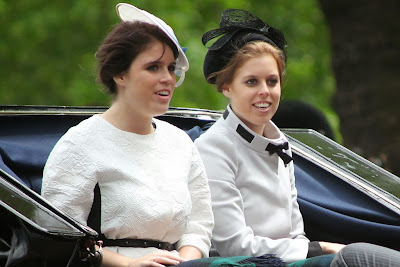
Princess Eugenie and Princess Beatrice

     In early 2013, the princesses visited Germany to undertake a series of engagements. In Berlin, they promoted British business as trade envoys on behalf Her Majesty’s Government. They also represented the Queen at the reopening of Herrenhausen Palace, where their ancestor, George II was born in 1683. The Hanoverian palace was bombed by the Royal Air Force during the Second World War, and had recently gone through a massive restoration project.

     Going into the New Year, there is speculation about Princess Beatrice marrying her long-time boyfriend, Dave Clark, and the longevity of their relationship – five years – makes marriage (or at least an engagement) this year a possibility. 

     Similarly, there are rumors about Prince Andrew and his former wife Sarah, Duchess of York. Unlike the nasty and very public break-up of Charles and Diana, Andrew and Sarah parted ways on amicable terms, remained good friends, and have been committed to raising their daughters together. That commitment has included going on vacations and attending some functions together, and today they live under the same roof at Royal Lodge, Windsor, and have jokingly described themselves as the “world’s happiest unmarried couple.” 

     Following an alleged getaway along the Mediterranean over the summer, there has been guessing as to whether they will tie the knot again. The Queen reportedly has a soft spot for Sarah, and invited her to spend a few days with the royal family at Balmoral. However, Prince Philip would be opposed to such a reunion because of her indiscretions over the years, so if – and it’s a big if – it does happen again, it likely only happen after the Duke of Edinburgh has passed away, which may not be for a long time to come. 

Wessexes

The Earl and Countess of Wessex.

    In 2013, the world was fixated on the big names of the monarchy – the Queen, Prince Charles, Prince William, Kate, etc. However, the profile of Prince Edward, Earl of Wessex and his wife Sophie have been on the rise, especially during the periods when the Duchess of Cambridge was off-duty due to her pregnancy and  in the immediate weeks after Prince George’s birth. 

     Prince Edward, the Queen’s fourth and youngest child, was once a film producer before dedicating himself to life a full-time working member of the royal family. He is slated to become Duke of Edinburgh when Prince Philip passes away, and as such, has become a Trustee and key figure in the Duke of Edinburgh Awards, which was founded by Prince Philip for the purpose of encouraging young men and women to participate in, or create, activities which improve their lives, as well as the greater society. In this year, he has hosted and attended several functions related to the D of E Awards, as well as other charities he supports.

     Countess of Wessex – like the Duchess of Cornwall – has come into her own as an important part of the monarchy with her brand of grace and charm. In this year, she hosted a reception at Buckingham Palace to commemorate the 50th anniversary of the Doctor Who television series, made an official visit with Edward to South Africa, and embarked on a solo tour of India and Qatar. Some of these tours included taking care of business for the D of E International Award's, and in October, she became its first Global Ambassador while in South Africa, where she was learning how the award's scheme was helping to improve the prospects of young people in a local community.

     In June, Edward and Sophie also represented the Queen at the wedding of Princess Madeleine of Sweden and Christopher O’Neill.

     Their children have also gathered more attention. Lady Louise Mountbatten-Windsor turned ten years old this year, and has been seen at more public functions with her parents, such as the service at Westminster Abbey  commemorating the 60th anniversary of her grandmother’s coronation and the ceremony of Trooping the Color for the Queen’s Official Birthday in June. Her little brother, James Mountbatten-Windsor, Viscount Severn turned six years old a few weeks ago, and was seen on the balcony of Buckingham Palace with his parents and sister at the end of Trooping the Color and also attended the Coronation Festival in July. 

Princess Anne and Family


     For Princess Anne, the year was largely uneventful aside from her usual engagements and day-to-day duties. She most notably spoke out in favor of Britons eating horse meat, in light of the scandal which revealed that such meat was increasingly being used in British food products.


     Her daughter Zara, an equestrian who followed in her mother’s footsteps as an Olympian last year, announced that she and her husband Mike Tindall were going to be expecting their first child in January. This child will be the Queen’s fourth great-grandchild and will be 16th in the line of succession. Zara was also named as a godmother to Prince George during his christening back in October. 

Kent’s and Gloucester’s 

     Elsewhere, the Queen’s royal cousins were also in the headlines – for good and not-so-good.

The Duke of Gloucester

     Prince Richard, Duke of Gloucester and his wife Birgette attended the Inaugural Mass of Pope Francis at the Vatican in March. He is Patron of the Richard III Society, and coincidentally not only shares the name of the 15th Century king, but also his title before he became king, Duke of Gloucester. In this role, he reportedly took an interest in the discovery and eventual confirmation of Richard III’s remains, which had been found under a parking lot on the site of a demolished abbey.

The Duke of Kent

     Prince Edward, Duke of Kent suffered a mild stroke on March 18, 2013, though it was not reported until March 21st. He made a full recovery, and was back to conducting his royal duties shortly thereafter. In June, he accompanied the Queen during the Trooping the Color ceremony while the Duke of Edinburgh was recovering from abdominal surgery. 

Prince Michael of Kent

     The Duke of Kent’s brother, Prince Michael of Kent welcomed his first grandchild, Maud Windsor in August. Maud is the first child of Prince Michael’s only son, Lord Frederick Windsor and his wife, Sophie, and is currently 42nd in line to the throne. 

     Princess Alexandra (Prince Edward and Prince Michael’s sister) was forced to cancel all of her engagements after suffering from the effects of arthritis, and undergoing treatment. She returned to public life on September 16th with an engagement in Herefordshire as Patron of the Pennington‑Mellor‑Munthe Charity Trust, which operates two mansions as museums and hosts various cultural events.

Final Thoughts

     So the year of 2013 has seen much activity from the royal family, from the Queen down to her great-grandchildren and cousins. They have had a spectacular run over the past three years - the royal wedding in 2011, the Diamond Jubilee celebrations in 2012, and the birth of Prince George in 2013. 

     However such milestones are but tiny specks in the long and illustrious history of the monarchy. Moreover, they are but a few of the activities in which the family is engaged throughout the year. We often only see what is on television, with no little or no knowledge or appreciation for what they do with virtually no public fanfare.

     In the New Year, the royal family will continue perform schedule of engagements, attend ceremonies, do charity work, and take an active part in national life. It may not be as flashy as the last couple of years, but with the Australian tour, the Commonwealth Games, and other events, it will be a year to which to look forward.


Photo Credit: Titanic Belfast via Flickr cc, Carfax2 via Wikimedia Commons cc, Carfax2 via Wikimedia Commons cc, Northern Ireland Office via Flickr cc, Mareklug via Wikimedia Commons cc, Charlie Dave via Flickr cc, Paul Reynolds via Flickr cc

Saturday, October 19, 2013

Malala, the Queen, and the Commonwealth

      Following on from the Duke of Cambridge’s first investiture ceremony, Friday was another red-letter day for Buckingham Palace, where Malala Yousafzai, the young education activist from Pakistan paid a visit to the Palace to meet the Queen, Prince Philip, and other members of the Royal Family at a reception entitled "Youth, Education, and the Commonwealth."

Malala Yousafzai
 
      The 16-year-old’s outspoken beliefs on the right to education – especially for women and girls – made her a target of the Taliban, the Islamic fundamentalist organization that once provided safe harbor for Osama bin Laden, and which believes in the strict implementation of Sharia law. Yousafzai was shot in the head in October of last year by Taliban fighters while she was on the bus going home from school. She was eventually airlifted to the United Kingdom for treatment at the Queen Elizabeth Hospital in Birmingham, which specializes in the treatment of military personnel who receive similar head injuries while in conflict. Yousafzai now lives with her family in the West Midlands region of England while she continues her rehabilitation and goes to school. 


     But on Friday, she admitted that she had to skip school so that she could attend the reception that was being hosted by the Queen and the Duke of Edinburgh, which was attended by over 350 guests from academic institutions from across the world, as well as representatives from across the Commonwealth. Students from St. Winefride's School in Manor Park, East London, were also there, as well as the Commonwealth Youth Orchestra.

     The Queen, who was reported to have been keen on Yousafzai’s progress, appeared to be delighted to meet the girl, who since the attack has been nominated for the Nobel Peace Prize (though the prize eventually went to the Organization for the Prohibition of Chemical Weapons), met with President Barack Obama, and spoken before the United Nations.
 

     Accompanied by her father Ziauddin, Malala gave the Queen a copy of her book, I Am Malala, and told her of the importance of every child having access to education, including in the United Kingdom. Prince Philip jokingly interjected that in Britain, people only send their children to school so as to get them out of the house, to which Malala was reduced to a fit of giggles. Malala also talked to the couple about their previous visits to Pakistan, particularly a visit while the Queen was in her 20’s, when she came to the Swat Valley region from which Malala hails.

     After the reception, Malala expressed her appreciation for the events of that day, saying that she felt honored to meet the Queen. Before going to the Palace, she said that she was a bit nervous, in part because she was not sure about the proper etiquette when in the presence of the Queen (such as whether to curtsey and when to speak), but remarked that the Queen put her at ease by talking to her "in a friendly kind of way." She also expressed hope that the Queen and the UK Government could help provide support to her campaign for education


     Other members of the royal family who were in attendance were the Duke and Duchess of Gloucester, as well as Princess Beatrice. Upon meeting Malala, the Princess shook her hand, told her that it was "incredible" that she had achieved much in the last year, and that she was honored to meet her. Beatrice also said that her mother, Sarah, Duchess of York had been "completely moved" by what Malala had done, and would like to meet her as well.

     Personally, this author has also been moved by the bravery and courage of Malala Yousafzai. Being outspoken about the right to education for women and girls in a place where such an idea can meet a hostile reception certainly earns much respect, but even after the attack, she has remained defiant in the face of continued threats against her life. In addition, she has shown nothing but poise, distinction, and dignity throughout her time in the spotlight (which unfortunately, is not always exhibited in what passes for female role models these days). On Saturday, she displayed such poise and dignity again upon receiving an honorary Master of Arts degree from the University of Edinburgh.


     It is also a good thing that the Queen and the United Kingdom have welcomed Malala and her family with open arms. In fact, Elizabeth II herself is very familiar with meeting people from various backgrounds and cultures, as Head of the Commonwealth of Nations. In the course of her 61-year reign, the Queen as visit almost every Commonwealth country (including Pakistan), and has gone out of her way to make Commonwealth leaders and peoples feel comfortable in their interactions against her, especially when they come to visit Britain. In Robert Hardman’s book, Her Majesty: Queen Elizabeth II and Her Court, such leaders have remarked that the Queen knows personal details about things within their countries which only could have been gained through all of those visits over the years. As a result, the President of the Maldives, Mohamed Nasheed, has remarked that he has not "seen anyone who understands us more." Hardman concludes that the Queen's devotion to the Commonwealth (even when her ministers in Britain are not as enthusiastic) is a reason for why minority communities in Britain are endeared to her and respect her. Indeed, it is her willingness to go halfway around the world to meet and engage with people so different from her (and much of Britain) that has perhaps allowed for "friendly" moments like the meeting between her and Malala.


Photo Credit: Diogenes 013 via Wikimedia Commons cc