 |
| Prince Charles visiting Jersey in 2012. |
In December 2005, it was reported by The Times that Prince Charles had private discussions among close friends in which he suggested the possibility of being known as King George VII, rather than King Charles III when he accedes to the throne. The Prince’s office responded to the report by saying that no decision had been made and that “it will be made at the time” of succession.
Nonetheless, the speculation has carried on for the better part of the last eight years regarding what the future King of Great Britain and Northern Ireland wishes to be called, and such speculation was mentioned in a previous posting on this blog. It is often taken for granted that regnal (or "reign") names used by reigning monarchs are the same as their first name, but the reality is that there is past precedence for British monarchs to use a different name than the first name given at birth.
- Robert III of Scotland was born as John Stewart in 1337, and he became Earl of Carrick as the heir to his father, the first
 |
| Robert III, King of Scotland. |
Stewart king of Scotland, Robert II. When he succeeded to the Scottish throne in 1390, he decided to adopt the name Robert as a tribute to his great-grandfather, Robert I (the Bruce), who defeated Edward II of England and the English army at the Battle of Bannockburn in 1314, and secured Scottish independence in 1328. The name “John” also drew negative connotations with John Balliol, the Scottish king who was a puppet of Edward I of England, and was then humiliated by Edward when Balliol attempted to assert his authority as an independent monarch. (The name “John” is also seen as bad luck on the English half of the monarchy. King John of England lost several military campaigns and territories to France, became unpopular with his domestic policies, battled with Pope Innocent III over the appointment of the Archbishop of Canterbury (and lost), and was forced to sign Magna Carta.)
 |
| Coronation portrait of the young Queen Victoria by George Hayter. |
- Queen Victoria’s full name was Alexandrina Victoria, and throughout her childhood, she was known among family and friends as “Drina”. However, she was styled as Princess Victoria of Kent from birth, and upon her succession to the throne in 1837 following the death of her uncle, William IV, she decided to be known as queen by her middle name.
 |
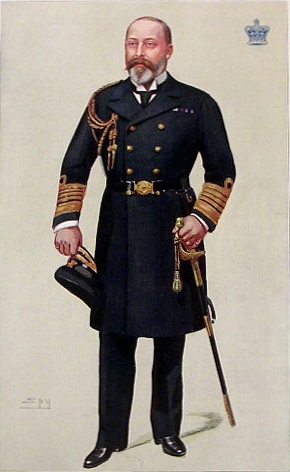
Edward VII portrayed by
Vanity Fair in 1902. |
- Edward VII was named Albert Edward when he was born in 1841, and was known as such throughout his time as Prince of Wales and heir to the throne. The first name of Albert was chosen in honor of his father, Prince Albert, whilst the middle name of Edward was chosen in memory of his maternal grandfather, Prince Edward, Duke of Kent. Among family and friends, he was known as “Bertie”. Queen Victoria intended for her son to use Albert Edward as his regnal name, but upon his accession in 1901 he decided only to be known as Edward, because he wished that the name of Albert should stand alone in its reference to his father.
 |
| George VI. |
- George VI was born as Albert Frederick Arthur George, and like his grandfather Edward VII, was known among family and friends as “Bertie”. As the second son of George V, he was not expected to become king, for that was a destiny reserved for his eldest brother, Edward (who was known among family and friends by one of his middle names, David). However, Edward VIII abdicated within 12 months of his accession, and Albert succeeded him as George VI in December 1936. The new king took his middle name as his regnal name so as to emphasize the sense of continuity and stability that had been established by his father (and nearly destroyed by his brother).
So, not only is there precedence for using a regnal name that differs from the first name, but three of the last six monarchs starting with Queen Victoria have done this.
But why might Prince Charles choose to be George VII and not Charles III?
Well for starters, his name in full is Charles Philip Arthur George Mountbatten-Windsor, so he has the choice of using either
 |
| King Charles I by Daniël Mijtens. |
his first name, or any of his middle names – though he is under no obligation to use any of them. He may want to avoid being Charles III because the name is seen as having an unhappy history in Britain. King Charles I remains the only reigning British monarch to have been tried and executed by his people, and his decapitation marked the beginning of the only republican period in British history. His son Charles II presided over the restoration of the monarchy, but also had the misfortune of being king during the Great Plague and Great Fire of London. He also engaged in fruitless wars against the Dutch, and battled with Parliament over the issue of excluding his brother James Stuart, Duke of York (the future James VII & II) from the succession due to his Catholicism. Charles was also known for his hedonistic and playboy lifestyle, in which he fathered at least twelve illegitimate children through several women.
The future king may also avoid using his first name because of
 |
| The would-be King Charles III. |
sensitivities toward Jacobitism. The Jacobites (whose name is derived from the Latin form of “James”) were originally the supporters of James VII & II who believed that he was wrongly deposed in the Glorious Revolution of 1688-89 for being a Roman Catholic. Among those who pressed the Jacobite claim to the throne was James’s grandson, Charles Edward Stuart, popularly known as Bonnie Prince Charlie (the Young Pretender) and referred to as Charles III by the Jacobites. He was decisively defeated at the Battle of Culloden in 1746, which marked the final attempt by the Jacobites to reclaim the British throne, as well as the last pitched battle on British soil. Nevertheless, to this day, there is a small band of Jacobite groups in Britain who regard the official line of succession since 1689 (legislated by Parliament) as illegitimate and illegal, and recognize Duke Francis of Bavaria – the most senior Jacobite claimant – as the rightful king.
In contrast, the Prince of Wales may prefer becoming George VII as a tribute to his grandfather George VI, a king who endeared himself to his people for his moral leadership during World War II. King George and Queen Elizabeth (the Queen Mother) stayed in the United Kingdom during the Blitz, survived a direct air attack on Buckingham Palace, and traveled around the country to stand in solidarity with their people during the hardships and struggles on the home front. As was already said, George VI also represented the stability and continuity of the monarchy following the abdication crisis of Edward VIII.
In my opinion, the Prince should go ahead with using his first name as his regnal name. For one thing, the name “Charles” has not been used in over 300 years, but “George” has been used six times in since 1714. It would be nice to see this old name make an appearance (like the name “Elizabeth” being used by a reigning monarch after 349 years), so that there may be some variety in the name choices, especially given that his grandson is named George. As for the Jacobite issue, it concerns only a small group of discontented people for whom living in the past and ignoring the realities of the present – among them being that none of the Jacobite heirs since 1746 has claimed the throne – appears to be a pastime. Furthermore, since we have come to know the Prince as
 |
George IV's excessive self-indulgence nearly
ruined the reputation of the monarchy. |
“Charles” for so long, it may be impossible for us to think of him by a different name. Also, it is not as if the name “George” has not had its own misfortunes as the name of kings in Britain. George III was the “king who lost America” and experienced bouts of apparent mental illness throughout the latter part of his reign. His son George IV was a hedonistic playboy who became massively obese (through copious amounts of food, alcohol, and drugs) and went into indebtedness to fund his lavish and expensive tastes in areas such as music, art, and architecture. Such excesses in his lifestyle helped to make George unpopular and debased the meaning of the monarchy, whose own popularity and finances did not recover until Queen Victoria and Prince Albert introduced middle-class “morality” and fiscal prudence to the institution.
When one thinks about it, the name “George” may have become tarnished to the extent that Victoria and Albert decided against using it as a first name for any of their sons. Their eldest son, Albert Edward (the future Edward VII), named his first son Albert Victor
 |
The Queen's grandfather may have restored
honor to the name George during his reign. |
Christian Edward, who was known as Eddy in the family, whilst his second son was named George Frederick Ernest Albert and was not expected to become king. But Prince Eddy died of influenza in 1892, and Prince George became second in line to the throne – eventually becoming King George V in 1910. Both George V and his second son Albert, who became George VI, are widely viewed as successful and beloved monarchs. Seen in this context, it would appear that the success of the last two George’s may have revived the fortunes of that name being used by members of the royal family. Perhaps something similar may same happen to the name “Charles” if the Prince of Wales decides on using it when he accedes to the throne.
At the end of the day, it is Charles’s decision as to what name he will take, and his alone. In fact, it is one of the first decisions that he will make in his reign. When Elizabeth II was informed of her accession in 1952, her assistant private secretary asked what she wanted to be called as monarch, and she replied, “Oh, my own name; what else?” Perhaps Charles may choose a name that has not been discussed, such as his other middle names, which would make him the first king to be named either Philip* or Arthur. Still yet, he will be within his prerogative to choose another name not given to him at birth, but this is unlikely since most precedence has been on the side of choosing a given name. The fact that such a decision has not yet been made – at least according to the Prince’s office – may indicate that Charles wants to be thoughtful in choosing a name that will set the right tone for the start of his reign, when and if that day should come.
*Philip II of Spain was King of England and Ireland, but only by right of being the husband of Queen Mary I. Such a claim to a title/office is known as jure uxoris (Latin for “by right of wife”), and his name is not always included in lists of English/British monarchs.
Photo Credit: Dan
Marsh via Wikimedia
Commons cc



.jpg)


