Showing posts with label Windsor Castle. Show all posts

Wednesday, January 29, 2014

Moments in Royal History: January 29

1820 - George III of the United Kingdom dies at Windsor, and his son becomes King

George III

     In the last decade of his reign, George III had slipped into a permanent state of apparent mental illness. During his Golden Jubilee year of 1810, his youngest and favorite daughter Princess Amelia had died, and this caused the King much grief. In 1811, the Regency Act was passed, which made the King's son and heir, George, Princes of Wales the Regent of the United Kingdom - with the powers but not the status of a king. By the end of that year, it was clear that George III has became permanently incapacitated, and he lived in seclusion at a small apartment in Windsor Castle for the rest of his life.

     Eventually becoming blind and deaf, and also suffering from dementia, George was unable to comprehend that his prime minister, Spencer Percival had been assassinated in 1812 (the only British Prime Minister to be murdered in office), that he had been upgraded to the status of king in Hanover following the Congress of Vienna in 1814, or that his beloved wife Charlotte had died in 1818. He had essentially become dead to the world, and spent hours thumping on an old harpsichord, as well as speaking nonsense. In his last few weeks, he was unable to walk, and his fourth-eldest son, Edward, Duke of Kent died. Six days after Edward's death, George III passed away on January 29th at 8:38 PM with his second-eldest son, Frederick, Duke of York at his side, and he was buried on February 16th in St. George's Chapel at Windsor Castle. 

     At the age of 81, and having been king for over 59 years, he was the longest-lived and longest-reigning monarch in British history. Though having been overtaken by Queen Victoria and Elizabeth II in those categories, he remains Britain's longest-lived and longest-reigning king.

George IV in Highland attire.

     On that same day, the Prince Regent succeeded his father as George IV of the United Kingdom of Great Britain and Ireland. Had been exercising his father's powers for nearly ten years, so his moment of accession meant no significant change in his status except for that fact that he was now King in authority and name.

1856 - Creation of the Victoria Cross

Obverse containing the insignia of the Cross

     This military decoration was established by Queen Victoria in response to the fact that there was no official system of recognition of gallantry in the British Armed Forces, aside from honors such as the Order of the Bath, which was mostly the purview of high-ranking and long-serving officers. In the 1850's, the Crimean War resulted in many acts of extraordinary bravery by British soldiers being reported William Howard Russell, one of the first modern war correspondents, and public pressure mounted to create a new award to recognize servicemen for their exploits in battle and not simply for their length of service.

     With this in mind, the Victoria Cross was created in 1856 as the highest military award for "most conspicuous bravery, or some daring or pre-eminent act of valour or self-sacrifice, or extreme devotion to duty in the presence of the enemy" to members of the armed forces in countries throughout the British Empire and later, the Commonwealth. In the later 20th Century, some Commonwealth countries developed their own honors systems independent of the British/Imperial orders, and it became necessary to create new awards and decorations that were the equivalent of the ones issued from the UK. Canada, New Zealand, and Australia now have their own versions of the Victoria Cross. 

     Since its creation, there have been over 1,350 recipients of the Cross, and it is usually presented by the British monarch to the recipient or the next of kin at an investiture at Buckingham Palace.


Photo Credit: Richard Harvey via Wikimedia Commons cc

Sunday, December 22, 2013

Christmas Tree's and the Royal Family


     As we enter the thick of the Christmas holiday season, it is worth remembering that this is a season of deeply-held traditions, symbols, and customs. From religious services and gift-giving to beautiful Christmas cards and caroling, this time of the year is known for these and other special qualities that are not seen in most other holidays.

     One of the most iconic symbols of the holiday season – one which is taken for granted – is the Christmas tree. It seems as old as the Scriptures, but the tree as we think of it today is actually a relatively recent invention that was made popular by the British Royal Family in the 18th and 19th centuries.

Queen Charlotte
     However, the modern custom of bringing in an evergreen and  decorating it was not an original British tradition. In northern Germany, such trees were used as part of the Yule and Christmas festivals celebrated by people like the family of Charlotte of Mecklenburg-Strelitz. Charlotte married George III of Great Britain and Ireland, who was also the Elector of Hanover, a small principality within the Holy Roman Empire which was next door to Mecklenburg-Strelitz. In 1800, Queen Charlotte hosted a Christmas party for children at Windsor Castle, and it was here that a decorated evergreen tree was on display – just as it would have been in Charlotte’s native Germany. The scene of the gathering was described by her biographer, Dr. John Watkins: 

In the middle of the room stood an immense tub with a yew tree placed in it, from the branches of which hung bunches of sweetmeats, almonds, and raisins in papers, fruits and toys, most tastefully arranged, and the whole illuminated by small wax candles. After the company had walked around and admired the tree, each child obtained a portion of the sweets which it bore together with a toy and then all returned home, quite delighted.

     The Christmas tree would become a staple of the royal holiday season. In 1832, the future Queen Victoria, who had a tree placed in her room, wrote an entry in her diary on Christmas Eve in which she gave her observation of Christmas trees in the common areas at home: 

After dinner...we then went into the drawing-room near the dining-room...There were two large round tables on which were placed two trees hung with lights and sugar ornaments. All the presents being placed round the trees...

     In 1841, Victoria married her cousin Prince Albert, who came from the German duchy of Saxe-Coburg and Gotha. Just as Albert 
The engraving of the royal family around the
Christmas as was seen in the Illustrated London News.
was determined to provide a strong educational foundation for his children in Britain, he was equally determined that they should partake in the Christmas holiday traditions he had celebrated as a child. Christmas trees (some decorated by the royal family) were placed in Windsor Castle, and this was picked up by several newspapers at the time, which resulted in an 1848 engraving in pages of The Illustrated London News, which depicted Victoria, Albert, and their family around the brightly-lit main Christmas tree in the castle. For many Britons (especially in the middle and upper classes), this image became the model for their own Christmas celebrations, and the tree became more widespread in British homes. Albert himself presented Christmas trees to military barracks and schools during the holiday season, which further integrated them into the annual holiday culture at Christmastime.

     In the United States, Christmas trees had been used by Germans 
Engraving of a royal Christmas as it was
published in Godey's Lady's Book.
and people of German origin for several decades since the founding of the republic. But once again, it was the influence of the British Royal Family that sparked the widespread use of the evergreen during Christmas. The illustration of the royal family around their Christmas tree was republished in Godey's Lady's Book two years after its debut in the Illustrated London News (albeit without Victoria’s crown and Albert’s mustache and Order of the Garter sash to give the engraving an American character). It was the first widely circulated image of a decorated Christmas tree in America, and resulted in many Americans wanting a Christmas tree of their own. So effective was the illustration in promoting the idea of the decorated Christmas tree, that art historian Karal Ann Marling refers to Victoria and Albert’s tree as “the first influential American Christmas tree,” and within a generation, the use of Christmas tree’s became common across the country.

Rockefeller Center Christmas Tree in New York City.

     Today in Britain, America, and throughout the world, we cannot think of a world in which there were no Christmas trees. They are everywhere – in our homes, offices, stores, parks, public institutions, and other venues. So integrated have they become in our annual holiday season that even non-Christians rejoice in their presence, and some such people have a tree in their homes – signifying that Christmas is as much a cultural holiday as it is religious one. Yet what would have happened had the royal family not been instrumental in popularizing the great evergreen? Perhaps they would have gained prominence through other ways, via German settlers in many parts of the world. However, the fact remains that the royal family – especially under Victoria and Albert – made a significant contribution to how we celebrate the Christmas season. For that, those of us who count this holiday as our favorite time of the year ought to be grateful.


Photo Credit: Anthony Quintano via Flickr cc, Laura Bittner via Flickr cc 


Sources:

"Queen Victoria popularized our Christmas traditions." BBC. Emma Midgley, 15 Dec. 2010. Web. 22 Dec. 2013.

"Windsor Castle and The Christmas Tree." ThamesWeb.co.uk. n.p., n.d. Web. 21 Dec. 2013.

"Christmas Tree." Wikipedia.com. n.p., n.d. Web. 22 Dec. 2013.

Monday, December 9, 2013

Royal Engagements - Monday, December 9, 2013


HRH The Earl of Wessex
     
     Prince Edward, Earl of Wessex will hold a dinner at Windsor Castle in his role as Trustee of The Duke of Edinburgh's Award, which was founded by Prince Philip for the purpose of encouraging young men and women to participate in, or create, activities which improve their lives, as well as the greater society.


HRH The Duchess of Gloucester

     Birgitte, Duchess of Gloucester will attend a charity Christmas carol service in London at St.-Martin-in-the-Fields, Trafalgar Square in her role as the Royal Patron of Missing People, an organization offers assistance to people who run away or go missing. During this time of year in which most people are expected to be with their families, this service with presumably focus attention on those missing persons who will not be fortunate to be in the company of loved ones.

Sunday, September 1, 2013

Royal Surnames and House Names: Part II - The House of Windsor

To see my explanation on how royal house names and surnames evolved up to the 20th Century, please read Part I.


     By 1910, the House of Saxe-Coburg and Gotha had reigned in the United Kingdom and the British Empire for nine years. That 
King Edward VII was the latest of a line of monarchs beginning with
George I in 1714 who were of German origin or descent.
year, the first monarch of that house, Edward VII, died and was succeeded by his eldest surviving son, George V, who had served in the Royal Navy and considered himself to be patriotically British. Yet the royal house to which he belonged was anything but British. It was the ancestral house of his grandfather Prince Albert, based on the German ducal lands his family held. Even so, the fact that the royal family was of immediate German origin was not a secret, and it did little to diminish the overall affection that the public had for them. World War I however, would change that.

     As the “war to end all wars” dragged on, Germans and Britons of German descent became increasingly suspect in the eyes of the British public, who were being fed stories about German war atrocities and cartoon images of blood-thirsty German soldiers. The anti-German mood became so toxic, that it manifested itself in riots and vandalism at homes and businesses owned by people with Germanic names. This led to the forced resignation of Prince Louis of Battenberg – a German prince who was a decorated British naval officer of 40 years and a cousin of the royal family – from his office of First Sea Lord (which is the professional head of the British Naval Service). Eventually, the British Royal Family itself was suspected of having too close of a connection with the enemy Hun, and not being full-heartedly supportive of the British war effort against Germany. In fact, only the opposite was true, but it certainly did not help being a first cousin of the German kaiser, Wilhem II, as George V was (because both men were grandsons of Queen Victoria). It also did the royal family no favors that it had a German royal house name – Saxe-Coburg-Gotha – and held German titles. The writer H.G. Wells criticized George for having an “alien and uninspiring court,” to which the king responded, “I may be uninspiring, but I’ll be damned if I’m an alien!” But the final straw came when Gotha G.IV planes were dropping bombs on London.

King George V (center), with his two eldest sons:
Prince Edward (the future Edward VIII)
on the left and Prince Albert
(the future George VI) to the right.
     It soon became apparent that there needed to be a change in name for the royal family. George did not know what his actual surname might be, so the College of Heralds was consulted, and they reported that his name was either Guelph (the ancestral house of the Hanoverians) or more likely Wettin (the ancestral house of the Saxe-Coburg’s). Either way, these names did not sound British, so a search began for new name. Proposed names included those of former royal dynasties: Plantagenet, Lancaster, and York. Tudor-Stewart was also suggested as a way to pay homage to the House of Tudor, which ended the fratricidal Wars of the Roses in England, as
Arthur Bigge, Baron Stamfordham,
the man who suggested Windsor
as a family name for George V
and his family in 1917.
well as the House of Stewart/Stuart, the Scottish royal house that brought the British Isles together under one monarch. These names were written off as either too English-oriented (in a kingdom which included the Scots, Irish, and Welsh) or backward-looking for a royal family attempting to re-christen itself as being a model, modern, and thoroughly British family. Eventually, George’s private secretary, Lord Stamfordham, suggested Windsor, after the king’s favorite residence of Windsor Castle, which has been a seat of the monarchy since the days of William the Conqueror, and used by Scottish and British monarchs since James VI & I ushered in the Union of the Crowns. There was also some historical basis for using the name, since Edward III of England was known as “Edward of Windsor” in his early years.


Windsor Castle. Built by William the Conqueror, it has been a royal residence since Henry I of England, and extensively modified and enlarged by successive English and British monarchs.

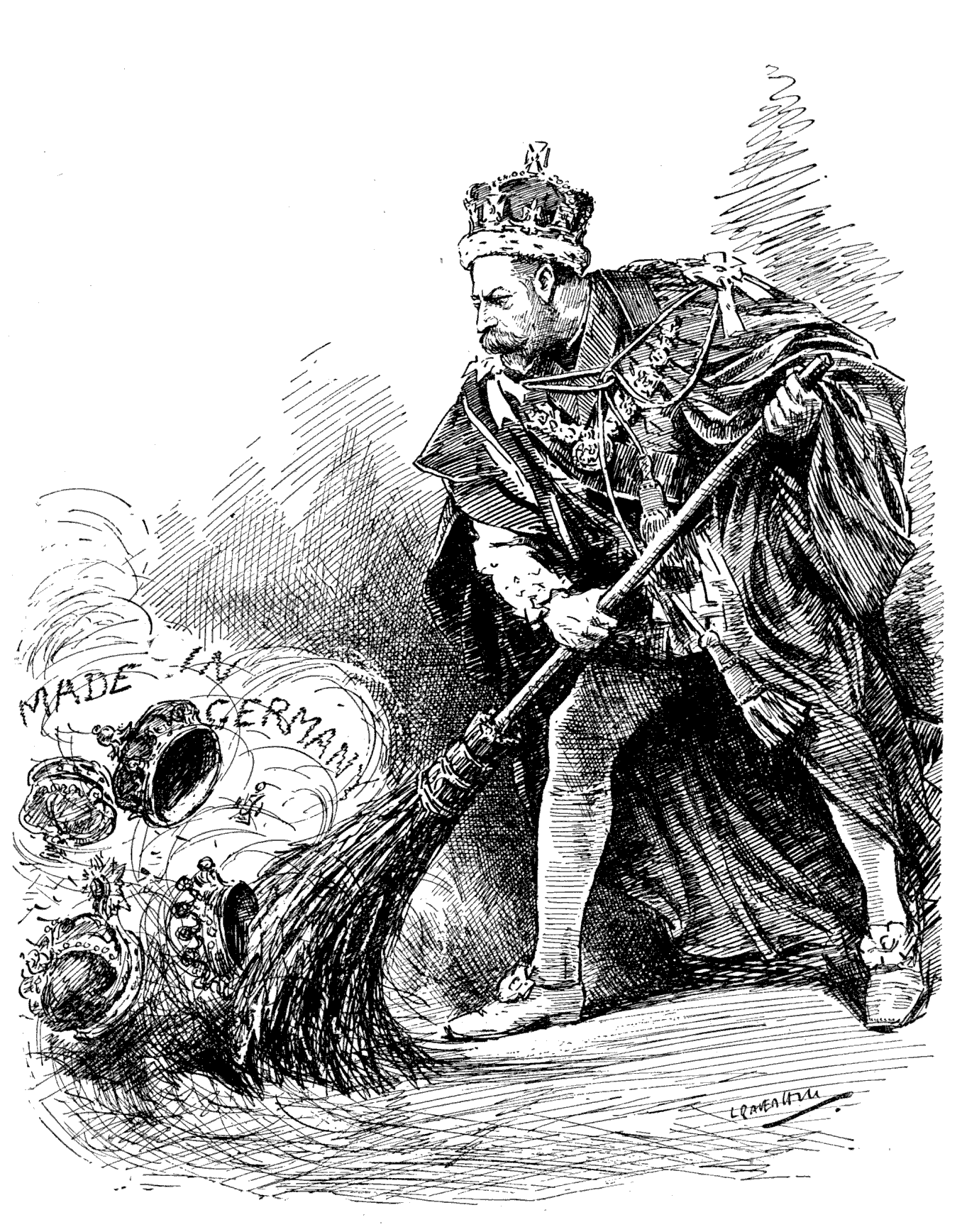
     On July 27, 1917, King George V issued a proclamation in which he renamed his royal house and family Windsor and renounced the German titles that he and his family held. The proclamation
Good Riddance: King George V
sweeping away his titles
"Made in Germany"
was significant as it allowed male-line descendants of Queen Victoria without the dignity and style of HRH Prince or Princess to use Windsor as their surname. This was necessary for two reasons. Firstly, George also issued Letters Patent that limited the dignity and style of a British prince and princess to children of a monarch, male-line grandchildren of a monarch, and the eldest living son of the eldest son of the Prince of Wales. Secondly, George V and Queen Mary had decided to allow their children to marry native British men and women, because hitherto, it was largely unheard of for royalty to in effect, marry their subjects, which explained the tendency to marry members of other royal families (particularly Protestant ones based in Germany). These two reasons guaranteed that there would be descendants of reigning monarchs without princely titles who would require a surname.

     In practice however, the name has been used by titled members of the royal family for birth registrations, marriage certificates, and other purposes. For example, the reigning queen’s father – the future George VI, who was then styled as His Royal Highness Prince Albert, Duke of York – was listed as “Windsor, Albert F.A.G. (Duke of York)” in an official index of registered British marriages in 1923. The initials F.A.G. stand for his middle names, Frederick Arthur George, and the maiden name of his bride, Lady Elizabeth Bowes-Lyon, is listed in the column next to him.
The marriage of Albert F.A.G. Windsor (the future George VI) to
Elizabeth Bowes-Lyon as listed on an official marriage index.

Source: Freebmd.org.uk
The birth of Elizabeth A.M. Windsor (the future Elizabeth II),
as listed on an official birth registration index.

Source: Freebmd.org.uk
Queen Elizabeth II herself – titled and styled at birth as Her Royal Highness Princess Elizabeth of York – is listed as “Windsor, Elisabeth [sic] A.M.” in an official index of registered British births in 1926, with A.M. being the initials of her middle names, Alexandra Mary.
The names of Philip Mountbatten and Elizabeth Alexandra Mary Windsor
as written on the marriage register of Westminster Abbey.
In 1947, her name appeared as “Elizabeth Alexandra Mary Windsor” on the marriage register, and still later, Prince Charles was listed as “Windsor, Charles P.A.G.” on the birth registration index of 1948, with P.A.G. standing for his middle names, Philip Arthur George.
The birth of Charles P.A.G. Windsor (Prince Charles)
as listed on an official birth registration index.

Source: Freebmd.org.uk
     But upon Elizabeth II’s accession in 1952, the question of the name of the royal family was re-opened. She had married Philip Mountbatten, Duke of Edinburgh (formerly Prince Philip of Greece and Denmark), and like most women, it was thought that she would take her husband’s name and that Mountbatten – the name of Philip’s maternal relatives in Britain which he adopted upon his naturalization as a British citizen – would be the name of their descendants. After her accession, Philip’s uncle, Lord Louis Mountbatten (known as “Dickie”), boasted at a dinner party that the “House of Mountbatten” now
Queen Mary was not amused about the prospect of the royal family
becoming the House of Mountbatten.
reigned. This insolent comment got around to Elizabeth’s grandmother, Queen Mary who convinced Prime Minister Winston Churchill that Windsor – the name chosen by her husband George V back in 1917 – and not Mountbatten ought to be the name of the royal family. Queen Elizabeth the Queen Mother (Elizabeth II's mother) agreed with Churchill and Queen Mary, and the new reigning queen herself wished to stick to the name of her father and grandfather. On April 9, 1952, she issued a statement reaffirming that her house and family would continue to bear the name Windsor.

     In reality however, the House of Windsor would have continued throughout the Queen’s reign. Traditionally, female monarchs reigned as members of the house/surname into which they had been born, while their successors reigned as members of the house/surname of their husband. For example, Queen Victoria was born into the House of Hanover, and reigned as the last monarch of that house in the United Kingdom. Her son, Edward VII became the first monarch of the House of Saxe-Coburg and Gotha, the ancestral house of his father and Victoria’s husband, Prince Albert. So by convention, the “House of Mountbatten” would not have come about until the accession of Prince Charles (or his male-line heirs).

     But in 1952, there were members of the British establishment who had been suspicious of Philip from before his marriage to Elizabeth. He had been a penniless Greek prince who came from a Germanic background – having been born into the German-Danish House of Schleswig-Holstein-Sonderburg-Glücksburg – and his sisters had all married German princes, some of whom had Nazi connections. Philip did have an honorable record serving in the Royal Navy during World War II, but his foreign background and brash temperament made him an outsider to the British establishment (which hoped that he would simply do no harm to the monarchy). His “Uncle Dickie”
Lord Lionel Hastings Ismay, Prime Minister Winston Churchill,
Lord Louis Mountbatten, and President Franklin Roosevelt.
Churchill liked Mountbatten for his service in World War II,
but came to loathe him for his role as the last Viceroy of
India and overseeing the process of Indian independence.
Mountbatten was a generally well-liked and respected member of that establishment (being a skilled and effective military leader and statesman), who exuded charm, confidence, and charisma. But Mountbatten was also viewed as pompous and arrogant, always shamelessly using his connections to lobby for jobs and positions he wanted. Mountbatten was also thought to hold views to the left of the political spectrum, and his role in Indian independence did nothing to endear him to the arch-imperialist Churchill (who as First Lord of the Admiralty in 1914, had forced Mountbatten's father, Prince Louis of Battenberg, to resign from his post as First Sea Lord). It was also feared that Mountbatten could use his 
The Duke of Edinburgh wanted to have a name
representing his side of the family, but the
young Queen sided with her establishment
adviser's and stuck to the Windsor name.
connections with the royal family to create a more
“progressive” monarchy that would shape government policy. So the establishment simply did not want the Mountbatten name to be plastered on the monarchy in the generations yet to come, and wanted the Queen, in writing, to state that Windsor would be the name of her house and the name that her descendants would carry. (Mountbatten would eventually have his own last laugh against Churchill and the establishment by becoming First Sea Lord some forty years after his father's forced resignation.) For his part, Philip was not enthusiastic about the Mountbatten surname, but nonetheless believed in the general principle that his children and future descendants ought to take his name, and he explained the traditional passing of royal house names to Churchill and members of his cabinet (see previous paragraph). Though Philip was historically correct, the Cabinet rebuffed this, as well as his attempt to find a compromise with names such as Edinburgh and Edinburgh-Windsor (based on his title, Duke of Edinburgh). He bitterly complained to a friend that he was nothing but “a bloody amoeba,” unable to pass his name on to his children like other men.

     The issue remained a sore point for Philip in the early years of the Elizabeth’s reign. But by 1960, with the death of Queen Mary in 1953, the resignation of Churchill in 1955, and the withdrawal of much of the old guard at the Palace and in government, the Queen decided to make an attempt to lay the issue to rest. On February 8, 1960, after extensive talks with her ministers and advisors, the Queen announced a compromise in which her royal house and family would continue to be known as Windsor, but that her and Philip’s male-line descendants without the style and dignity of HRH Prince or Princess would bear the surname Mountbatten-Windsor. (It should be noted that this change did not affect the Queen’s male cousins through George V and Queen Mary – the Duke of Gloucester, Duke of Kent, and Prince Michael of Kent – or their descendants, whose surname remained Windsor). But the effect has
Mountbatten-Windsor is listed as Princess Anne's
maiden name on the birth registration list
containing her son, Peter Phillips.
Source: Freebmd.org.uk
been that the surname has been available for use by all of the Queen’s children and her descendants with British princely titles on occasions when a surname may be necessary (such as on birth and marriage certificates). Princess Anne signed her name as Mountbatten-Windsor upon her 1973 marriage to Captain Mark Phillips, and her maiden name is listed as such on the 1977 birth registration index containing their son, Peter Phillips. The children of Prince Edward, Earl of Wessex – who do not use the royal titles afforded to them by birth – are styled as children of an earl: Lady Louise Mountbatten-Windsor and James Mountbatten-Windsor, Viscount Severn. (Prince Edward’s secondary title is Viscount Severn, and it is customary for the eldest son of a man with aristocratic titles to use the secondary title, known as a courtesy title).
 

     But there is one more wrinkle in all of this: members of the royal family who have territorial titles (i.e., Prince of Wales) can use the territorial designation of such titles as an informal surname. For example, Prince Edward was known as “Edward Windsor” during his time working in the entertainment industry, but upon becoming Earl of Wessex in 1999, he became professionally known as “Edward Wessex.” Prince William – whose formal title before 
Flight Lieutenant William Wales
becoming Duke of Cambridge was Prince William of Wales – decided to be known as “William Wales” while he attended the University of St. Andrews as well as during his military career, and
Prince Harry has done the same (owning to the fact that their father is the Prince of Wales). The recently-born Prince George of Cambridge will probably be informally known as “George Cambridge” for similar purposes. This is why members
of the royal family are sometimes referred to as the Wales's (Prince of Wales & family), Cambridge’s (Prince William, Duke of Cambridge & family), York’s (Prince Andrew, Duke of York & family), Wessex’s (Prince Edward, Earl of Wessex & family), as well as the Kent’s and Gloucester’s (who are the Queen's cousins through George V and Queen Mary), and so on.

     In the final analysis (and to give a straight answer), Mountbatten-Windsor is the surname of the royal family of Queen Elizabeth II, but the members of the family with the style and dignity of HRH Prince or Princess are not required to use it except perhaps for circumstances in which a surname may be necessary, such as signing birth and marriage certificates. Such members can use informal surnames derived from the territorial designation of their titles or just the titles themselves without any surname at all, which explains the absence of a surname on Prince George’s birth certificate. 

On his birth certificate, Prince George was written in as
His Royal Highness Prince George Alexander Louis of Cambridge.

     It should be noted that the name of the royal house and family can change at any time, either at the behest of a reigning monarch, or by the accession of a monarch with a different house and family name than the previous one. Upon Prince Charles becoming king however, it is not expected that he will make changes to the name of the royal family, and that the he and his family will continue to be of the House of Windsor, whilst the formal surname will continue to be Mountbatten-Windsor.

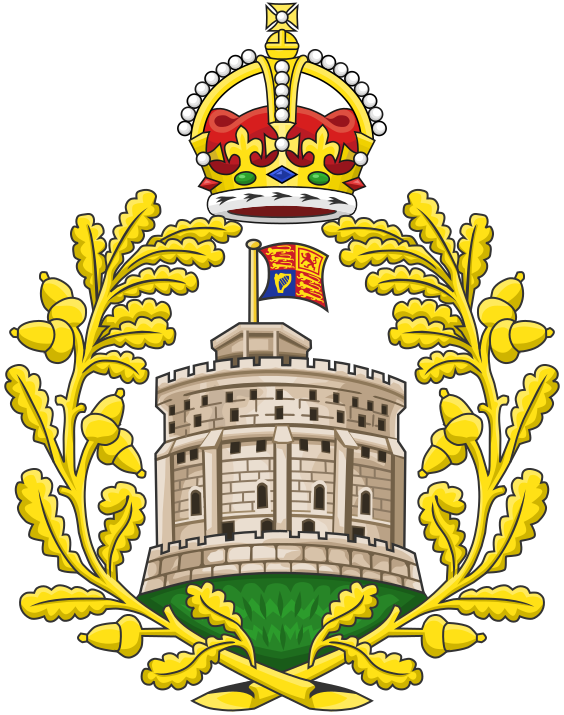
The Badge of the House of Windsor


Photo Credit: Mark S. Jobling via Wikimedia Commons cc, German Federal Archives (Bundesarchiv) via Wikimedia Commons cc, BiblioArchives/Library Archives via Flickr cc, Robert Payne via Flickr cc, Sodacan via Wikimedia Commons cc 

Sources:  

Marr, Andrew. The Real Elizabeth: An Intimate Portrait of Queen Elizabeth II. New York: St. Martin's Press. 2012. Print (Pages 22-25, 50-53, 74-77, 88, 135-137).

Smith, Sally Bedell. Elizabeth the Queen: The Life of a Modern Monarch. New York: Random House. 2012. Print (Pages 146-147).