Showing posts with label Malcolm III. Show all posts

Wednesday, March 26, 2014

Royal Profile: Malcolm III of Scotland

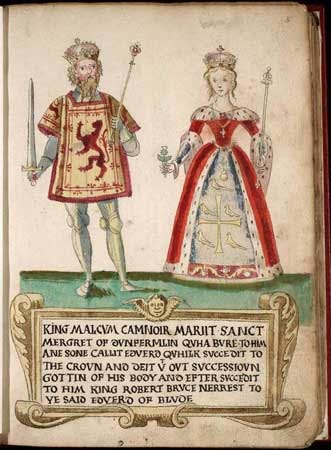
Depiction of Malcolm III and Saint Margaret of Scotland. History
also knows him as Malcolm Canmore (Gaelic for
great head' or 'chief).

     Malcolm was born in 1031 - possibly on March 26th - as the eldest son of Duncan I of Scotland and Queen Suthen.

     His father's reign was not successful, and it ended with the King's death at the hands of his cousin, Macbeth, who seized the throne for himself on August 15, 1040. Malcolm's family unsuccessfully attempted to overthrow Macbeth, and he was sent to a safe haven - possibly in England, at the court of Edward the Confessor.

     In 1057, he returned to Scotland, and at the Battle of Lumphanan in Aberdeenshire, he defeated and killed Macbeth, who was succeeded by his stepson, Lulach, until he too was killed by Malcolm on April 23, 1058. Malcolm was now King of Scots and he was crowned as such two days later at Scone.

     Before taking the throne, it is likely that the King had been married for some time to Ingibjörg, the daughter of a Norwegian nobleman, Finn Arnesson, who was an adviser to Olaf II and Harald III of Norway, as well as Sweyn II of Denmark. Ingibjörg was also the widow of Thorfinn Sigurdsson – the powerful Earl of Orkney. Because much of north and western Scotland was still under Scandinavian, Norse-Gael, and Gaelic control, this marriage helped to secure peace in those areas for King Malcolm. It also produced three sons: Duncan, Donald, and Malcolm.

     Meanwhile, events south of the border would greatly shape the course of Malcolm III's reign. The Norman Conquest of England led by William the Conqueror in the late 1060's and early 1070's resulted in Malcolm granting sanctuary to the Anglo-Saxon royal exiles, including Edgar the Ætheling, who had been elected as King of England after the death of Harold II at the Battle of Hastings and before the takeover by William I on Christmas Day 1066.

     In either 1070 or 1071, Malcolm III married for a second time (following the death of Ingibjörg) to Edgar's sister, Margaret of Wessex, with whom he had eight children. Their names marked a change from the Norse or Gaelic names (i.e., Malcolm, Cináed and Áed) that had been the established tradition previously for Scottish royalty, but also marked out their Anglo-Saxon heritage: Edward was named for Queen Margaret's father Edward the Exile, Edmund for her grandfather Edmund Ironside, Æthelred for her great-grandfather Æthelred the Unready, and Edgar for her great-great-grandfather Edgar and her aforementioned brother. The remaining children from this marriage were Alexander, David, Matilda, and Mary.

     King Malcolm may have believed that his marriage into Anglo-Saxon royalty and the Anglo-Saxon names of his children could have put him in a position to challenge William the Conqueror, or at least undermine his shaky authority by carrying out raids into England on land and sea without consequence. However in 1072, William I's position was strengthened by his Harrying of the North, and he rode to Scotland and forced Malcolm to sign the Treaty of Abernethy, which stipulated that in return for swearing allegiance to William, he was to be given estates in Cumbria, England.

     Nonetheless, Malcolm continued to conduct raids on northern England, with the hope of annexing the northern English counties and pushing Scotland's border further south. In 1080, William sent his eldest son Robert to deal with Malcolm, and a new peace deal was struck, which lasted for over a decade.

     During the reign of William Rufus (William II of England), the peace began to break down again in 1092, but an attempt was made to settle the disputes over lands and estates in Cumbria when a meeting was arranged between Malcolm and Rufus in Gloucester. This failed to materialize when Malcolm was informed that Rufus was not negotiating and that the dispute would be judged by English barons. Malcolm left for home angry and humiliated, and he proceeded to raiding the northern counties again.

     It was on his return journey from one of these raids that Malcolm was ambushed by Robert de Mowbray, Earl of Northumbria, whose lands had been devastated by Malcolm. This incident became known as the Battle of Alnwick, at which Malcolm III of Scotland was killed on November 13, 1093. He was initially buried at Tynemouth Priory, but was re-interred at Dunfermline Abbey next to his queen, Margaret (who was later beatified and is Scotland's only royal saint), during the reign of his son, Alexander I.

     Malcolm was immediately succeeded by his brother as Donald III, who in turn was succeeded by Malcolm's surviving sons - Duncan II, Edgar, Alexander I, and David I. His elder daughter Matilda would marry Henry I of England, and be an ancestor to the English Plantagenet dynasty, beginning with her grandson, Henry II.

      In terms of his legacy, Malcolm - despite his efforts - did little to change to political map of Britain. What he did achieve was the founding of a line of kings who would gradually remove Norse influence and power from Scotland. The royal dynasty to which he belonged, the House of Dunkeld, would rule Scotland for nearly 200 more years.

     Malcolm III of Scotland is a 26th great-grandfather of Elizabeth II of the United Kingdom.

Saturday, November 30, 2013

St. Andrew's Day

The flag of Scotland featuring St. Andrew's Saltire
     
     Today is St. Andrew's Day, and it is the national holiday of Scotland.

     Saint Andrew is the patron saint of Scotland - one of the four patron saints of the British or Anglo-Celtic Isles (with the other ones being St. David for Wales, St. Patrick for Ireland, and St. George for England).

Carving of St. Andrew at the National Museum of Scotland

     He was a Galilean fisherman, who according to the New Testament was a brother of Simon Peter. He was also a disciple of St. John the Baptist, whose testimony led him and his brother to become disciples of Jesus Christ. As such, Andrew was present at many important events in the New Testament, including the Last Supper, and he is credited with preaching the word of God across Greece and Asia Minor during the 1st Century. According to tradition, Andrew also founded a diocese in  Byzantium that would eventually become the Ecumenical Patriarchate of Constantinople. He was crucified by the Romans in the city if Patras, Greece on an X-shaped cross (Crux decussata or Saltire). The choice of the Saltire was supposedly made by Andrew because he believed himself to be unworthy of being crucified on the same type of cross on which Christ was crucified. Nonetheless, Andrew became a Christian martyr and a saint.

     St. Andrew became the venerated patron saint of many countries and institutions, including Russia, Ukraine, Russia, Greece, Romania, and the Order of the Golden Fleece.

     With regard to Scotland, legend tells us that in 832 a Pictish kingÓengus II – led an army of Picts and Scots into battle against a larger army of Angles (one of the early English peoples) under King Æthelstan, and vowed to make Saint Andrew the patron saint of Scotland if his armies won the battle. On the day of the battle, a white diagonal cross appeared to take shape in the clouds against the blue sky, emboldening the soldiers under Óengus with divine inspiration, and leading them to victory. Saint Andrew then became Scotland’s patron saint, and a its flag (and eventually the Union Flag for the United Kingdom) features a white saltire on a blue field.

Half and half: Scotland's flag provides one-third of the
Union Flag for the United Kingdom. The other two-thirds are
St. George's Cross (for England) and St. Patrick's Cross (for Ireland).

     St. Andrew has also become a place name in several locations in Scotland, including the town of St. Andrews. It is said that a Greek monk by the name of St. Rule was bringing some of saint's remains to Scotland when he got shipwrecked off the coast of a settlement where a church had been built to store the remains, and that St. Andrew's grew from that settlement. It is the home of the University of St. Andrew's which was attended by the Duke and Duchess of Cambridge (or the Earl and Countess of Strathearn as they are known in Scotland).


St. Andrews, Scotland, UK
© Peter Gordon

     Festivals of celebration for St. Andrew's Day have occurred in traditions going back as far as the reign of King Malcolm III, but it was only in 2006 that the day became an official bank (or public) holiday in Scotland under legislation passed by the devolved Scottish Parliament which was given Royal Assent by Queen Elizabeth.

A Pipe and Drum band marches in a parade for St. Andrew's Day in Inverness.

     November 30th is also the date of Barbadian independence, and it is the beginning of a series of winter festivals in Scotland, which culminate on January 25th with Burns Night.

     Throughout Scotland, the day is marked by a celebration of Scottish culture, including traditional food, music, and dances. There are special events at Scottish schools, including storytelling, writing tales, cooking meals, and playing bagpipes. This year, the Queen's Gallery of art at the Palace of Holyroodhouse in Edinburgh (the British monarch's official residence in Scotland) is open free of charge to the public, and features an array of activities for people of all ages to participate.

Palace of Holyroodhouse
© Kim Traynor

     However, the people of Scotland may be forgiven for having a more solemn observance this year due to the tragedy that recently occurred in Glasgow (Scotland's largest city and the UK's fourth-largest city) in which a helicopter crashed into a pub where numerous casualties are feared. My personal thoughts and prayers are with the people affected by this unfortunate incident.


UPDATE: The Queen has released the following statement to the Lord Provost of Glasgow:


I was saddened to learn of the dreadful helicopter crash in Glasgow last night.

My thoughts and prayers are with those who have been bereaved or injured.

I send my thanks to the emergency services and to everyone who helped with the rescue.

ELIZABETH R

30 November 2013


Photo Credit: Kim Traynor via Wikimedia Commons cc, Peter Gordon via Geograph cc, Kim Traynor via Wikimedia Commons cc